One employee calls in sick before a busy warehouse shift. A hotel suddenly needs more room attendants for a high-occupancy weekend. Meanwhile, a new contract creates more work than the existing team can comfortably manage.
In situations like these, temporary staffing can give employers additional workforce capacity for defined shifts, short assignments or changing periods of demand.
However, simply finding available people does not solve every staffing problem. The employer still needs the right skills, availability, shift compatibility, location practicality and role-specific checks.
Therefore, effective temporary workforce cover starts with a clear operational requirement and a staffing provider that understands it.
What Is Temporary Staffing?
Temporary staffing allows an employer to bring in additional people for a limited period, specific shifts or changing workload requirements without immediately filling every vacancy through permanent recruitment. Businesses commonly use it for absence cover, seasonal peaks, short-term projects, unexpected demand, new contracts and other temporary workforce gaps.
Depending on the arrangement, a temporary worker may have a contract with an employment business while carrying out an assignment for the hirer.
GOV.UK describes an agency worker as someone who has a contract with an agency but works temporarily for a hirer.
That distinction matters because temporary recruitment does not always create the same employment relationship as directly hiring a permanent employee.
How Does Temporary Staffing Work?
Although processes vary between providers, temporary staffing generally follows a clear sequence.
1. The employer identifies the requirement
First, the business establishes what operational gap needs covering.
That should include:
- Role required
- Number of people
- Workplace location
- Start date
- Shift times
- Working days
- Assignment duration
- Required experience
- Essential qualifications or licences
- Site-specific requirements
A request for “ten warehouse staff tomorrow” gives an agency far less useful information than a complete staffing brief.
2. The employer shares the job and shift details
Next, the employer explains what the people will actually do.
For example, warehouse operatives may work in picking, packing, dispatch, returns, loading or stock handling. Although those tasks sit within the same sector, they can require different experience and working conditions.
3. The temporary staff agency assesses the requirement
A temporary staff agency should consider whether the role, location, schedule and expectations are realistic before beginning candidate matching.
Travel matters particularly for early starts, night work and industrial locations with limited public transport.
4. Candidate sourcing begins
The staffing provider can then search its candidate pool, advertise where appropriate or use other sourcing channels to identify potentially suitable people.
However, candidate volume alone does not determine recruitment quality.
5. Screening and relevant checks take place
Depending on the role, screening may consider:
- Identity
- Right-to-work requirements
- Employment history
- Relevant experience
- Qualifications
- Licences
- Availability
- Shift compatibility
- Travel practicality
Different roles naturally require different checks.
6. The staffing requirement is confirmed
The employer and agency should confirm the assignment details before work starts.
Additionally, both sides should understand who manages reporting, rotas, changes and operational queries.
7. Temporary workers begin their assignments
Once confirmed, agency workers attend the agreed workplace and shifts.
The hirer should provide appropriate site information, supervision, induction and health-and-safety arrangements relevant to the work.
8. The rota changes as operational demand changes
Finally, temporary workforce requirements may increase, decrease or continue for longer than originally expected.
Clear communication becomes especially important at this stage.
What Does a Temporary Staff Agency Do?
A temporary staff agency helps businesses source people for short-term and flexible workforce requirements.
However, useful staffing support goes beyond supplying names.
A capable provider should understand:
- What work needs completing
- Which experience matters
- How many people are required
- Where the site is located
- When shifts begin and finish
- Whether transport could affect attendance
- Which qualifications or licences apply
- How long the assignment may last
- How changes should be communicated
The agency may then support candidate sourcing, screening, availability checking, role matching, staffing coordination and ongoing rota communication.
For example, sending someone with warehouse experience to a 6:00 am shift does not help if that person has no realistic way to reach the workplace by 6:00 am.
Therefore, operational suitability matters alongside experience.
When Should a Business Use Temporary Staffing?
Businesses tend to use temporary staffing when workforce requirements rise faster than permanent headcount needs to change.
Employee Absence
Sickness, annual leave and unexpected absence can leave important shifts below planned headcount.
In those cases, temporary cover may reduce pressure on the remaining team.
Seasonal Demand
Demand often changes throughout the year.
For example, ecommerce operations may experience higher order volumes around major retail periods. Likewise, hotels and venues can become busier around holidays, conferences and events.
Temporary personnel can add capacity during the peak without automatically creating the same long-term headcount after demand falls.
Sudden Order Volumes
A warehouse may receive a larger order volume than forecast.
Consequently, additional pickers, packers, loaders or dispatch personnel may help the operation process the temporary workload.
New Contracts
Winning new business can create immediate staffing pressure.
While management assesses the longer-term workforce requirement, temporary recruitment can provide interim operational capacity where suitable candidates are available.
Short-Term Projects
Some work has a defined beginning and end.
Therefore, short term staff may suit stock projects, temporary production requirements, relocations, events or other time-limited operations.
Event Requirements
Events often create workforce demand around specific dates rather than throughout the year.
Security, stewarding, hospitality and operational support can therefore require temporary personnel aligned with the event schedule.
Recruitment Gaps
Permanent recruitment takes time.
Meanwhile, existing teams still need to operate.
Temporary workers can sometimes provide interim cover while the employer continues recruiting for a long-term vacancy.
Business Expansion
An expanding company may not immediately know what its permanent workforce structure should look like.
As a result, flexible staffing can help management respond to rising workloads while evaluating longer-term requirements.
What Are the Benefits of Temporary Staffing?
The main benefits of temporary staffing are flexibility and access to additional short-term workforce capacity.
Common practical benefits include:
- Covering employee absence
- Supporting seasonal demand
- Increasing staffing during workload peaks
- Filling short-term operational gaps
- Supporting projects with defined durations
- Providing interim cover during permanent recruitment
- Adjusting workforce capacity as demand changes
- Accessing candidates already engaged with a staffing provider
Workforce flexibility
Employers can align temporary headcount more closely with actual operational demand.
For example, a fulfilment centre may require additional staff during a promotional campaign but return to normal staffing afterwards.
Absence cover
Unexpected absence can affect productivity quickly, particularly where staffing levels connect directly to output.
Temporary cover may help maintain operational capacity while permanent employees are unavailable.
Seasonal workforce support
Businesses with predictable peaks can plan temporary recruitment before demand arrives.
Consequently, managers can avoid relying entirely on last-minute hiring.
Support during recruitment gaps
An employer may know that a permanent position needs filling but still require immediate operational support.
Temporary recruitment can act as an interim option rather than a replacement for the permanent search.
Scalable capacity
With flexible staffing, workforce capacity can change as order volumes, occupancy, projects or shift requirements change.
However, no staffing provider can sensibly guarantee unlimited candidate availability for every role and location.
Planning still matters.
What Should Employers Consider Before Using Temporary Staff?
Temporary staffing solves specific workforce problems, but it also needs management.
A clear role brief
Temporary workers cannot meet expectations they have never received.
Therefore, explain duties, standards, reporting lines and performance expectations clearly.
Site induction
Even an experienced person may be unfamiliar with your workplace.
A suitable induction should explain relevant procedures, emergency arrangements, site access, reporting and health-and-safety requirements.
Training requirements
Some roles rely heavily on company-specific systems or processes.
In those cases, a very short assignment may provide less value if the training requirement is substantial.
Travel practicality
Early mornings and late finishes can limit candidate availability.
For example, a candidate living several miles away may appear suitable until the employer explains that the shift starts before normal public transport reaches the site.
Shift communication
Incorrect rota details can create avoidable failures.
Therefore, agree how shift changes, cancellations and additional requests should be communicated.
Workforce forecasting
Constantly treating predictable demand as an emergency limits recruitment options.
Instead, employers should share expected peaks as early as practical.
Health and safety
Employers still have responsibilities for agency workers’ health and safety while they work at the employer’s site.
As a result, temporary status should never mean weaker site controls or induction.
What Are Agency Workers?
Agency workers generally have a contract with an agency or employment business while working temporarily for another organisation, known as the hirer. The exact contractual arrangement matters, so employers should understand who employs and pays the individual and which responsibilities sit with each party.
Businesses use agency workers for reasons including:
- Absence cover
- Seasonal peaks
- Temporary projects
- Extra shifts
- Operational workload increases
- Interim staffing
- Event requirements
What rights do agency workers have in the UK?
Current UK rules provide agency workers with specific protections.
From the first day of an assignment, hirers must provide access to relevant shared facilities and information about job vacancies. Employers also retain responsibility for agency workers’ health and safety.
Furthermore, after a 12-week qualifying period in the same role, qualifying agency workers gain equal-treatment rights covering certain basic working and employment conditions, including areas such as pay and working time.
Employers should check current GOV.UK guidance or take professional advice when applying these rules to a specific situation.
How long can temporary workers work for a company?
There is not a simple universal rule stating that every temporary assignment must end after 12 weeks.
Instead, the 12-week point is particularly relevant because qualifying agency workers can gain additional equal-treatment rights after completing the qualifying period in the same role.
The actual assignment length depends on the contract, business requirement and applicable employment rules.
How Does Flexible Staffing Help Busy Operational Teams?
Flexible staffing allows a business to adjust workforce capacity around changes in demand rather than maintaining the same headcount for every trading period.
For example:
- A warehouse adds pickers during a high-volume week.
- A hotel increases housekeeping capacity around higher occupancy.
- A venue increases staffing around an event.
- A factory adds production personnel during a large order.
- A logistics operation adds loading or dispatch support during a peak.
Consequently, workforce planning can follow operational demand more closely.
However, flexible workforce models work best when managers share forecasts rather than waiting until every staffing gap becomes urgent.
Temporary Staffing Across Different Operational Sectors
Warehouse and Logistics Temporary Staffing
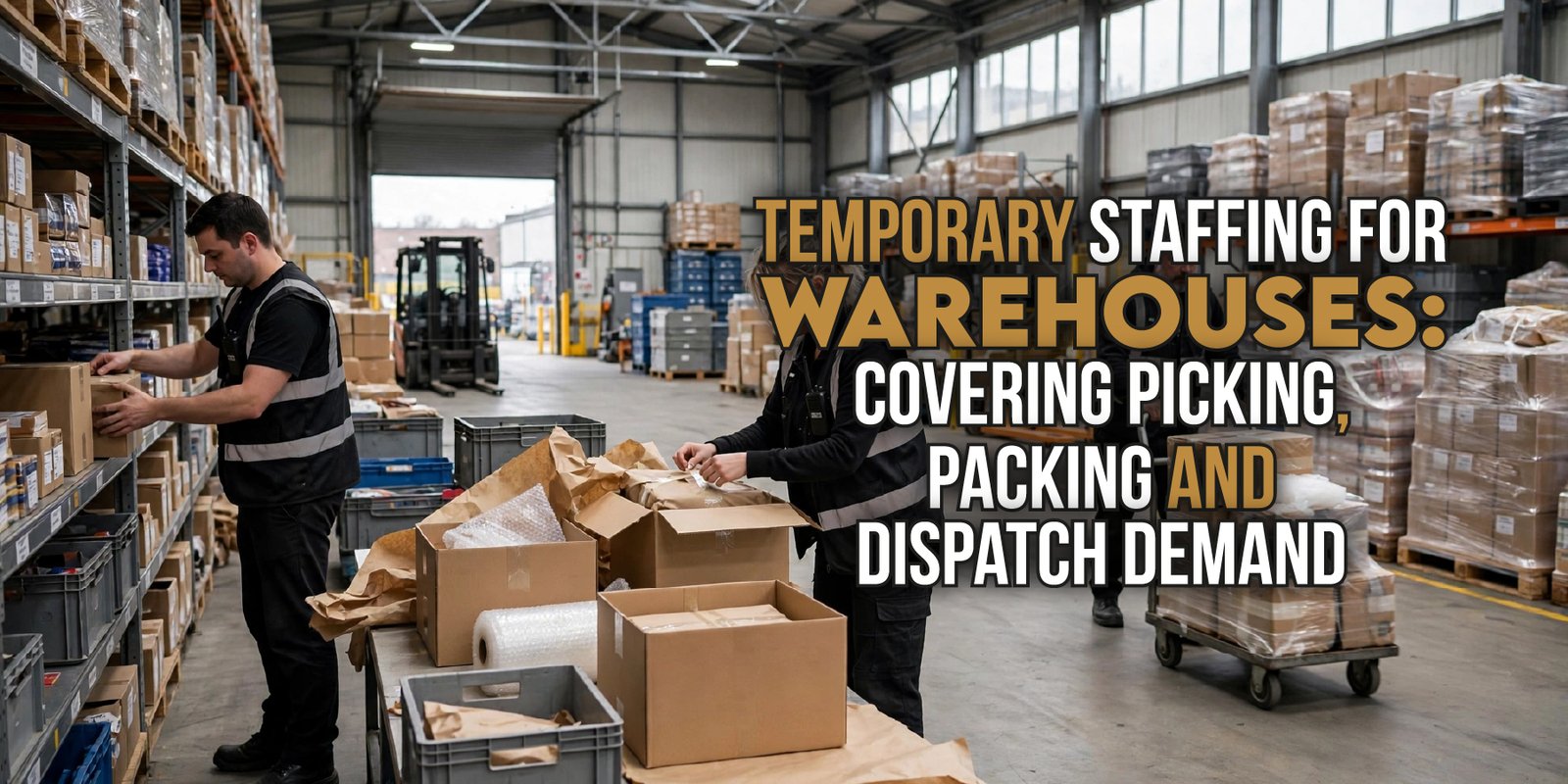
Warehouses are particularly suited to planned temporary staffing because order volumes can vary by day, season and customer activity.
Temporary personnel may support:
- Picking
- Packing
- Loading
- Goods-in
- Goods-out
- Dispatch
- Stock handling
- Returns processing
- Warehouse operations
- Forklift roles where relevant requirements are met
An ecommerce warehouse, for example, might expect order volumes to rise following a major campaign. Additional pickers and packers can increase workforce capacity during that period.
Shift timing remains important.
Warehouses around Heathrow and West London may operate early, late or overnight schedules. Therefore, recruitment needs to consider how candidates will reach the workplace as well as whether they have relevant experience.
Employers needing additional logistics personnel can explore H&D Recruitment’s warehouse staffing support when planning temporary or longer-term warehouse requirements.
Hospitality Temporary Staffing
Hospitality staffing can change with occupancy, bookings, events, conferences and seasonal demand.
Relevant temporary roles may include:
- Housekeepers
- Room attendants
- Porters
- Cleaners
- Waiting staff
- Receptionists
- Front-of-house personnel
For example, a hotel expecting a particularly busy weekend may require additional housekeeping capacity to support room turnaround.
However, employers should still communicate service standards, shift times, dress requirements and specific workplace expectations.
Temporary recruitment works better when the staffing provider understands the environment rather than simply matching a job title.
Security Temporary Staffing
Security requirements can increase around events, venues, retail operations, construction sites and other time-sensitive assignments.
Relevant roles can include:
- Door Supervisors
- Security Officers
- CCTV Operators
- Event security personnel
- Event stewards where appropriate
Licensing requirements depend on the activity.
For regulated private security work, employers must ensure the individual holds the correct SIA licence where one is required. GOV.UK provides a licence-checking service and lists regulated activities including door supervision, security guarding and public space surveillance.
Therefore, a generic request for “security staff” may not give a recruiter enough information.
Instead, explain the site, duties and required security activity.
Industrial and Manufacturing Temporary Staffing
Production workloads can change with:
- Large orders
- Seasonal output
- Short projects
- Absence
- Production backlogs
- New product runs
- Additional shifts
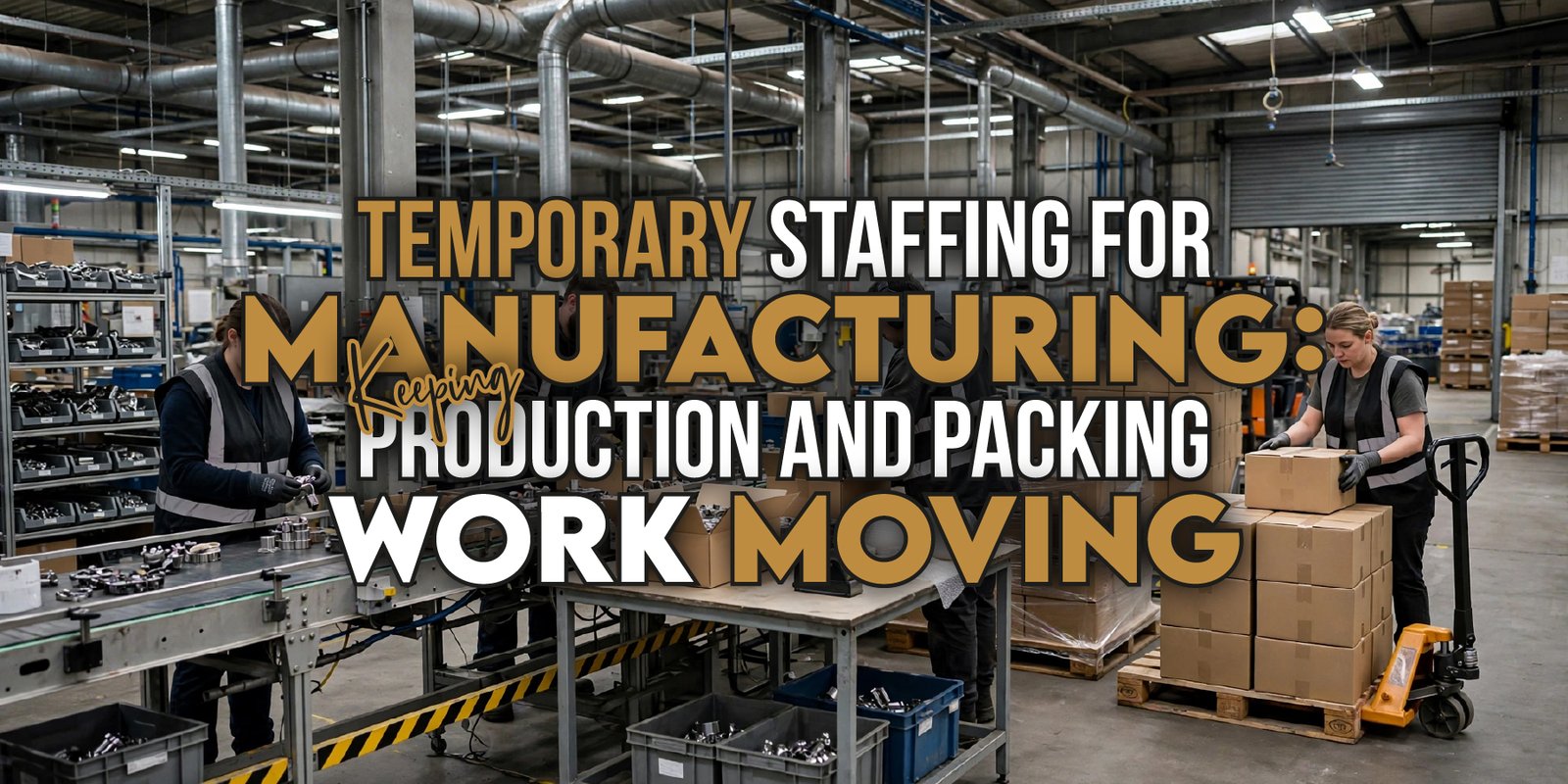
Temporary personnel may support assembly, packing, production lines and other suitable operational tasks.
For example, a factory that receives a defined high-volume order may need additional production capacity for several weeks rather than indefinitely.
Employers can review H&D Recruitment’s industrial recruitment services when considering temporary or longer-term industrial workforce support.
Temporary Staffing vs Permanent Recruitment
Neither model is automatically better. The right choice depends on why the vacancy exists.
| Business Need | Temporary Staffing | Permanent Recruitment |
|---|---|---|
| Seasonal peak | Strong fit | Usually unnecessary alone |
| Sickness cover | Strong fit | Usually not required |
| Short project | Strong fit | Depends on duration |
| Immediate workload rise | Useful where candidates are available | May take longer |
| Long-term core vacancy | Can provide interim cover | Often appropriate |
| Permanent expansion | Offers interim flexibility | Often appropriate |
| Event-specific requirement | Strong fit | Usually unnecessary for the event alone |
| Recruitment gap | Can support operations temporarily | Addresses longer-term vacancy |
Additionally, temporary staffing is not automatically cheaper than permanent recruitment.
Employers should compare the full commercial arrangement, internal recruitment costs, assignment length, agency charges and long-term workforce need rather than assuming one model always costs less.
What Information Should You Give a Temporary Staffing Agency?
The quality of the staffing brief can directly affect candidate matching.
H&D Recruitment’s current quote process asks employers for information including the service needed, when cover is required, site location or postcode, number of staff, type of site and shift pattern.
A useful employer brief can include:
| Information | Why It Matters |
|---|---|
| Role required | Helps identify relevant experience |
| Number of staff | Sets the sourcing requirement |
| Site location | Helps assess travel practicality |
| Start date | Establishes the recruitment timeline |
| Shift start and finish | Helps match availability |
| Working days | Prevents rota misunderstandings |
| Shift pattern | Supports continuing workforce planning |
| Assignment duration | Sets expectations |
| Required experience | Improves candidate matching |
| Essential licence or certification | Important for specialist or regulated roles |
| Main duties | Clarifies actual role requirements |
| PPE requirements | Helps prepare candidates |
| Site induction | Supports a smoother first shift |
| Transport or parking information | Helps assess journey practicality |
| Reporting manager | Gives staff a clear contact |
| Cancellation procedure | Helps manage changes |
| On-site contact details | Supports shift communication |
If the requirement changes, update the agency quickly.
Accurate information gives the provider a better chance of matching workers to the real assignment rather than an incomplete description.
Temporary Staffing Checklist for Employers
Use this checklist when comparing temporary workforce providers.
| What to Check | Why It Matters | Question to Ask |
|---|---|---|
| Sector experience | Operational requirements differ by industry | Which similar roles do you regularly support? |
| Candidate screening | Availability alone does not prove suitability | What do you check before assigning candidates? |
| Availability process | Rotas must match real availability | How do you confirm workers can attend each shift? |
| Travel practicality | Early and late shifts can create access problems | Do you assess journey feasibility? |
| Compliance | Requirements differ by role and arrangement | Which checks do you complete and what remains our responsibility? |
| Shift communication | Poor rota communication creates gaps | How should we send changes? |
| Short-notice process | Urgent requirements need clear expectations | What information do you need for urgent cover? |
| Replacement arrangements | Absence can still happen | How do you handle a worker becoming unavailable? |
| Local knowledge | Geography affects attendance | How familiar are you with our area and shift times? |
| Account structure | Employers need an escalation route | Who manages our requirement? |
| Commercial terms | Total cost and obligations must be understood | What rates, notice and transfer terms apply? |
| Ongoing support | Assignments can change | How do you manage headcount and rota changes? |
How Do You Choose a Reliable Temporary Staffing Provider?
Choose a temporary staffing provider by assessing sector knowledge, candidate screening, communication, shift understanding, local knowledge, compliance processes, workforce flexibility and commercial transparency. A reliable provider should ask detailed questions about the role, site, working hours and expected duration before recommending candidates.
1. Check sector knowledge
A provider familiar with your working environment can ask better questions.
Warehouse staffing, for example, involves very different operating conditions from hotel housekeeping.
2. Understand candidate screening
Ask what the agency verifies before assigning someone.
Moreover, clarify which checks remain the employer’s responsibility.
3. Assess communication
Find out who manages day-to-day staffing changes and how urgent issues should be escalated.
4. Discuss shift patterns
A candidate may be available generally but unavailable for your actual rota.
Therefore, provide precise working times.
5. Consider location knowledge
Candidate travel should form part of suitability, especially for early or overnight shifts.
6. Ask how changing demand is managed
Operational headcount can rise or fall.
Consequently, understand how your provider handles revised requirements.
7. Review compliance processes
Different sectors and roles create different requirements.
Ask what the provider checks rather than relying on broad claims about “fully compliant staff”.
8. Give a complete employer brief
Recruitment quality depends partly on information quality.
A vague request encourages broad matching.
9. Focus on candidate suitability
The question is not simply whether someone can start.
Instead, ask whether they have the relevant experience, availability and practical ability to perform the assignment.
10. Read the commercial terms
Understand rates, notice periods, cancellation arrangements, invoicing and any applicable transfer provisions before work begins.
Temporary Staffing in Hounslow and West London
Location has a practical effect on temporary staffing.
H&D Recruitment operates from 4 Bell Parade, Bell Rd, Hounslow TW3 3NU, placing it within a West London employment area connected to Heathrow and businesses across warehousing, logistics, hospitality, security and other operational sectors. H&D’s live website confirms its Hounslow address and multi-sector staffing positioning.
For Hounslow and Heathrow-area employers, temporary recruitment should consider:
- Public transport
- Early starts
- Night shifts
- Travel time
- Site accessibility
- Warehouse locations
- Hotel shift patterns
- Heathrow-area operations
- Candidate availability
- Weekend schedules
Consider a warehouse near Heathrow that needs additional operatives from 6:00 am.
One candidate may have several years of warehouse experience but rely on public transport that does not reach the site before the shift begins.
Another candidate with suitable experience and practical transport may offer a better operational match.
Therefore, a temporary staff agency needs accurate location and shift information before assessing suitability.
The same principle applies to hotel staff finishing late and security personnel working event or night shifts.
How H&D Recruitment Supports Temporary Staffing Requirements
H&D Recruitment is a recruitment and staffing agency based in Hounslow, West London.
Its current website lists staffing coverage across sectors including security, warehouse, hospitality, manufacturing, construction and healthcare. The company’s quote page also promotes short-notice cover and states that its operations team provides 24/7 support for scheduling, replacements and urgent requests.
For employers, that support can begin with a practical staffing brief covering:
- Required role
- Headcount
- Site
- Shift
- Start date
- Assignment length
- Relevant experience
- Licence requirements where applicable
H&D Recruitment can then discuss appropriate recruitment and workforce options based on the requirement rather than treating every staffing request in the same way.
Employers with an upcoming requirement can discuss their temporary staffing requirements with H&D Recruitment.
How Can Employers Improve Temporary Staffing Outcomes?
Employers and agencies both influence staffing performance.
Plan predictable demand early
Black Friday, Christmas, known events and scheduled projects should not become surprise requirements.
Earlier planning gives candidate sourcing more room.
Give accurate shift details
Do not describe a role as “day shift” if workers actually need to arrive at 5:45 am.
Precise information improves availability matching.
Prepare induction information
Temporary personnel should understand where to report, who supervises them and which site rules apply.
Communicate rota changes quickly
If six people are required instead of ten, tell the staffing provider promptly.
Likewise, communicate extra requirements as soon as they become known.
Give specific feedback
Feedback such as “not suitable” provides little guidance.
Instead, explain whether the issue involved experience, performance, attendance, system familiarity or another relevant factor.
Specific feedback can improve future candidate matching.
Why Do Employers Use Temporary Staffing?
Employers use temporary staffing to add workforce capacity when absence, seasonal demand, unexpected orders, projects or recruitment gaps create short-term pressure. It can give operational teams more flexibility without requiring every temporary increase in workload to become an immediate permanent hire.
However, temporary workforce support works best when it forms part of workforce planning rather than replacing it.
The strongest results generally come from combining realistic forecasts, accurate role briefs, proper induction and clear communication between employer and staffing provider.
Temporary Opportunities for Candidates
Temporary assignments can also suit candidates who want flexible shifts, shorter placements or experience across different working environments.
Candidates interested in opportunities through H&D Recruitment can explore current job opportunities.
The main staffing decision, however, remains employer-led. Businesses should define the operational need clearly before deciding whether short-term cover or permanent recruitment provides the better solution.
FAQs
1. What is temporary staffing?
Temporary staffing allows employers to bring in people for limited periods or specific shifts to cover short-term workforce requirements. Companies commonly use temporary personnel for absence, seasonal peaks, projects, unexpected workloads and recruitment gaps without immediately turning every temporary requirement into permanent headcount.
2. Why do employers use temporary staffing?
Employers use temporary workforce cover to respond to changes in workload and staffing availability. For example, it can support sickness cover, warehouse demand peaks, hotel occupancy increases, events or defined projects. However, employers still need accurate planning, role briefing, induction and communication.
3. What is a temporary staff agency?
A temporary staff agency sources and matches people to short-term assignments based on factors such as role requirements, experience, availability, location and shifts. Depending on its service and contractual arrangement, the provider may also manage screening, staffing coordination and communication during the assignment.
4. What are agency workers?
Agency workers have a contract with an agency while working temporarily for a hirer. UK rules provide specific protections, including certain day-one rights. After completing a qualifying 12-week period in the same role, qualifying workers can receive equal treatment for specified basic working and employment conditions.
5. When should a company use short term staff?
Companies may use short term staff for sickness cover, annual leave, seasonal peaks, temporary projects, events, additional orders or interim support while recruiting permanent employees. The arrangement makes most sense when the business requirement has a defined or fluctuating duration.
6. What is flexible staffing?
Flexible staffing means adjusting workforce capacity according to demand rather than keeping exactly the same headcount throughout every operating period. A warehouse might increase pick-and-pack staffing during a sales peak, while a hotel could add housekeeping personnel during periods of higher occupancy.
7. Which industries use temporary staffing?
Temporary workforce models appear across many operational sectors, including warehousing, logistics, hospitality, manufacturing, production, events and security. The suitability of temporary personnel depends on the role, required training, working conditions, compliance requirements and expected assignment length.
8. Can temporary staffing cover sickness?
Yes, temporary personnel can provide absence cover when suitable candidates are available. However, employers should give the agency the role, location, exact shift, required experience and expected period of cover. More accurate information gives the provider a stronger basis for candidate matching.
9. Can staffing agencies provide same-week or urgent cover?
They may be able to, but employers should not assume that suitable people will always be available. Candidate supply depends on the role, location, shifts, notice period and required skills or licences. H&D Recruitment’s live website states that it supports short-notice staffing and operates 24/7 staffing coordination.
10. Can H&D Recruitment provide temporary staffing in Hounslow?
H&D Recruitment is based at 4 Bell Parade, Bell Road, Hounslow TW3 3NU and supports temporary and flexible staffing requirements across several operational sectors. Its current website includes warehouse, hospitality, security, manufacturing and construction among its areas of recruitment support.
Final Employer CTA
Need Temporary Workforce Cover?
If absence, seasonal demand, a new contract, increased order volumes or changing shifts are putting pressure on your team, temporary staffing may provide the additional workforce capacity your operation needs.
H&D Recruitment is based in Hounslow and supports staffing requirements across Hounslow, Heathrow, West London and wider locations where suitable.
For a more useful staffing discussion, provide:
- Role required
- Number of people
- Workplace location
- Start date
- Shift start and finish times
- Working days
- Expected assignment duration
- Required experience
- Relevant licences or qualifications
Employers can request a staffing quote and share their current workforce requirement with H&D Recruitment.