A warehouse adds another shift, but candidate sourcing cannot keep pace. A hotel still has housekeeping vacancies before a high-occupancy weekend. Meanwhile, a new security requirement creates demand for appropriately licensed personnel while managers already have several open roles to fill.
In situations like these, a recruitment agency can add external hiring capacity without replacing the employer’s own decision-making.
The value is not simply access to more applicants. Good recruitment support can reduce the time managers spend sourcing candidates, carrying out initial screening, checking availability, coordinating applicants and managing temporary recruitment requirements.
However, an agency cannot correct an unclear brief, unrealistic shift expectations or delayed employer decisions on its own. Therefore, the strongest results come from a structured partnership between the employer and recruitment provider.
How Can a Recruitment Agency Reduce Hiring Pressure?
A recruitment agency can reduce hiring pressure by helping employers define vacancies, source candidates, carry out initial screening, check availability, match experience to roles and coordinate temporary or longer-term recruitment. This adds recruitment capacity when internal HR or operational teams are managing multiple vacancies, urgent shifts, business growth or changing workforce requirements.
Hiring pressure is ultimately a capacity problem.
Sometimes the business lacks candidates. In other cases, suitable applicants exist, but managers lack enough time to advertise, review applications, make calls, arrange interviews and coordinate start dates while continuing to run daily operations.
That distinction matters because the solution should address the actual recruitment bottleneck.
What Creates Hiring Pressure for Employers?
Hiring pressure develops when recruitment demand exceeds the organisation’s available time, candidate supply or internal recruitment capacity.
Multiple vacancies
Filling one vacancy can be manageable internally. Recruiting 20 people across several shifts creates a very different workload.
Each vacancy can involve:
- Advertising
- Application reviews
- Candidate communication
- Screening
- Availability checks
- Interview coordination
- Reference or compliance processes where relevant
- Offer management
- Start-date coordination
Consequently, high-volume recruitment can place significant pressure on HR and operational managers.
Poor applicant relevance
High application numbers do not necessarily make recruitment easier.
A manager may receive hundreds of applications yet find relatively few people who meet essential experience, shift, location or licence requirements.
Therefore, candidate relevance matters more than raw applicant volume.
Employee turnover
Repeated vacancies can create a cycle in which managers continuously recruit instead of focusing on workforce planning.
A recruitment agency may add sourcing capacity while the employer examines the reasons behind recurring turnover.
However, recruitment alone cannot fix underlying retention problems.
Seasonal demand
Warehouses, hotels, venues, manufacturing operations and other shift-based businesses may experience predictable peaks.
If managers wait until demand arrives before recruiting, the requirement can quickly become urgent.
Sickness and absence
Unexpected absence creates a different problem because the vacancy was not planned.
Temporary recruitment may provide operational cover where suitable candidates are available.
Business growth
A company that adds contracts, sites, shifts or production capacity may need to recruit several roles simultaneously.
As a result, internal recruitment workload can rise faster than the permanent HR team.
Hard-to-fill positions
Some roles have limited candidate pools because of skills, licences, working hours, location or experience requirements.
Recruitment pressure therefore does not always mean “we need more applicants”. Sometimes it means “we need access to more relevant candidates”.
What Does a Recruitment Agency Do for Employers?
A recruitment agency supports employers by understanding the vacancy, sourcing potential candidates, carrying out agreed initial screening and helping coordinate the recruitment process. Services vary by agency, but support may include temporary staffing, permanent recruitment, candidate matching, availability checks and communication between employers and candidates.
The process should begin with the business requirement.
For example, asking for “warehouse staff” leaves too many unanswered questions.
Are the vacancies for picking, loading, dispatch or forklift duties? Are shifts during the day or overnight? Does the site have practical public transport at the required start time? Is the assignment temporary or permanent?
The better a recruitment company understands these factors, the stronger its basis for candidate matching.
What Does Employer Recruitment Support Include?
Employer recruitment support can cover the practical work required between identifying a vacancy and getting a suitable person ready to start.
Depending on the service agreed, this may include:
- Defining staffing requirements
- Clarifying job descriptions
- Candidate sourcing
- Vacancy management
- Initial candidate screening
- Availability checks
- Experience matching
- Candidate communication
- Shift coordination
- Temporary cover
- Recruitment updates
- Start-date coordination
H&D Recruitment’s current employer-facing website positions the company around temporary, part-time and full-time staffing and highlights hospitality, security and warehouse recruitment among its principal areas.
Good employer recruitment support should also reduce unnecessary activity.
For example, if night-shift availability is essential, the agency should establish that before presenting candidates rather than after the employer has reviewed them.
Therefore, a precise hiring brief saves time on both sides.
Staff Supply: What Should Employers Expect?
Staff supply should mean more than receiving a list of available names.
For operational recruitment, employers should expect candidate suitability to be considered against the actual assignment.
Relevant factors may include:
- Required experience
- Exact availability
- Shift compatibility
- Workplace location
- Travel practicality
- Essential qualifications
- Licence requirements where applicable
- Employer-specific duties
- Assignment duration
- Communication expectations
Consider a security vacancy as an example.
If the activity requires an SIA licence, simply finding someone with security experience is not enough. Current GOV.UK guidance states that employers must check that an individual has the correct security licence before hiring them for licensable private security work.
Likewise, warehouse staff supply needs more detail than general logistics experience.
Someone suitable for daytime picking may not automatically fit a night loading assignment.
The employer should therefore judge supply quality by role fit rather than candidate quantity alone.
How Can a Recruitment Agency Support Workforce Hiring?
Workforce hiring becomes more complex when an organisation needs multiple people rather than a single replacement.
A recruitment agency can add recruitment capacity across several types of hiring requirement.
Filling one vacancy
This may involve sourcing a smaller shortlist for a defined role.
Recruiting multiple people
When headcount increases, the agency may need to coordinate a larger candidate pool, availability and start dates.
Building a temporary team
Short-term assignments often require people who can work the same location, dates and shift pattern.
Supporting several shifts
Day, night and weekend requirements can split the candidate pool because availability differs.
Recruiting across departments
A hotel, for example, may need room attendants and reception personnel at the same time.
Supporting a new contract
New business can require a larger recruitment exercise with a fixed mobilisation or operational start date.
Therefore, workforce hiring should begin with headcount planning rather than treating every vacancy as an isolated job.
When Does Temporary Recruitment Make Sense?
Temporary recruitment makes sense when an employer needs additional workforce capacity for a limited, uncertain or fluctuating period rather than immediately increasing permanent headcount.
Common situations include:
- Sickness cover
- Annual leave
- Seasonal demand
- Temporary projects
- New contracts
- Recruitment gaps
- Warehouse order peaks
- Hotel occupancy peaks
- Events
- Production increases
- Short-term workforce shortages
For example, a fulfilment operation may need extra pickers during a known order peak.
Meanwhile, a hotel may require additional housekeeping capacity around a busy weekend.
In both cases, temporary recruitment can provide an interim staffing option where suitable candidates are available.
However, temporary staffing should not become a substitute for fixing permanent recruitment or retention issues where the underlying requirement is clearly long term.
Recruitment Agency vs In-House Recruitment
Neither approach is universally better.
Many organisations use both.
| Recruitment Factor | Recruitment Agency | In-House Recruitment |
|---|---|---|
| Candidate sourcing | Adds external sourcing capacity | Managed by internal team |
| Initial screening | Agency may manage agreed early stages | Internal team completes screening |
| Temporary recruitment | Often available as a specialist service | Depends on internal capability |
| Candidate networks | Can provide access to agency sourcing channels | Depends on employer database and reach |
| Employer control | Process is shared | Greater direct internal control |
| Recruitment cost | Agency fees apply | Internal salary, advertising and management time apply |
| Specialist vacancies | Sector experience may widen sourcing | Depends on internal expertise |
| Recruitment volume | Can add external capacity | Limited by internal resources |
| Employer knowledge | Agency must learn the operation | Internal team already understands the business |
| Relationship ownership | Shared with recruitment partner | Fully internal |
A recruitment agency is therefore not necessarily a replacement for an internal HR function.
Instead, the agency can increase recruitment capacity when the internal team reaches its practical limit.
When Should an Employer Use a Recruitment Agency?
An employer should consider a recruitment agency when vacancies, sourcing workload, temporary cover or specialist requirements exceed internal recruitment capacity. Agencies can be particularly useful for multiple roles, urgent staffing gaps, changing workforce demand and sectors where shift patterns, licences or operational experience narrow the suitable candidate pool.
Urgent vacancies
Unexpected departures or absence can create immediate operational gaps.
However, “urgent” should not mean leaving important job details undefined.
Multiple open roles
An external recruitment provider can add candidate sourcing and screening capacity when several vacancies run simultaneously.
Staff absence
Short-term staffing may help cover operational gaps while permanent employees are unavailable.
Seasonal peaks
Known demand periods allow employers and agencies to plan candidate requirements before the peak starts.
Business expansion
Growth may involve recruiting across several departments or sites at once.
New contracts
A fixed operational start date can increase recruitment pressure substantially.
Therefore, employers should engage recruitment support early rather than after mobilisation deadlines become difficult.
Temporary projects
Defined projects may need additional personnel without creating an ongoing permanent vacancy.
Specialist roles
Qualifications, licences or narrow experience requirements can reduce the candidate pool.
Recruitment team capacity problems
Sometimes the biggest constraint is simply internal time.
Managers cannot indefinitely review applications while also running operations.
High-volume recruitment
Recruiting dozens of people requires candidate pipelines, scheduling and coordinated start dates.
That makes high-volume recruitment a process-management issue as much as a sourcing issue.
Hiring Pressure Across Busy Operational Sectors
The causes of hiring pressure differ by sector.
Warehouse and Logistics
Warehouse recruitment often responds directly to workload.
Pressure can come from:
- Order peaks
- New shifts
- Seasonal fulfilment
- Weekend operations
- Night shifts
- High returns volume
- Dispatch demand
- New contracts
- Absence
- Forklift requirements
Current H&D warehouse content includes picking, packing, loading, stock, dispatch, returns and forklift-related recruitment, alongside temporary and longer-term staffing requirements in Hounslow, Heathrow and wider West London.
For example, adding an overnight shift may require more than simply finding ten warehouse operatives.
The recruitment agency also needs the site location, duties, start time, finish time and experience requirements.
Employers dealing with this type of operational demand can review H&D Recruitment’s warehouse staffing services.
Hospitality
Hospitality recruitment pressure often follows customer demand.
Hotels and venues may face:
- Higher occupancy
- Large check-outs
- Conferences
- Events
- Busy weekends
- Seasonal peaks
- Employee absence
- Permanent vacancies
Roles may include:
- Housekeepers
- Room attendants
- Waiters and waitresses
- Receptionists
- Porters
- Cleaners
- Kitchen and chef personnel where relevant
H&D Recruitment’s current jobs content lists hospitality roles including waiter or waitress, receptionist, porter, cleaner and chef positions and connects candidates with hotels, restaurants, bars and resorts.
Therefore, hospitality workforce hiring should connect staffing numbers with expected operational demand rather than using one fixed headcount assumption.
Security
Security recruitment introduces role-specific compliance considerations.
Hiring pressure can arise around:
- Events
- Venues
- Retail sites
- Construction locations
- Corporate environments
- Shift gaps
- New contracts
- Night requirements
Current H&D content lists roles including SIA Security, SIA Door Supervisor, Event Steward and CCTV Operator.
For licensable security activities, employers need appropriately licensed personnel. Therefore, the staffing brief should explain the actual duties rather than merely request “security staff”.
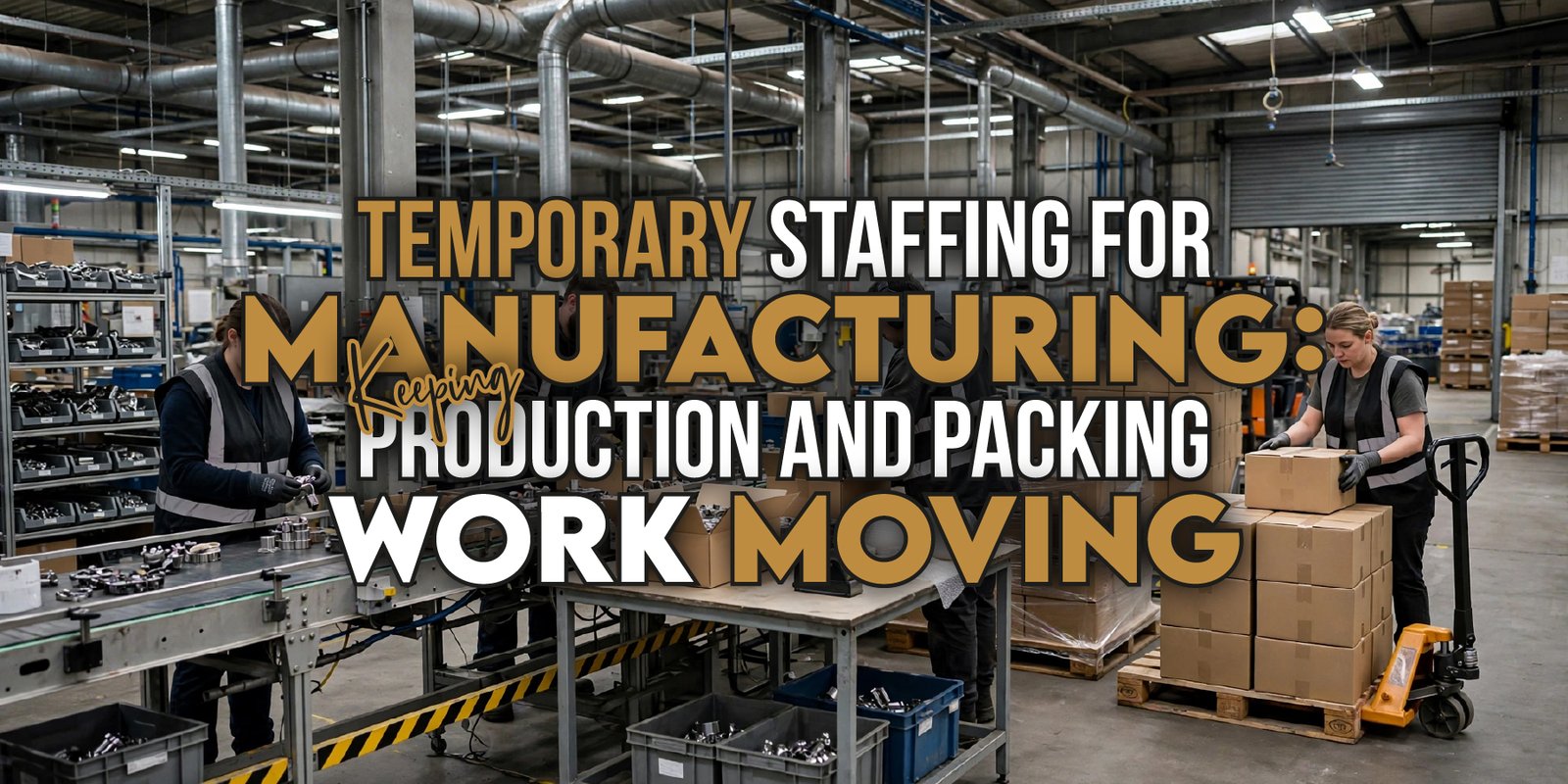
Industrial and Manufacturing
Industrial and manufacturing recruitment may respond to:
- Production peaks
- Additional shifts
- Packing requirements
- Assembly demand
- Large orders
- Temporary projects
- Absence
- Increased output
A manufacturer that receives a short-term production order might need additional operational capacity for several weeks rather than indefinitely.
In that case, an industrial recruitment agency can support relevant candidate sourcing within the employer’s wider staffing plan.
How Does a Recruitment Agency Work With an Employer?
The exact recruitment process varies, but a typical employer relationship follows nine stages.
1. The employer identifies the staffing need
First, define why recruitment is required.
Is the need caused by growth, absence, turnover, seasonal demand or a permanent vacancy?
2. The agency collects the brief
Next, the recruitment agency needs details about the role, location, headcount, shifts and start date.
3. Hiring priorities are clarified
Separate essential criteria from preferences.
This prevents unnecessary rejection of otherwise suitable candidates.
4. Candidate sourcing begins
The agency searches appropriate candidate channels based on the requirement.
5. Initial screening takes place
Potential candidates can then be checked against the agreed criteria.
6. Relevant candidates are matched
The staffing provider compares experience, availability, qualifications and other relevant factors with the brief.
7. The employer reviews candidates where appropriate
The exact process depends on the staffing model.
Permanent vacancies may involve employer interviews, while some temporary assignments can follow a different confirmation process.
8. Start details are agreed
Location, reporting point, shift, induction and required equipment should be confirmed before the first day.
9. Recruitment support continues where needed
The requirement may change.
Consequently, employers and agencies should keep communicating about headcount, performance, availability and future staffing needs.
What Information Should You Give a Recruitment Agency?
A recruitment agency can make better candidate-matching decisions when the employer provides a complete operational brief.
H&D Recruitment’s current quote process asks for details including the service required, timing, site or postcode, number of staff, site type and shift pattern. Its live employer material also describes rota, replacement and staffing coordination support.
| Information | Why It Matters |
|---|---|
| Job title | Defines the broad requirement |
| Main duties | Clarifies what the role actually involves |
| Number of people required | Sets hiring volume |
| Site location | Affects travel practicality |
| Shift pattern | Helps match availability |
| Start date | Defines recruitment timing |
| Assignment duration | Clarifies temporary or permanent need |
| Required experience | Improves candidate relevance |
| Essential qualifications | Filters unsuitable applicants |
| Licence requirements | Important for regulated roles |
| Pay or rate information | Supports clear candidate communication |
| Reporting manager | Clarifies onboarding |
| PPE or uniform | Helps personnel arrive prepared |
| Interview process | Sets candidate expectations |
| Induction requirements | Supports first-day readiness |
| Essential vs desirable criteria | Prevents unnecessary filtering |
What information should employers give a recruitment agency?
At minimum, provide:
- Role and duties
- Headcount
- Full location
- Shift pattern
- Start date
- Assignment length
- Essential experience
- Required qualifications or licences
- Pay or rate information where applicable
- Reporting and induction details
More precise information usually gives the recruitment provider a stronger basis for screening.
A Better Hiring Brief: Practical Example
Weak brief
Need 10 warehouse staff urgently.
This leaves major questions unanswered.
The recruitment agency still does not know the shift, exact location, duties, assignment duration or experience expectations.
Better brief
Need 10 warehouse operatives in Hounslow for 06:00–14:00 shifts starting Monday. Main duties are picking and packing. Previous warehouse experience is preferred. Safety footwear is required. The assignment is expected to run for four weeks.
The second brief gives the agency information it can actually use.
It identifies:
- Headcount
- Location
- Shift
- Start date
- Duties
- Experience preference
- PPE
- Assignment duration
Consequently, the sourcing process starts with fewer assumptions.
Recruitment Agency Checklist for Employers
Use this checklist when comparing recruitment providers.
| What to Check | Why It Matters | What to Ask |
|---|---|---|
| Sector expertise | Operational requirements differ | Which similar roles do you recruit regularly? |
| Recruitment process | Shows how the provider works | What happens after we send the brief? |
| Candidate sourcing | Determines how candidates are identified | Which sourcing methods do you use? |
| Screening | Reduces irrelevant introductions | What do you check before recommending someone? |
| Availability checks | Essential for shift-based roles | How do you confirm exact availability? |
| Temporary recruitment | Important for fluctuating demand | Can you support temporary as well as longer-term requirements? |
| Compliance | Responsibilities must be understood | Which checks apply to this role and who completes them? |
| Communication | Requirements change | Who manages our account? |
| Replacement process | Availability can change | What happens if confirmed personnel become unavailable? |
| Local knowledge | Travel can affect reliability | Do you consider location and shift accessibility? |
| Commercial terms | Employers need clarity | What rates, fees and notice conditions apply? |
| Reporting | Supports ongoing management | How are staffing changes and issues communicated? |
How Do Employers Choose a Reliable Recruitment Agency?
Employers should choose a recruitment agency by assessing sector relevance, candidate sourcing, screening, communication, temporary recruitment capability, local knowledge, compliance processes and commercial transparency. A strong agency should ask detailed questions about duties, shift patterns, location and essential criteria before recommending candidates rather than relying only on database size.
1. Test sector relevance
Ask for an explanation of how the provider approaches your type of role.
Someone who understands hospitality recruitment should recognise that housekeeping and reception present different staffing requirements.
2. Assess understanding of the role
Listen to the questions the recruiter asks.
Good questions about duties, shifts and essential criteria indicate a more detailed approach than simply asking for the job title.
3. Understand candidate sourcing
Ask how the provider intends to identify candidates.
Furthermore, clarify whether the agency already has a relevant candidate network or expects to begin a new sourcing campaign.
4. Review screening
Determine what happens before a candidate reaches you.
This can significantly affect internal screening workload.
5. Evaluate communication
Know who manages the requirement and how frequently updates will occur.
6. Check temporary recruitment capability
If your workforce demand fluctuates, understand whether the provider can support temporary requirements as well as permanent hiring.
7. Consider local knowledge
Location affects workforce suitability.
A local recruitment agency should still assess each journey individually rather than assume every nearby candidate can reach every shift.
8. Clarify compliance
Different roles create different requirements.
For example, GOV.UK currently requires employers to check an applicant’s right to work before directly employing them, while the exact responsibility in agency arrangements depends on the contractual relationship.
Official guidance should be checked for the current arrangement rather than relying on assumptions.
9. Compare commercial terms
Price matters, but it is only one factor.
Understand the service being provided, applicable fees, notice arrangements and other contractual conditions.
10. Assess ongoing support
Recruitment does not necessarily finish at the start date.
For continuing temporary assignments, employers may still need rota and staffing coordination.
How Should a Recruitment Agency Screen Candidates?
A recruitment agency should screen against the actual role rather than use one identical checklist for every candidate.
Relevant screening may include:
- Work history
- Role experience
- Availability
- Shift compatibility
- Travel practicality
- Essential qualifications
- Required licences
- Employer-specific criteria
- Right-to-work considerations according to the contractual arrangement
For example, the Security Industry Authority maintains a public service that allows licences for regulated private security activities to be checked.
Meanwhile, current Home Office guidance explains the right-to-work duties that apply to employers and the available checking methods.
However, not every check applies identically to every job.
Screening should therefore reflect the role and current legal requirements.
Common Mistakes Employers Make When Using Recruitment Agencies
Giving vague job briefs
Unclear information creates unclear matching.
Define the real duties before sourcing starts.
Hiding difficult shifts
Do not describe a 05:30 start as simply “morning”.
Candidates need accurate information to decide whether they can realistically attend.
Changing requirements late
An employer may initially request 20 people and later reduce the requirement to 12.
Changes happen. However, communicating them late creates unnecessary recruitment work.
Treating desirable criteria as essential
An excessive requirement list can shrink the candidate pool unnecessarily.
Separate genuine must-haves from preferences.
Requesting unrealistic start dates
An urgent requirement does not automatically mean suitable candidates exist immediately.
Therefore, give the recruitment agency as much notice as practical.
Ignoring site access
Warehouses, hotels, factories and security sites can have specific entry procedures.
Explain them before the first shift.
Weak induction
Candidate sourcing does not replace employer onboarding.
New personnel still need site-specific guidance.
Failing to give feedback
Specific feedback improves subsequent candidate matching.
“Not suitable” tells the recruiter very little.
Over-relying on last-minute recruitment
Temporary recruitment can provide flexibility, but predictable demand should still be forecast.
Comparing agencies only on price
The lowest quoted cost does not automatically indicate the strongest recruitment process.
Compare relevance, screening, communication and terms as well.
What Can a Recruitment Agency Not Solve on Its Own?
A recruitment agency can add sourcing and recruitment capacity, but it cannot independently solve every hiring problem.
An unclear vacancy
If the employer cannot explain what the person will do, the agency cannot reliably assess suitability.
Unrealistic pay or conditions
Recruitment activity does not automatically overcome a role that candidates consistently reject.
Impossible transport requirements
A suitable candidate cannot attend a shift if the journey is not practical.
Poor workplace experience
Continually replacing people will not fix underlying retention issues.
Missing induction
An agency can explain assignment information, but the employer still needs to cover workplace-specific procedures.
Constant changes
Frequent last-minute adjustments make candidate coordination harder.
Severe skills shortages
A narrow specialist candidate market remains narrow even when an agency is involved.
Slow employer decisions
Candidates can accept other opportunities while waiting.
Therefore, the employer and staffing provider share responsibility for keeping the recruitment process moving.
Recruitment Agency Support in Hounslow and West London
H&D Recruitment operates from 4 Bell Parade, Bell Rd, Hounslow TW3 3NU. Its current website identifies Hounslow as its base and promotes recruitment across hospitality, security and warehouse staffing, with wider employer options also including manufacturing, construction and healthcare.
Local context can matter when assessing staffing requirements across Hounslow, Heathrow and West London.
Important factors include:
- Public transport
- Early shift starts
- Night finishes
- Warehouse locations
- Heathrow-area logistics
- Hotel schedules
- Security sites
- Candidate commute distance
- Weekend transport
- Shift patterns
Consider a candidate with suitable warehouse experience.
If a Heathrow-area assignment starts at 06:00, the recruitment agency should still consider whether the candidate can reach that exact workplace before the shift begins.
Simply knowing that both candidate and business are somewhere in West London is not enough.
Therefore, employers should provide the full postcode and exact shift times when requesting staffing support.
Local presence can improve contextual understanding, but it does not guarantee candidate availability or faster recruitment.
How H&D Recruitment Supports Employers
H&D Recruitment is a recruitment agency based in Hounslow, West London.
Its current employer-facing material covers part-time, temporary and full-time recruitment, while the business highlights hospitality, security and warehouse staffing among its primary sectors. Its quote service also lists manufacturing, construction and healthcare as employer service options.
H&D’s employer page describes candidate assessments as part of its recruitment approach across key sectors, while the quote service references rota, replacement and staffing coordination support.
For employers, the useful starting point is still the hiring requirement.
Prepare:
- Role
- Headcount
- Location
- Shift
- Start date
- Assignment duration
- Essential experience
- Relevant qualifications
- Licence requirements where applicable
Then the recruitment team can discuss an appropriate staffing approach rather than beginning with a vague request for personnel.
Businesses ready to review a current vacancy or multi-role requirement can discuss their staffing requirements with H&D Recruitment.
Why Employer and Agency Coordination Matters
A recruitment agency can reduce hiring workload, but the employer retains important decisions and responsibilities.
The best division of work is usually clear.
The employer defines
- Operational need
- Role duties
- Essential criteria
- Pay or rate
- Site conditions
- Working pattern
- Final hiring decisions where applicable
- Site induction and management
The recruitment partner can support
- Candidate sourcing
- Initial screening
- Availability checks
- Candidate communication
- Matching
- Temporary staffing coordination
- Recruitment updates
When those responsibilities remain clear, employer recruitment support becomes more efficient.
Confusion usually appears when one side assumes the other will manage information that was never discussed.
Is Using a Recruitment Agency Worth It for Employers?
A recruitment agency can be worthwhile when the value of added recruitment capacity exceeds the cost of managing the requirement entirely in-house.
The calculation is not only about agency fees.
Employers can also consider:
- HR time
- Operations-management time
- Advertising
- Application screening
- Interview coordination
- Vacancy duration
- Temporary operational gaps
- Recruitment volume
- Specialist sourcing requirements
However, an agency is not automatically the right choice for every vacancy.
A business that recruits one straightforward position occasionally may prefer to manage it internally.
In contrast, an employer facing multiple roles, urgent temporary recruitment or persistent sourcing pressure may gain more value from external support.
A Short Note for Candidates
H&D Recruitment also provides opportunities for candidates across sectors including hospitality, security and warehouse recruitment.
Job seekers can explore current job opportunities and review available roles and application requirements.
The primary purpose of this guide, however, is helping employers make better recruitment decisions when internal hiring pressure rises.
Reducing Hiring Pressure Starts With a Better Recruitment Process
A recruitment agency reduces employer pressure most effectively when it adds structured recruitment capacity rather than simply more applicant volume.
The process starts with a clear brief.
Next comes relevant sourcing, screening, communication and candidate matching.
Finally, employers still need timely decisions, accurate shift information and suitable onboarding.
For busy operational businesses, the strongest recruitment model often combines internal knowledge of the workplace with external sourcing capacity.
That approach can support staff supply, workforce hiring, temporary recruitment and longer-term recruitment without pretending that every workforce problem has the same solution.
1. What does a recruitment agency do for employers?
A recruitment agency can help an employer define vacancies, source candidates, carry out agreed initial screening, check availability and coordinate the recruitment process. Depending on the provider, support may include temporary staffing, permanent recruitment, high-volume sourcing or sector-specific recruitment services.
2. How can a recruitment agency reduce hiring pressure?
A recruitment provider can reduce internal workload by taking on parts of candidate sourcing, initial screening, communication and recruitment coordination. This can be particularly useful when HR or operational teams are managing several vacancies, urgent requirements or workforce expansion while still handling normal business responsibilities.
3. What is employer recruitment support?
Employer recruitment support describes recruitment services provided to a business rather than a candidate. It can include vacancy planning, job briefing, candidate sourcing, initial screening, availability checks, candidate communication, temporary cover and recruitment coordination, depending on the service agreed.
4. What does staff supply mean?
In recruitment, staff supply generally refers to providing suitable personnel for an employer’s staffing requirement, particularly in temporary or flexible arrangements. Employers should expect the process to consider duties, availability, experience, shifts, location and relevant compliance requirements rather than simply candidate availability.
5. When should a business use temporary recruitment?
Temporary recruitment can be useful for absence cover, seasonal demand, projects, workload peaks, new contracts and interim cover while permanent recruitment continues. Employers should still define the expected duration, duties, shift pattern and experience required before requesting temporary personnel.
6. How does a recruitment agency support workforce hiring?
For larger workforce hiring requirements, an agency can add sourcing and screening capacity across multiple vacancies, shifts or departments. Employers should provide headcount, priorities, start dates and operational requirements so candidate recruitment can be planned as one coordinated exercise rather than several disconnected vacancies.
7. What information should employers give an agency?
Provide the role, duties, headcount, location, shift pattern, start date, assignment duration, essential experience, qualifications, licence requirements where applicable, pay information and onboarding details. The more accurate the staffing brief, the less time both parties spend correcting avoidable mismatches.
8. How do employers choose a reliable recruitment agency?
Assess sector relevance, candidate sourcing, screening, availability checks, communication, local understanding, compliance approach and commercial terms. Additionally, pay attention to the questions the agency asks. Detailed questions about duties, shifts and essential criteria usually provide a better foundation for candidate matching than focusing on database size alone.
9. Does H&D Recruitment support employers in Hounslow?
Yes. H&D Recruitment operates from 4 Bell Parade, Bell Road, Hounslow TW3 3NU and currently promotes employer recruitment across hospitality, security, warehouse and other staffing requirements. Its live site also lists temporary, part-time and full-time workforce solutions.
10. How can I discuss staffing needs with H&D Recruitment?
Prepare the role, headcount, location, shift pattern, start date, assignment length and essential experience first. Include relevant licence or qualification requirements and any important site conditions. H&D Recruitment can then discuss recruitment or staffing options based on the actual employer requirement.
Need Additional Recruitment Capacity?
If open vacancies, temporary cover or business growth are stretching your internal hiring capacity, start by defining the requirement clearly.
H&D Recruitment operates from 4 Bell Parade, Bell Rd, Hounslow TW3 3NU and provides recruitment support across several operational sectors.
Before speaking with the recruitment team, prepare:
- Role
- Number of people required
- Workplace location
- Shift pattern
- Start date
- Assignment duration
- Essential experience
- Required qualifications
- Licence requirements where applicable
- Site-specific conditions
- Reporting or induction requirements
A clear brief gives the recruitment agency a stronger starting point for candidate sourcing and matching.
Employers can request a recruitment quote to discuss current staffing requirements with H&D Recruitment.