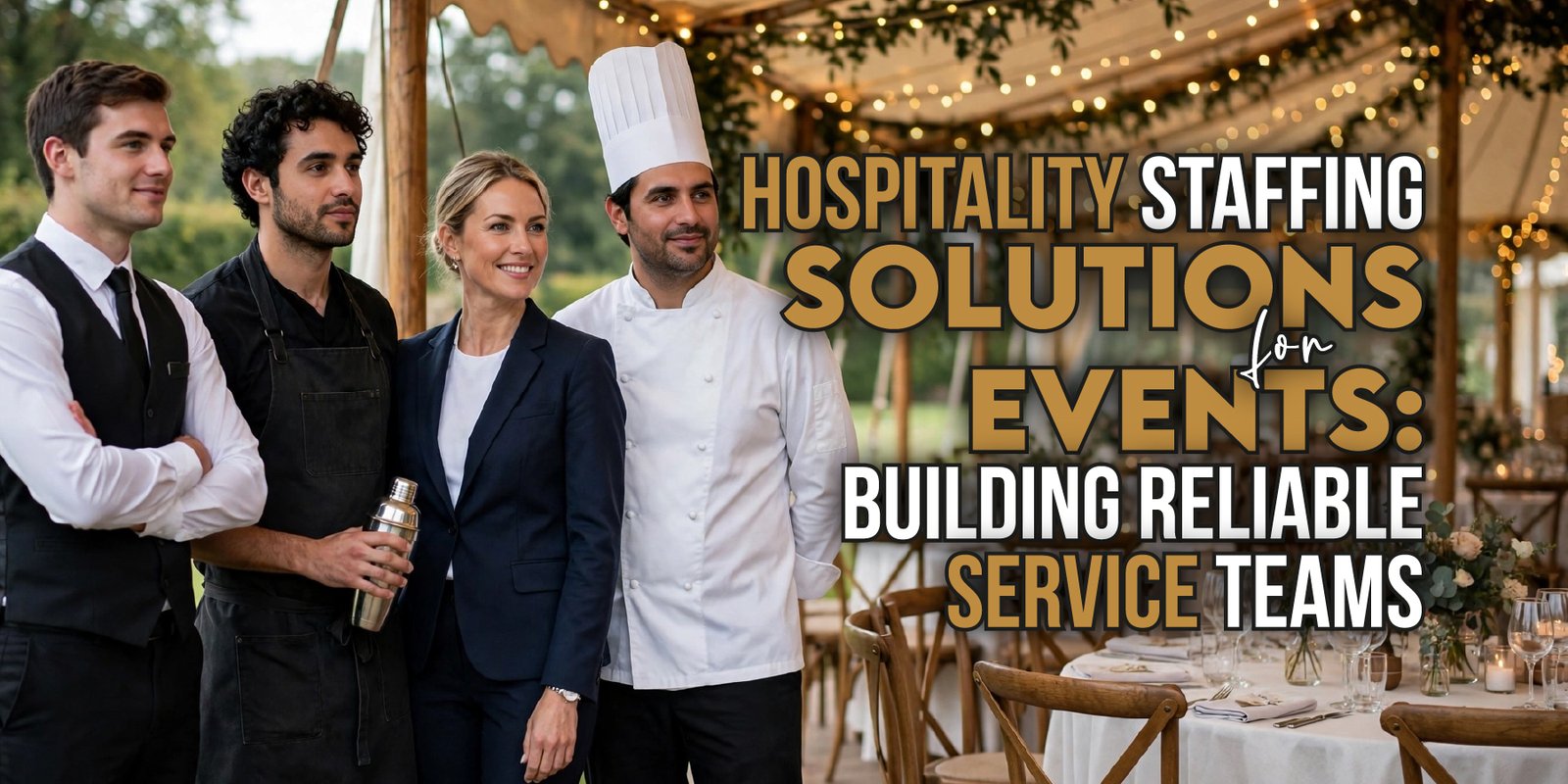
A hotel can move from manageable occupancy to a demanding check-out morning very quickly. Several room attendants may be absent, a conference group may arrive together, or a weekend function may add pressure to food, beverage and guest-service teams.
Hospitality Staffing Solutions give hotels, venues and event operators another way to increase workforce capacity when permanent teams cannot cover every operational requirement.
However, additional people only help when they match the role, shift, location and service expectations. Therefore, employers need more than available candidates. They need a clear staffing plan.
This guide explains how hospitality employers can plan flexible cover, brief an agency properly and choose staffing support that reflects the way their operation actually works.
What Are Hospitality Staffing Solutions?
Hospitality Staffing Solutions help hotels, restaurants, venues, events and similar employers source suitable personnel for temporary, flexible or longer-term requirements. They can support absence, high occupancy, seasonal demand, functions, recruitment gaps and changing workloads by matching staffing requirements with appropriate roles, shifts, experience and availability.
The exact staffing model depends on the employer’s requirement.
For example, a hotel may need additional room attendants for several high-occupancy days. A wedding venue may instead require waiting personnel for one evening, while another business could need temporary reception cover during annual leave.
Therefore, the starting point should always be the operational gap.
What Does a Hospitality Staff Agency Do?
A hospitality staff agency helps employers source and coordinate people for hospitality roles according to the workplace, duties, schedule and staffing model required.
Effective support can include:
- Understanding the staffing brief
- Identifying suitable roles
- Candidate sourcing
- Candidate screening
- Checking relevant experience
- Confirming availability
- Matching people to shifts
- Considering travel practicality
- Communicating assignment details
- Supporting rota requirements
- Coordinating staffing changes
- Discussing replacement requirements where necessary
However, simply sending whoever is available is not the same as effective hospitality recruitment.
A 7:00 am housekeeping shift, for example, creates different practical requirements from an evening banqueting assignment. Likewise, a guest-facing receptionist needs a different profile from someone supporting room turnaround.
Consequently, a hospitality staff agency should understand both the job title and the working environment.
When Should Employers Use Hospitality Staffing Solutions?
Businesses commonly consider Hospitality Staffing Solutions when staffing demand changes faster than permanent headcount.
High Hotel Occupancy
Higher occupancy can increase pressure across several departments simultaneously.
Housekeeping teams may have more rooms to service. Meanwhile, reception can face larger check-in and check-out periods, and food-and-beverage operations may experience stronger breakfast or restaurant demand.
Flexible staffing can help add capacity around those peaks.
Employee Absence
Sickness and annual leave can leave gaps even when the normal rota looks sufficient.
For example, losing one room attendant during a quiet weekday may be manageable. However, the same absence on a high check-out morning can affect room turnaround much more significantly.
Therefore, the staffing decision should consider workload as well as headcount.
Seasonal Demand
Hospitality demand can fluctuate around:
- Christmas
- Summer travel
- Bank holidays
- School holidays
- Tourism periods
- Wedding seasons
- Conference calendars
- Major local events
Planning seasonal hospitality staff in advance gives employers more options than treating predictable demand as an emergency.
Conferences and Corporate Events
A conference can change the workload across reception, food service, banqueting and guest-support functions.
Furthermore, large groups may arrive, take breaks and dine at similar times.
Employers should therefore plan around the event timetable rather than using one general staffing figure for the whole day.
Weddings and Banquets
A wedding or private function may create demand for waiting staff and service personnel for a defined period.
In this situation, Hospitality Staffing Solutions can support a temporary increase without requiring the same headcount throughout the rest of the week.
Recruitment Gaps
A permanent employee may leave before a replacement starts.
Temporary hospitality staff can sometimes provide interim operational cover while the permanent recruitment process continues.
New Openings or Contracts
A new hospitality contract, venue opening or service expansion can create uncertainty around the final workforce requirement.
Flexible cover may provide additional capacity while managers assess longer-term staffing needs.
Busy Weekends
Restaurants, hotels and venues often experience concentrated demand on particular days.
Consequently, employers may choose flexible hospitality staffing rather than maintaining peak-level staffing during quieter periods.
Hotel Staffing: Which Roles May Need Flexible Cover?
Hotel staffing is rarely one single requirement because each department works differently.
A useful staffing plan should therefore begin by identifying where pressure will occur.
Housekeeping
Housekeeping demand depends heavily on occupancy, check-outs, stayovers, room standards and turnaround requirements.
Relevant roles may include:
- Housekeepers
- Room attendants
- Cleaners
- Linen-related support where required
Consider a 200-room hotel as a simple example. The hotel will not necessarily require the same housekeeping capacity every day.
One morning might involve a high number of departures and incoming guests. Another could involve more stayover rooms and fewer turnovers.
Therefore, managers should consider expected workload rather than simply repeating yesterday’s headcount.
Before requesting housekeeping support, provide:
- Expected room workload
- Shift start time
- Expected finish time
- Department standards
- Required experience
- Reporting arrangements
- Site-specific procedures
That information gives a staffing provider much more context than a request for “five cleaners”.
Front of House
Front-of-house staffing influences the guest experience immediately.
Relevant roles may include:
- Receptionists
- Guest-service personnel
- Porters
- Front-of-house staff
Demand can rise around:
- Group check-ins
- Conference arrivals
- Large check-outs
- Special events
- Busy weekends
- Late arrivals
A conference group arriving within a 30-minute window, for example, can put significantly more pressure on reception than the same number of guests arriving gradually.
Consequently, hotel staffing plans should consider when workload occurs, not only total guest numbers.
Food and Beverage
Food-and-beverage requirements can change throughout the same day.
Relevant roles may include:
- Waiters
- Waiting staff
- Service personnel
- Banqueting support where appropriate
Breakfast may require one staffing profile, while an evening wedding function creates another.
Therefore, managers should brief the staffing provider on:
- Type of service
- Guest numbers
- Shift times
- Function schedule
- Expected duties
- Dress requirements
- Service standards
- Supervisor details
Detailed information improves the chance of suitable matching.
How Does Hotel Staffing Work During Occupancy Peaks?
Effective hotel staffing starts with workload forecasting.
Managers can review:
- Occupancy percentage
- Expected check-outs
- Expected arrivals
- Stayover rooms
- Group bookings
- Events and conferences
- Restaurant bookings
- Known absence
- Permanent-team availability
Then, managers can identify where extra capacity is actually required.
For example, high occupancy does not automatically mean every department needs the same increase.
A heavy departure day may create stronger housekeeping pressure, while a conference arrival could affect reception, guest service and food-and-beverage operations more heavily.
Good hospitality workforce planning therefore connects staffing numbers to operational activity.
When Do Venues Need Event Staff Cover?
Event staff cover can help venues manage temporary demand created by weddings, conferences, exhibitions, corporate functions, private events and other scheduled hospitality activity.
However, venue managers should calculate requirements around the real event plan.
Before contacting an agency, confirm:
- Event date
- Guest numbers
- Roles required
- Number of personnel
- Staff arrival time
- Guest arrival time
- Expected finish time
- Duties
- Dress code
- Service style
- Break arrangements
- Supervisor
- Reporting point
- Venue access
- Transport after late finishes
For example, an afternoon corporate reception creates different staffing demands from an all-day conference followed by dinner.
Likewise, a wedding with table service may require different experience from a standing drinks reception.
Therefore, event staff cover works best when the venue gives the agency a detailed schedule rather than a general request for event personnel.
When Are Temporary Hospitality Staff Useful?
Temporary hospitality staff are particularly useful when the workforce requirement has a clear short-term or fluctuating reason.
Common examples include:
- Sickness cover
- Annual leave
- Busy weekends
- High occupancy
- Conferences
- Weddings
- Private functions
- Seasonal demand
- Recruitment gaps
- Short-term vacancies
- Large booking periods
The main advantage is additional workforce flexibility.
However, temporary personnel may need site briefing, supervision and time to understand property-specific procedures.
For that reason, temporary staffing should supplement good workforce planning rather than compensate indefinitely for unclear processes.
When should a hotel use temporary hospitality staff?
A hotel may use temporary hospitality staff when occupancy, absence, conferences, events or recruitment gaps create a short-term requirement beyond the permanent team’s capacity. Employers should define the department, duties, shift times, location, required experience and expected assignment length before requesting additional personnel.
What Are the Benefits of Flexible Hospitality Staffing?
Flexible Hospitality Staffing Solutions can help employers align workforce capacity more closely with actual demand.
Matching staffing with workload
Hotels and venues do not experience identical demand every day.
Therefore, flexible staffing can increase resources during busy periods without requiring peak headcount throughout every quieter shift.
Covering predictable peaks
Known weddings, conferences, seasonal periods and busy weekends can be planned in advance.
This allows staffing support to become part of the operating plan rather than a last-minute reaction.
Supporting operational continuity
An absent employee can put pressure on colleagues, particularly in departments with workload-linked staffing requirements.
Additional cover may help protect planned service levels.
Supplementing permanent teams
Agency personnel do not have to replace permanent employees.
Instead, they can add capacity around the permanent workforce when demand temporarily rises.
Supporting recruitment gaps
If a permanent vacancy remains open, temporary cover may provide an interim option.
Meanwhile, management can continue the permanent recruitment process without leaving every shift short.
What Makes Hospitality Staffing Work Well?
Strong Hospitality Staffing Solutions depend on a clear exchange of information between the employer, staffing provider and personnel arriving on site.
Accurate duties
Avoid vague titles wherever possible.
Two “hotel assistant” positions might involve completely different tasks.
Instead, define the actual duties.
Exact shift times
Give real start and finish times.
A worker who can start at 9:00 am is not necessarily suitable for a 6:30 am assignment.
Site location
Provide the full hotel or venue location.
Travel practicality becomes particularly important around Heathrow, early starts and late finishes.
Department
Tell the agency whether the assignment is in housekeeping, reception, food and beverage, banqueting or another department.
Dress requirements
Guest-facing hospitality environments often have specific presentation expectations.
Therefore, communicate dress requirements before the assignment.
Experience requirements
Decide which experience is essential rather than simply desirable.
For example, a busy guest-facing role may require previous customer-service experience.
Reporting arrangements
Every temporary worker should know who to report to on arrival.
Clear accountability reduces confusion during the first part of the shift.
Site standards and induction
Temporary personnel still need to understand relevant health-and-safety requirements, workplace rules and site procedures.
Employers remain responsible for agency workers’ health and safety while they work at the hirer’s site. Current UK guidance also provides agency workers with certain rights from the first day of an assignment and additional equal-treatment rights after the qualifying period where applicable.
Employers should check current GOV.UK guidance or seek professional advice when applying employment rules to a particular staffing arrangement.
What Information Should You Give a Hospitality Staff Agency?
A detailed staffing brief makes Hospitality Staffing Solutions more effective.
H&D Recruitment’s current enquiry process asks businesses for information including the service needed, timing, site or postcode, staff numbers, type of site and shift pattern.
Employers can build on that information with the following:
| Information | Why It Matters |
|---|---|
| Role required | Helps identify relevant experience |
| Number of staff | Defines the capacity required |
| Hotel or venue | Gives operational context |
| Full location | Helps assess travel practicality |
| Shift date | Establishes availability |
| Start and finish time | Prevents shift-matching problems |
| Department | Clarifies where the person will work |
| Expected duties | Improves candidate suitability |
| Required experience | Helps target appropriate profiles |
| Dress code | Allows personnel to arrive prepared |
| Assignment duration | Sets expectations |
| Reporting manager | Gives a clear point of contact |
| Arrival instructions | Reduces first-shift confusion |
| Break arrangements | Supports accurate shift briefing |
| Site induction | Helps workers understand procedures |
| Special requirements | Identifies anything unusual before arrival |
What information does a hospitality staffing agency need?
At minimum, provide:
- Role
- Headcount
- Location
- Date
- Shift start and finish
- Department
- Main duties
- Required experience
- Assignment duration
- Reporting contact
Additional information about dress, transport, breaks and site procedures can improve the assignment brief further.
Hospitality Staffing Solutions Checklist for Employers
Use this checklist when comparing staffing providers.
| What to Check | Why It Matters | Question to Ask |
|---|---|---|
| Hospitality experience | Hotels and venues have specific service requirements | Which hospitality environments do you regularly support? |
| Department understanding | Housekeeping differs from reception or service | How do you match candidates to different departments? |
| Candidate screening | Availability alone does not prove suitability | What do you check before recommending someone? |
| Relevant experience | Some assignments require previous hospitality exposure | How do you assess role experience? |
| Availability process | Hospitality rotas often include weekends and evenings | How do you confirm exact shift availability? |
| Travel practicality | Early starts and late finishes can create problems | Do you consider travel before confirming staff? |
| Short-notice process | Urgent gaps need realistic expectations | How do you handle short-notice requirements? |
| Replacement process | Availability can change | What happens if an assigned person becomes unavailable? |
| Communication | Rotas and requirements can change | Who manages our day-to-day staffing request? |
| Local knowledge | Location affects candidate suitability | How familiar are you with our area and shift patterns? |
| Compliance | Employer and agency responsibilities must be clear | Which checks do you carry out? |
| Commercial terms | Employers need predictable expectations | What rates, notice and other terms apply? |
How Do You Choose a Reliable Hospitality Staff Agency?
Choose a hospitality staff agency by assessing its hospitality experience, understanding of individual departments, candidate screening, shift matching, communication, location knowledge and commercial terms. A reliable provider should ask detailed questions about duties, service expectations, working hours and workplace location before discussing suitable staffing options.
1. Test sector knowledge
Do not simply ask whether the agency “does hospitality”.
Instead, ask how it approaches housekeeping, reception, food service or events differently.
2. Discuss individual departments
A provider should understand that room attendants and front-of-house personnel solve different operational problems.
Therefore, department-level understanding matters.
3. Ask about screening
Find out what the agency assesses before suggesting personnel.
Relevant factors may include experience, availability, role suitability and travel practicality.
4. Review communication
Establish who manages the account and what happens when a rota changes.
Hospitality schedules can move quickly, so communication routes should be clear.
5. Check shift matching
Ask how the provider confirms exact availability.
Someone who says they are “available weekends” may still be unable to work your particular hours.
6. Assess local knowledge
A staffing provider should consider whether the candidate can realistically reach the workplace.
This becomes particularly relevant for Heathrow-area hotels and venues operating outside standard office hours.
7. Understand replacement processes
Ask what happens if an assigned person becomes unavailable.
However, avoid treating replacement support as a guarantee that every role can always be filled immediately.
8. Provide a proper brief
Good matching depends partly on employer information.
Therefore, agencies that ask detailed operational questions may give employers a stronger basis for assessing suitability.
9. Review candidate suitability rather than quantity
A large candidate database sounds impressive, but the employer needs people who fit the actual assignment.
Quality of matching matters more than headline database size.
10. Read commercial terms
Understand charges, notice expectations, cancellation arrangements and any relevant contractual conditions before work begins.
Hospitality Staffing Solutions vs Permanent Recruitment
Hospitality Staffing Solutions and permanent recruitment solve different workforce problems.
| Requirement | Flexible / Temporary Staffing | Permanent Recruitment |
|---|---|---|
| Busy weekend | Strong fit | Usually not required alone |
| Staff sickness | Strong fit | Usually unnecessary |
| Seasonal peak | Strong fit | Depends on recurring need |
| Wedding or conference | Strong fit | Usually unnecessary for the event alone |
| Permanent vacancy | Useful interim support | Often appropriate |
| Long-term core role | May provide temporary cover | Often appropriate |
| Hotel expansion | Adds flexible capacity | Supports long-term growth |
| Annual leave | Strong fit | Usually unnecessary |
| Uncertain new demand | Provides flexibility | Appropriate once need becomes stable |
Temporary cover should not automatically replace permanent recruitment.
Likewise, permanent recruitment may be inefficient for a workforce increase that only lasts several days.
Employers should choose the staffing model according to the duration and predictability of demand.
What Are the Limitations of Temporary Hospitality Staffing?
Balanced workforce planning also means understanding what temporary staffing cannot solve automatically.
Site familiarity
A new person will not know every hotel layout, system or routine immediately.
Therefore, management should provide clear instructions.
Service standards
Different hospitality businesses have different expectations.
A worker who performed well in one venue may still need guidance on another organisation’s service style.
Training requirements
Roles requiring substantial property-specific training may deliver less short-term benefit on very brief assignments.
Customer-service expectations
Guest-facing personnel need clear information about expected communication and presentation standards.
Supervision
Temporary status does not remove the need for appropriate management.
A supervisor should remain available to answer questions and address operational issues.
Travel constraints
Late finishes and early starts may limit the practical candidate pool.
Last-minute availability
A staffing agency cannot create suitable candidates simply because the request is urgent.
Therefore, employers should give as much notice as practical, especially for specialist roles or difficult shift patterns.
Hospitality Staffing Solutions in Hounslow and West London
H&D Recruitment operates from 4 Bell Parade, Bell Rd, Hounslow TW3 3NU, and its current website positions the company across hospitality, warehouse, security and other recruitment sectors.
For Hospitality Staffing Solutions in Hounslow and West London, location can affect candidate suitability almost as much as experience.
Early hotel shifts
Housekeeping, breakfast and operational support can begin early.
Therefore, employers should consider whether public transport allows candidates to reach the property before the shift.
Late finishes
Events, banquets and evening service may finish after normal commuting hours.
Providing realistic finish times helps the agency assess travel before assigning personnel.
Heathrow-area hospitality
Hounslow’s proximity to Heathrow creates a relevant local context for hotels and other shift-based hospitality businesses.
However, employers should not assume that “West London” automatically means every candidate can reach every property easily.
Exact location still matters.
Weekend travel
Transport frequency can differ at weekends, while hospitality demand may increase.
Consequently, shift planning should consider the day as well as the time.
For example, an experienced room attendant may appear suitable for an early Heathrow-area shift. Yet if public transport does not allow arrival before the required start time, experience alone does not solve the staffing problem.
A better staffing brief includes the postcode, start time and finish time from the beginning.
How H&D Recruitment Supports Hospitality Employers
H&D Recruitment is a Hounslow-based recruitment agency with hospitality recruitment alongside its wider staffing services.
The company’s current job content includes hospitality positions such as waiters and waitresses, luggage porters and chef roles, while other H&D hospitality content references housekeepers, room attendants, cleaners, reception staff and front-of-house roles.
H&D’s hospitality content covers settings including hotels, restaurants, venues and events. Its existing material also focuses separately on brand fit and on the role of a hospitality staffing agency, so this guide concentrates more broadly on workforce planning and employer decision-making.
Employers with several operational workforce requirements can also explore H&D Recruitment’s warehouse staffing services or industrial recruitment support where those services are relevant to another part of their organisation.
For hospitality requirements, employers can discuss their hospitality staffing requirements and provide the role, headcount, location and shift details.
How Can Hotels and Venues Improve Staffing Reliability?
Hospitality Staffing Solutions work best when employers treat external personnel as part of a planned operation rather than an emergency resource with no context.
Forecast demand
Review:
- Occupancy
- Check-outs
- Arrivals
- Event calendars
- Conference bookings
- Restaurant reservations
- Known annual leave
- Expected absence
- Permanent vacancies
Forecasting does not eliminate staffing gaps, but it helps identify predictable pressure.
Separate roles clearly
Do not request five generic hospitality personnel when the actual requirement is three room attendants and two waiting staff.
Specificity improves matching.
Send rotas early
If managers already know next weekend’s staffing requirement, sharing it sooner gives the agency more opportunity to check suitable availability.
Prepare first-shift instructions
Personnel should know:
- Where to report
- Who to ask for
- What to wear
- What time to arrive
- Which department they are supporting
Give useful feedback
“Not suitable” is difficult for an agency to act on.
Instead, explain whether the issue related to punctuality, experience, service standards, communication or role understanding.
Specific feedback can improve future matching.
Why Do Hospitality Employers Use Staffing Solutions?
Hotels, venues and event operators use Hospitality Staffing Solutions because hospitality workload does not always remain constant.
Occupancy changes. Events occur on fixed dates. Employees take annual leave. People become ill. Meanwhile, permanent vacancies may remain open while operations continue.
External staffing support can add capacity around those pressures.
However, reliable staffing does not come from simply requesting more people.
The strongest process connects four things:
- A clear operational forecast
- A detailed employer brief
- Suitable candidate matching
- Good on-site communication
When those elements work together, flexible staffing can support the permanent workforce rather than creating another management problem.
Hospitality Opportunities for Candidates
H&D Recruitment also supports candidates looking for roles across hospitality and other sectors. Its current jobs content includes hospitality opportunities across hotel and service environments.
Candidates looking for suitable assignments can explore hospitality job opportunities and review current vacancies and requirements before applying.
The main purpose of this guide, however, remains helping hospitality employers plan workforce capacity more effectively.
FAQ Section
1. What are Hospitality Staffing Solutions?
Hospitality Staffing Solutions help hotels, venues, restaurants and event businesses source suitable people for temporary, flexible or longer-term staffing needs. Employers may use them for absence, high occupancy, seasonal peaks, events, recruitment gaps and other workload changes that require additional workforce capacity.
2. What does a hospitality staff agency do?
A hospitality staff agency helps employers define staffing requirements, source candidates, assess relevant experience, check availability and coordinate shifts. Effective agencies should also consider workplace location, duties and department requirements rather than simply supplying whoever is available.
3. Which roles can a hotel staffing agency help recruit?
Depending on the agency’s coverage, hotel staffing can include roles such as housekeepers, room attendants, cleaners, receptionists, porters, waiting staff and other front-of-house or service personnel. Employers should confirm the roles a particular agency actually supports before agreeing to work together.
4. When are temporary hospitality staff useful?
Temporary hospitality staff can help during sickness, annual leave, busy weekends, high occupancy, conferences, weddings, seasonal demand and permanent recruitment gaps. They work best when employers provide accurate duties, shift times, site details and expectations before the assignment starts.
5. What is event staff cover?
Event staff cover means bringing in additional personnel for a defined hospitality event or function. Requirements may arise around weddings, conferences, exhibitions, corporate functions or private events. Venues should provide accurate guest numbers, duties, shift times, dress requirements and reporting arrangements before requesting support.
6. How should hotels plan staffing for high occupancy?
Hotels should review expected departures, arrivals, stayovers, events, restaurant demand and permanent-team availability. Then, managers can identify which departments face the greatest workload. For example, a high departure day may create stronger housekeeping demand than a day with similar occupancy but fewer room turnovers.
7. What information should employers give a hospitality agency?
Provide the role, headcount, hotel or venue location, date, start and finish time, department, expected duties, experience requirements, assignment duration and reporting contact. Additionally, tell the agency about dress expectations, access instructions, transport considerations and site-specific requirements where relevant.
8. How do you choose a reliable hospitality staffing agency?
Compare agencies based on hospitality experience, department knowledge, candidate screening, shift matching, communication, travel awareness, replacement processes and commercial terms. Furthermore, assess the questions the agency asks. A provider that understands the operational brief has a stronger foundation for candidate matching.
9. Does H&D Recruitment provide hospitality staffing in Hounslow?
H&D Recruitment is based in Hounslow and currently promotes hospitality recruitment alongside security, warehouse and other staffing services. Its website references roles including housekeepers, room attendants, waiters, cleaners, receptionists and porters across hospitality environments.
10. Can hospitality agencies provide last-minute shift cover?
A staffing agency may be able to help with short-notice requirements when suitable candidates are available. However, employers should not assume every shift can always be covered. Availability depends on the role, location, hours, notice period, experience requirements and current candidate supply.
Planning Hospitality Staffing for an Upcoming Shift or Event?
Effective Hospitality Staffing Solutions start with a clear brief.
H&D Recruitment operates from Hounslow and supports hospitality employers with recruitment requirements across relevant hotel, venue and service roles.
Before making an enquiry, prepare:
- Role required
- Number of people
- Hotel or venue location
- Shift date
- Start time
- Finish time
- Department
- Main duties
- Required experience
- Assignment duration
- Dress requirements
- Important site instructions
Providing this information helps the staffing conversation begin with the actual operational requirement.
Employers can request a hospitality staffing quote from H&D Recruitment for upcoming workforce requirements.