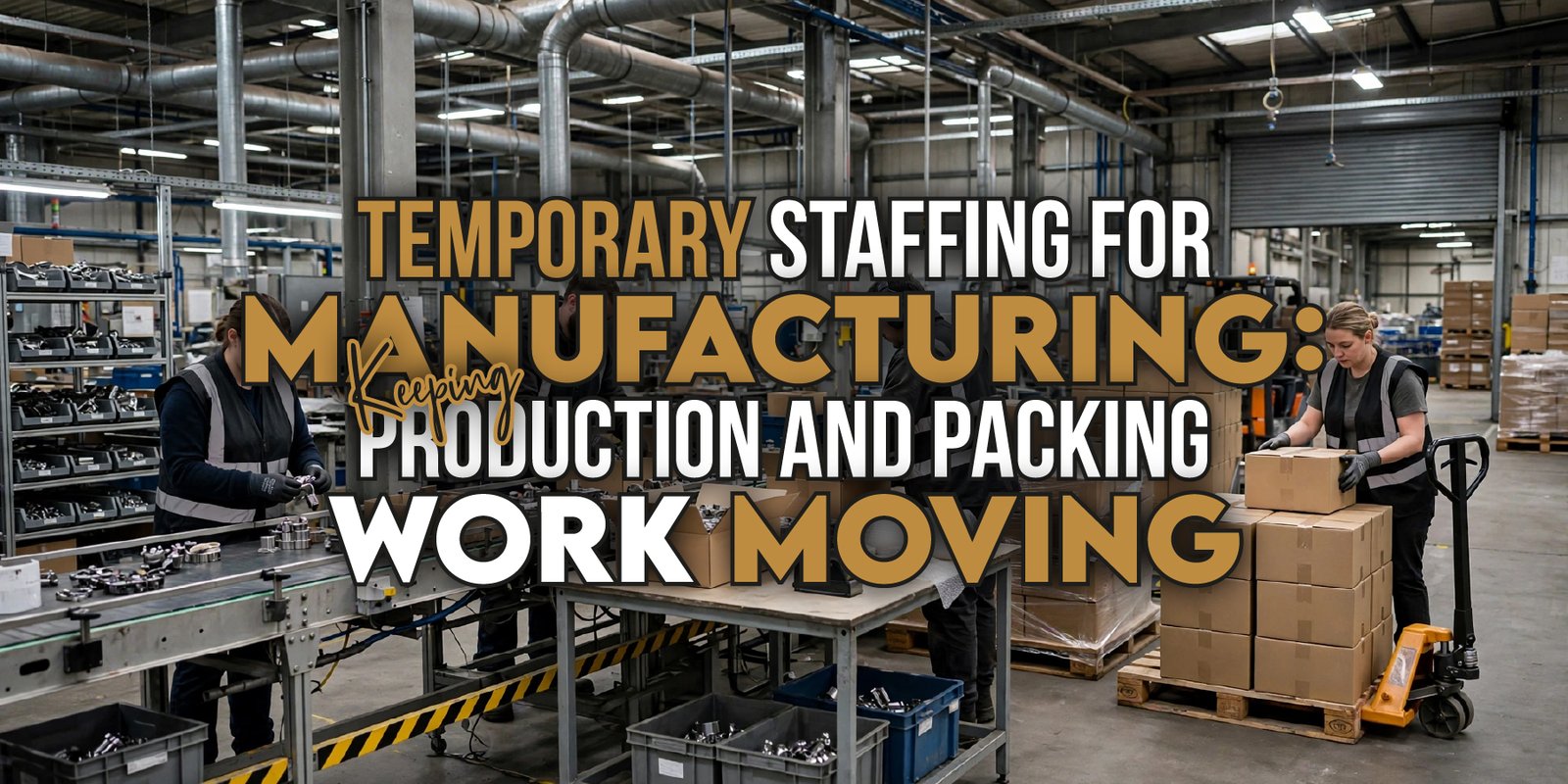
Warehouse demand rarely remains completely consistent. Order volumes can increase during seasonal peaks, promotional campaigns, new contracts or unexpected periods of high demand, while employee absence and changing shift requirements can create additional operational pressure.
For these situations, temporary staffing gives warehouse managers a way to plan additional personnel around a defined or changing requirement. However, effective staffing starts before candidates arrive. Businesses first need to understand where demand exists, which warehouse roles require support, what shifts need covering and how long the requirement may continue.
This guide explains how temporary staffing can support picking, packing, dispatch and wider warehouse operations, while helping employers prepare clearer staffing requirements before approaching a recruitment provider.
What Is Temporary Staffing for Warehouses?
Temporary staffing allows a warehouse to bring in personnel for a defined period or changing operational requirement, subject to candidate availability, role requirements and agreed arrangements. It can support businesses when workload rises temporarily or when existing teams need additional personnel for particular warehouse functions, shifts or operational periods.
Unlike permanent recruitment, temporary staffing generally focuses on a specific operational need rather than an ongoing position. For example, a warehouse may need additional operatives for several weeks during a seasonal peak, for particular shifts after a new contract begins or while permanent employees are absent.
In practice, the value of temporary staffing depends on how clearly the employer defines the requirement. Managers should identify the work that needs completing, the number of personnel required, the shifts involved and the expected duration.
Additionally, warehouses should distinguish between general operative requirements and roles needing particular experience, equipment knowledge or site-specific training.
When Should a Warehouse Consider Temporary Staffing?
A warehouse may consider temporary staffing when operational demand increases for a limited or uncertain period. Typical situations include seasonal peaks, unexpected order growth, staff absence, promotional campaigns, new contracts, short-term projects, warehouse expansion or temporary changes to operating hours and shift structures.
For seasonal demand, temporary staffing can help managers align additional personnel with periods when picking, packing and goods-out activity increases. However, employers should estimate the likely duration before requesting support.
Similarly, a sudden increase in customer orders may create pressure across several warehouse functions rather than one department alone. Picking demand can rise first, followed by packing, labelling, order checking and dispatch preparation.
New contracts can also affect staffing requirements. Therefore, warehouse managers should consider expected volumes, start dates, operating hours and the complexity of the work before deciding how much temporary staffing they need.
Employee absence is another common reason to review short-term personnel requirements. If several team members are unavailable, managers should determine which operational duties require cover rather than simply replacing headcount without considering workload.
For short-term projects, promotional campaigns or warehouse changes, temporary staffing may also provide a way to add personnel around a defined workload without treating every short-term requirement as permanent recruitment.
Warehouse Agency Staff for Picking Operations
Picking can become one of the first pressure points when order volumes increase. Additional warehouse agency staff may support activities such as order picking, item location, stock movement, batch picking, preparation for packing and order consolidation.
However, temporary staffing for picking should begin with a clear description of the work. Different warehouses use different picking methods, layouts, systems and equipment. Therefore, employers should not assume that every available candidate will automatically match every picking environment.
Before requesting personnel, managers should confirm:
- the items being handled
- the picking method used
- shift start and finish times
- expected working pattern
- whether equipment forms part of the role
- relevant experience requirements
- site-specific training requirements
- warehouse environment and working conditions
- reporting arrangements
- supervision on site
For example, a small fulfilment warehouse may require different capabilities from a large distribution centre using scanners, pallet-handling equipment or specialist stock processes.
Clear information also helps a recruitment provider understand whether a role requires general warehouse operatives or candidates with more specific experience. Businesses reviewing their broader requirements can explore H&D Services’ warehouse staffing agency support for warehouse recruitment and staffing requirements.
Ultimately, effective temporary staffing for picking depends on matching the operational requirement with suitable personnel rather than simply adding numbers to a shift.
Temporary Warehouse Workers for Packing Demand
Packing demand often increases directly after picking volumes rise. Temporary warehouse workers may support packing orders, preparing parcels, labelling products, checking orders, preparing items for dispatch and maintaining the flow between picking and goods-out operations.
However, responsibilities vary considerably between warehouses. Some packing roles involve straightforward parcel preparation, while others may require product checks, packaging standards, documentation or handling instructions.
Therefore, businesses using temporary staffing should explain exactly what the packing role involves before requesting personnel.
A useful starting point is to confirm the products being handled, packing method, shift structure, operating environment and any relevant equipment or procedural requirements.
Additionally, managers should explain where the packing team sits within the wider workflow. If pickers feed work directly into packing stations, for example, staffing one function without reviewing the other may simply move the operational bottleneck.
In practice, temporary staffing works more effectively when picking, packing and dispatch requirements are considered together rather than as completely separate activities.
Picker Packer Staff: What Should Employers Confirm?
When requesting picker packer staff, employers should provide enough operational detail for the staffing requirement to be understood clearly.
Before the requirement goes live, confirm:
- Picking duties: What products will personnel pick and how does the picking process work?
- Packing duties: Will the role involve wrapping, boxing, labelling, checking or preparing orders?
- Shift patterns: Are shifts fixed, rotating, daytime, evening or overnight?
- Working hours: What are the exact start and finish times?
- Physical requirements: Does the work involve regular movement, standing, lifting or other physical activity?
- Warehouse environment: Is the work carried out in a standard warehouse, fulfilment centre, chilled environment or another setting?
- Equipment: Will personnel use scanners, pallet equipment or other systems?
- Training: What induction or site-specific instruction applies?
- Performance requirements: What expectations and procedures should personnel understand?
- Site procedures: What access, safety and operational rules apply?
- Reporting arrangements: Who supervises the team and handles operational questions?
Because duties vary, temporary staffing should never rely on a vague title such as “warehouse worker” when the actual role includes several distinct responsibilities.
Businesses requiring personnel across picking, packing and wider warehouse functions can also review H&D Services’ warehouse operatives recruitment information when defining operative requirements.
Temporary Staffing for Dispatch and Goods-Out Operations
Temporary staffing can support dispatch and goods-out operations when increased order volumes create additional work around checking, preparation, stock movement, returns or loading-related activities. Employers should define each responsibility clearly because dispatch duties, systems, documentation requirements and equipment can differ significantly between warehouse environments.
Dispatch sits at the end of the fulfilment process, but problems earlier in the workflow can quickly affect goods-out performance. If picking volumes rise, packing teams may receive more orders. Consequently, dispatch preparation may also require additional personnel.
Depending on the warehouse, additional operatives may support:
- preparing orders for dispatch
- checking completed orders
- moving stock into dispatch areas
- preparing goods for loading
- supporting goods-out processes
- sorting or handling returns
- updating or preparing dispatch documentation where relevant
- maintaining movement between packing and dispatch zones
Before requesting temporary staffing, managers should specify which of these activities apply to the role.
Additionally, the employer should clarify whether personnel need specific equipment experience, system knowledge or internal training before carrying out particular duties.
Clear responsibility boundaries are especially important where different teams handle picking, checking, packing, stock movement and loading. Therefore, supervisors should explain who is responsible for each stage before additional personnel start.
Logistics Staffing for Peak Warehouse Demand
Logistics staffing helps businesses plan personnel around changing warehouse and distribution workloads. When order volumes rise, demand may increase across picking, packing, replenishment, goods-in, dispatch, returns and stock movement. Effective planning considers the entire operational flow rather than increasing personnel in only one part of the warehouse.
For peak periods, temporary staffing should reflect actual workload rather than assumptions about headcount.
Warehouse managers can begin by reviewing:
- expected order volume
- expected duration of higher demand
- shift structure
- warehouse operating hours
- existing internal personnel
- role complexity
- picking and packing workload
- dispatch schedules
- goods-in requirements
- stock movement needs
- returns volumes
No single staffing ratio works for every warehouse. For example, two businesses processing similar order numbers may require different personnel levels because product types, picking methods, warehouse layouts and operating systems differ.
Therefore, logistics staffing decisions should reflect the individual operation.
If demand affects several departments, managers should map the order journey from goods-in or stock location through picking, packing and dispatch. As a result, they can identify where temporary staffing is most likely to be required.
How to Plan Temporary Staffing Before Orders Increase
Good temporary staffing planning begins before the warehouse reaches peak pressure. Managers should identify what is changing, translate that change into individual roles and shifts, and provide clear information to the recruitment provider.
1. Identify the demand
First, establish why the workload is changing.
Is the business expecting seasonal orders, launching a promotion, beginning a new contract or dealing with temporary absence?
Next, estimate when the increase will begin and how long it may last. This gives the temporary staffing requirement a clearer operational timeframe.
2. Define the roles
Identify exactly where additional personnel are required.
For instance, the warehouse may need pickers, packers, general warehouse operatives or personnel supporting dispatch and stock movement.
A clear role definition helps avoid confusion once temporary staffing personnel arrive on site.
3. Confirm shifts
Provide the precise start and finish times, required days and working pattern.
Additionally, explain whether shifts remain consistent throughout the assignment or may change as demand develops.
Shift information matters because temporary staffing availability can depend on the specific working pattern and location.
4. Estimate duration
Clarify whether the requirement is expected to last several days, several weeks, throughout a seasonal period or for an uncertain duration.
Although forecasts can change, providing the best available estimate helps recruitment teams understand the requirement.
5. Define site requirements
Confirm the warehouse location, transport or access considerations, site entry procedures, working environment, clothing requirements and any relevant equipment.
Before requesting temporary staffing, employers should also identify whether any role-specific induction or training applies.
6. Confirm supervision
Identify who will manage personnel on site.
A supervisor should explain duties, site expectations, break arrangements, operational processes and reporting structures.
Therefore, clear supervision supports better integration between existing teams and temporary staffing personnel.
7. Review performance requirements
Set practical expectations for quality, accuracy, attendance and role responsibilities.
However, expectations should reflect the actual role and warehouse environment rather than unsupported assumptions about what each person can achieve.
When demand changes, review the temporary staffing requirement again and adjust planning accordingly.
What Information Should Employers Give a Staffing Agency?
Employers should provide a staffing agency with the warehouse location, role title, number of personnel required, start date, expected duration, working days, shift times, duties, experience requirements, equipment requirements and site arrangements. Clear information helps recruitment teams understand the requirement and identify the type of candidates the warehouse needs.
Before requesting temporary staffing, prepare the following information:
- warehouse address and location
- role title
- number of personnel required
- proposed start date
- expected duration
- shift start and finish times
- working days
- picking responsibilities
- packing responsibilities
- dispatch duties
- relevant experience requirements
- equipment requirements
- site access arrangements
- clothing or PPE requirements where applicable
- induction or training information
- primary site contact
- supervisor details
- any important operational instructions
In addition, explain whether the workload may increase or decrease during the assignment.
The clearer the information, the easier it becomes to discuss appropriate temporary staffing arrangements and candidate requirements.
Discuss Your Warehouse Staffing Requirements
Warehouses preparing for higher demand should provide practical information before requesting personnel. That includes the warehouse location, roles required, number of personnel, expected duration, shift structure and the areas of operation experiencing additional workload.
For example, an employer may require temporary staffing primarily for picking during one shift and additional packing or dispatch support during another.
Businesses can discuss your warehouse staffing requirements by outlining the roles, shift patterns, location, operational demand and expected staffing period.
Providing these details early helps create a clearer starting point for discussing staffing support.
Temporary Staffing vs Permanent Warehouse Recruitment
Choosing between temporary staffing and permanent recruitment depends on the nature and duration of the warehouse requirement. Neither model is automatically the better option.
| Factor | Temporary Staffing | Permanent Recruitment |
|---|---|---|
| Typical purpose | Short-term or changing demand | Longer-term staffing requirement |
| Duration | Defined or variable period | Ongoing employment |
| Peak demand | Useful where workload changes | Better suited to stable requirements |
| Flexibility | Depends on available personnel and arrangements | Usually less suited to sudden short-term changes |
| Planning | Focuses on immediate or defined requirements | Focuses on longer-term workforce planning |
For example, temporary staffing may suit a warehouse expecting a seasonal rise in orders for several weeks. By comparison, permanent recruitment may make more sense when the business expects an ongoing position to remain necessary.
However, managers should base the decision on workload forecasts, operational structure and longer-term staffing plans.
Some businesses may also use both approaches at different times. In practice, permanent teams can support the ongoing operation while temporary staffing addresses defined peaks or short-term requirements.
Common Temporary Warehouse Staffing Mistakes
Several planning mistakes can make temporary staffing harder to organise effectively.
- Waiting until demand has already increased.
If managers wait until picking or dispatch is already under pressure, they may have less time to define roles, shifts and candidate requirements properly. - Providing unclear job requirements.
A generic request for warehouse operatives may not explain whether the actual need relates to picking, packing, dispatch or another function. - Failing to confirm shift times.
Exact working hours matter. Therefore, employers should provide start times, finish times and required days before requesting temporary staffing. - Underestimating the duration.
A requirement expected to last several days may continue for several weeks. Managers should provide the most realistic forecast available. - Ignoring travel or site location considerations.
Warehouse location and shift timing can influence candidate suitability and availability. - Not explaining warehouse duties clearly.
Picking, packing, loading preparation and stock movement require different responsibilities. Consequently, employers should describe the actual work involved. - Forgetting equipment requirements.
If a role involves equipment, scanners or specific warehouse systems, include this information in the temporary staffing brief. - Failing to identify site supervision.
New personnel need to know who manages duties, questions and operational instructions. - Comparing only the headline staffing cost.
Employers should also consider role matching, process clarity, communication and whether the proposed staffing arrangement reflects the real requirement. - Not planning for changing order volumes.
If demand continues to rise or falls earlier than expected, managers should review their temporary staffing plan rather than relying on the original forecast indefinitely.
How to Compare Warehouse Staffing Support
Employers comparing warehouse recruitment providers should focus on how well each provider understands the operational requirement.
A useful comparison should consider:
- understanding of warehouse roles
- knowledge of picking, packing and dispatch requirements
- candidate availability
- communication processes
- role matching
- approach to temporary staffing
- ability to understand shift requirements
- operational understanding
- flexibility around changing requirements
- clarity of quotations and arrangements
For example, a provider should understand the difference between requesting general warehouse personnel and asking for candidates who need specific equipment experience.
Additionally, warehouse managers should explain their priorities consistently to each provider. That makes quotations and proposed approaches easier to compare.
Ultimately, the right approach depends on the individual warehouse, required roles, assignment duration and operational conditions.
Temporary Staffing Checklist for Warehouse Managers
Use this checklist before requesting temporary staffing:
☐ Confirm warehouse location
☐ Identify roles required
☐ Confirm number of personnel required
☐ Define picking, packing or dispatch duties
☐ Confirm start date
☐ Estimate duration
☐ Confirm shift times
☐ Confirm working days
☐ Define experience requirements
☐ Identify equipment requirements
☐ Confirm site access
☐ Confirm clothing or PPE requirements where applicable
☐ Confirm supervision
☐ Provide operational instructions
☐ Confirm contact details
☐ Review the requirement as demand changes
Completing these points gives managers a more structured staffing brief. As a result, recruitment discussions can focus on the actual operational requirement rather than trying to establish basic details after the process has already started.
1. What is temporary staffing for warehouses?
Temporary staffing allows warehouses to bring in additional personnel for a defined or changing period of operational demand. It may support picking, packing, dispatch and other warehouse activities during seasonal peaks, employee absence, promotional periods or short-term projects. The employer should first define the roles, shifts, expected duration and relevant candidate requirements.
2. When should a warehouse use temporary staffing?
A warehouse may consider temporary staffing when workload rises temporarily or when existing teams need additional support. Common situations include peak seasons, unexpected order increases, absence cover, new contracts and changes to operating hours. Managers should assess how much work is changing, where pressure will occur and how long the requirement may continue.
3. What are warehouse agency staff?
Warehouse agency staff are personnel supplied through a recruitment or staffing provider for warehouse roles subject to the agreed assignment and candidate suitability. Duties may include picking, packing, stock movement or dispatch support. However, employers should describe the role clearly because skills, equipment requirements and responsibilities differ between warehouse environments.
4. Can temporary warehouse workers support picking and packing?
Yes. Temporary warehouse workers may support picking and packing when those duties match the agreed role and candidate requirements. For example, personnel may pick orders, prepare parcels, label goods or prepare completed orders for dispatch. Before arranging temporary staffing, employers should explain duties, shifts, equipment and any relevant training requirements.
5. What does picker packer staff recruitment involve?
Recruitment for picker packer staff involves identifying the employer’s picking and packing duties, shift pattern, warehouse environment and relevant experience requirements. The staffing provider can then understand what type of candidates the role requires. Clear information about equipment, physical duties, site procedures and expected assignment duration also supports more accurate temporary staffing discussions.
6. What is logistics staffing?
Logistics staffing refers to recruiting personnel for operations connected with warehousing, fulfilment, stock movement, goods-in, picking, packing, dispatch and related functions. During periods of changing order volume, temporary staffing may form part of a wider logistics staffing plan, depending on the roles required, assignment period, shift structure and available candidates.
7. What information should employers provide when requesting temporary warehouse staff?
Employers should provide the warehouse location, number of personnel, role titles, duties, start date, working days, shift times, expected duration and relevant experience or equipment requirements. Additionally, they should explain site access, supervision and operational instructions. This gives the recruitment provider a clearer temporary staffing requirement to discuss.
8. How can a business request warehouse staffing support?
A business should first define its warehouse requirement, including location, roles, personnel numbers, start date, shifts, duration and the picking, packing or dispatch work involved. It can then provide these details to the recruitment provider when requesting temporary staffing, allowing the staffing discussion to focus on the actual operational requirement.
Discuss Your Warehouse Staffing Requirements
Warehouse requirements can change as order volumes, contracts, seasonal demand and operational schedules change. Therefore, businesses considering temporary staffing should first outline the warehouse location, required roles, number of personnel, shift patterns, proposed start dates and expected duration.
Managers should also explain whether support relates primarily to picking, packing, dispatch, stock movement or wider warehouse operations. Furthermore, any relevant experience, equipment or site-specific requirements should form part of the initial brief.
Businesses can request warehouse staffing support and provide details about their operational requirement, working patterns and anticipated staffing period.
A well-defined requirement creates a stronger starting point for discussing temporary staffing and the type of personnel needed for the warehouse operation.