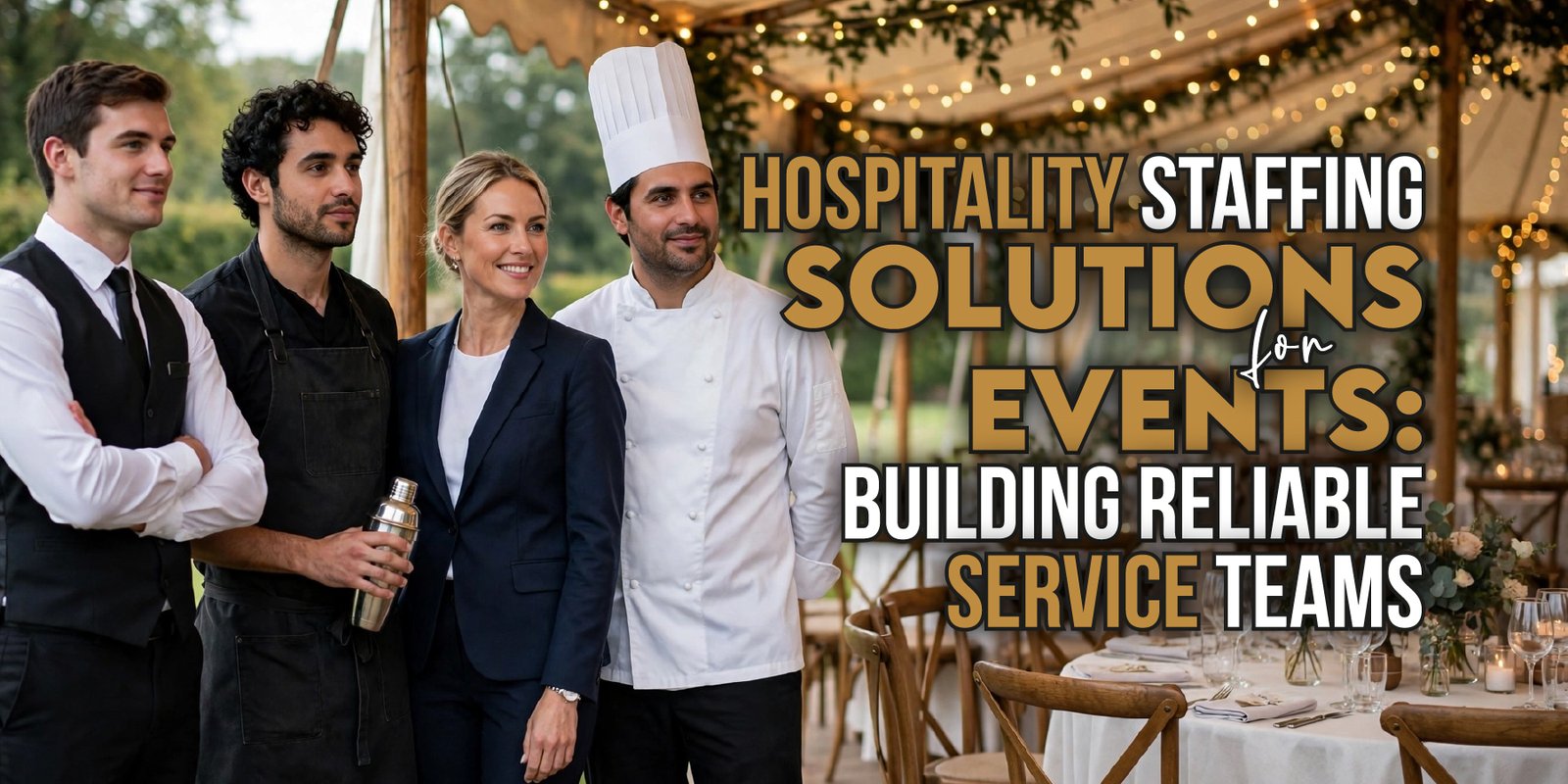
Hotel demand can change quickly. Occupancy, conferences, weddings, restaurant bookings, seasonal peaks and staff absence can all alter staffing requirements within a short period. For that reason, hospitality staffing solutions can help hotels plan additional personnel around changing operational needs across housekeeping, food and beverage and guest-facing operations.
Effective hospitality staffing solutions start with a clear employer brief. Hotel managers should define the department, role, shift, expected duration and level of demand before requesting support. This helps recruitment teams understand the requirement and focus on the type of personnel the hotel actually needs.
What Are Hospitality Staffing Solutions?
Hospitality staffing solutions are recruitment and staffing arrangements that help hotels and hospitality businesses cover defined personnel requirements across housekeeping, room operations, waiting services, food and beverage, front of house and other guest-facing functions. The exact approach depends on the role, shift pattern, expected duration, operational demand and employer requirements.
For hotels, hospitality staffing solutions may support short-term peaks, recurring busy periods or broader recruitment requirements. However, employers should not treat every staffing gap in the same way. A room attendant requirement differs from a waiting staff requirement, while a guest-facing role may call for different experience and communication skills.
In practice, managers should specify what work needs doing, when the shift starts, how long the requirement may last and who will supervise the personnel on site.
Why Do Hotels Use Hospitality Staffing Solutions?
Hotels use hospitality staffing solutions when staffing demand changes faster than their regular team structure can comfortably absorb. Common triggers include higher occupancy, seasonal demand, conferences, weddings, functions, staff absence, restaurant peaks, new contracts and operational expansion.
If occupancy rises, housekeeping demand may increase because more rooms need cleaning and preparation between guest stays. Similarly, a large event can increase food and beverage activity, waiting staff demand and front-of-house workload.
Therefore, hospitality staffing solutions can form part of a wider plan for busy periods. Managers should first review bookings, occupancy forecasts, event schedules and internal availability before deciding where additional support may be needed.
Planning early also makes the request clearer. For example, a hotel expecting a busy weekend can separate room-turnaround requirements from restaurant service and guest-facing support instead of making one general request for hospitality personnel.
Hotel Staff Agency Support for Changing Demand
A hotel staff agency can help employers source and match candidates to defined hospitality roles, although services vary between providers. Employers may reasonably expect a provider to discuss role requirements, shifts, duration, experience needs and operational context before identifying suitable options.
When comparing a hotel staff agency, managers should look at whether the provider understands different departments. Housekeeping, waiting staff, reception support and event service involve different duties and working patterns.
Hospitality staffing solutions also depend on communication. If a requirement changes, the hotel should explain revised shift times, headcount or duration promptly. Meanwhile, the provider needs enough detail to understand what has changed.
A useful starting point is to provide the role title, department, number of people required, working hours, location and responsibilities.
Housekeeping Staff for Rooms and Turnaround Demand
Housekeeping staff may cover room attendant duties, housekeeping support, public-area cleaning, linen-related activity and preparation between guest stays, depending on the requirement.
Hospitality staffing solutions can help hotels plan around periods when occupancy and room turnover increase. However, managers should avoid assuming that room count alone determines personnel needs. Room type, check-out patterns, service standards, shift length and site procedures can all affect workload.
Before requesting housekeeping staff, employers should confirm expected room volumes, shift times, duties, start dates and relevant site instructions. Additionally, they should explain whether the requirement covers guest rooms, public areas, linen support or a combination of tasks.
If occupancy increases sharply, hospitality staffing solutions may help hotels respond to additional room-turnaround pressure. Clear supervision also matters, so housekeeping managers should identify who allocates rooms, answers questions and oversees site procedures.
Waiting Staff for Busy Hotel Service
Waiting staff requirements often change around breakfast, lunch, dinner, conferences, weddings, private events and seasonal functions. Therefore, hotels should connect staffing decisions to expected covers, event schedules and service periods.
Hospitality staffing solutions may support hotels that need additional waiting staff for defined periods. However, employers should explain whether the role involves table service, event service, clearing, food and beverage support or another specified responsibility.
Before requesting waiting staff, managers should provide service times, venue layout, reporting arrangements, experience requirements and expected duration. For instance, a breakfast shift may require a different working pattern from an evening wedding or conference dinner.
In addition, hospitality staffing solutions should reflect how the hotel organises service. If teams cover several function rooms or service areas at different times, include that information in the staffing brief.
Front of House Staff for Hotels
Front of house staff may support reception, concierge functions, event reception and other guest-facing operations, depending on the staffing arrangement. Because these roles involve direct guest interaction, employers should define responsibilities, communication expectations and reporting lines clearly.
Hospitality staffing solutions for front of house should reflect the actual role rather than a broad label. Reception support may involve different systems and responsibilities from event reception or concierge support.
When demand changes, hospitality staffing solutions can help hotels plan additional front of house staff around check-in periods, conferences, functions or temporary operational gaps. Employers should confirm shift times, customer-facing responsibilities, relevant system knowledge and on-site supervision.
Hospitality Staffing Solutions for Peak Occupancy
Hospitality staffing solutions can help hotels respond to higher occupancy by matching additional staffing requirements to the departments experiencing greater workload. Higher occupancy often increases room turnover, while more guests may also increase breakfast, restaurant, reception and front-of-house requirements.
The relationship is straightforward:
- Higher occupancy → more occupied rooms → more room turnover → greater housekeeping demand
- Events → more guests → greater food and beverage activity → increased waiting staff demand
- Busy check-in and check-out periods → more guest-facing activity → increased front of house demand
Therefore, hospitality staffing solutions should be planned by department rather than treated as one hotel-wide number. A hotel may need more housekeeping staff in the morning, additional waiting staff during an evening function and extra guest-facing personnel around arrival periods.
Managers should also review conferences, weddings, restaurant bookings and group arrivals alongside occupancy because these factors can reshape demand even when room occupancy remains similar.
How Hotels Can Plan Staffing Before Demand Increases
Hospitality staffing solutions are easier to organise when hotels plan before demand reaches its peak.
1. Forecast demand
First, review occupancy forecasts, restaurant bookings, conferences, weddings and planned events. Identify the dates and service periods most likely to create pressure.
2. Identify staffing gaps
Next, compare expected demand with the internal team available. Hospitality staffing solutions should target defined gaps rather than adding personnel without a clear operational purpose.
3. Define roles
Specify whether the hotel needs housekeeping staff, waiting staff, front of house staff or another hospitality role.
4. Confirm shifts
Provide exact start and finish times, working days and shift patterns. Because hospitality staffing solutions depend on candidate availability and agreed arrangements, accurate shift details matter.
5. Estimate duration
Clarify whether the requirement covers one event, several days, a seasonal period or a longer-term gap.
6. Explain responsibilities
List the duties expected for each role. For example, a room attendant brief should not simply say “housekeeping” if linen handling or public-area support also forms part of the work.
7. Confirm site requirements
Provide information about uniform expectations, site access, induction and relevant operational procedures.
8. Identify supervision
Finally, explain who will manage the team on site and answer operational questions.
What Should a Hotel Tell a Staffing Provider?
A hotel should give a staffing provider the location, department, role, number of personnel required, start date, expected duration, shift times, working days, duties, experience requirements, uniform expectations where applicable, site instructions and supervisor details. Clear information helps recruitment teams focus on the real staffing requirement.
Before requesting hospitality staffing solutions, prepare:
- hotel location
- department and role title
- number of personnel required
- start date and expected duration
- shift start and finish times
- working days
- core duties
- relevant experience requirements
- uniform requirements where applicable
- site access and induction information
- supervisor and contact details
Additionally, explain known changes in demand. For example, if occupancy is expected to rise over a weekend but fall after a conference, this gives the hospitality staffing solutions requirement useful context.
Discuss Your Hotel Staffing Requirements
Hotels can discuss hospitality staffing solutions by providing practical information about staffing gaps, departments, roles, shift requirements, dates, expected duration and operational demand.
Businesses can discuss your hospitality staffing requirements by outlining the role, location, number of personnel required, working pattern and anticipated staffing period.
A clear brief keeps the discussion focused on real operational needs rather than broad assumptions about hotel staffing.
Temporary vs Longer-Term Hospitality Staffing
Choosing between hospitality staffing solutions for short-term needs and longer-term recruitment depends on the nature of the requirement. Neither approach is automatically better for every hotel.
| Factor | Temporary Staffing | Longer-Term Staffing |
|---|---|---|
| Typical purpose | Short-term or changing demand | Ongoing staffing requirements |
| Duration | Defined or variable period | Longer-term |
| Seasonal demand | Can suit changing requirements | Better suited to stable roles |
| Planning | Focuses on immediate or defined needs | Focuses on longer-term workforce planning |
| Flexibility | Depends on available candidates and arrangements | Depends on role and recruitment requirements |
For example, hospitality staffing solutions may suit a hotel that needs additional personnel around events or a seasonal occupancy increase. By comparison, a consistently vacant permanent position may require a longer-term recruitment approach.
Common Hotel Staffing Challenges
- Sudden increases in occupancy. A late rise in bookings can create extra room-turnaround and guest-service pressure. Hospitality staffing solutions may form part of the response when a clear staffing gap exists.
- Seasonal demand. Holiday periods can change workloads across departments. Therefore, managers should review expected occupancy and service demand early.
- Staff absence. Unexpected absence can leave gaps in housekeeping, food and beverage or guest-facing functions.
- Event-related workload. Conferences, weddings and private functions can generate concentrated demand over short periods.
- Housekeeping pressure. High check-out and check-in volumes can increase room-turnaround requirements.
- Restaurant service peaks. Breakfast, dinner and function periods can place additional pressure on waiting staff.
- Difficulty forecasting requirements. Demand can change after the original rota is prepared, so forecasts should be reviewed regularly.
- Unclear role descriptions. Hospitality staffing solutions work better when employers define duties, hours and experience needs clearly.
- Changing shift requirements. Event times, guest arrivals or operational changes may alter working patterns.
- Last-minute operational changes. Clear internal communication helps hotels update staffing requirements when plans move.
How to Choose Hospitality Staffing Support
Hotels comparing providers should consider hospitality-sector understanding, role knowledge, communication, candidate matching, flexibility, recruitment processes, shift understanding and quotation clarity.
Hospitality staffing solutions should reflect the hotel’s real requirement. Therefore, employers should explain the same duties and shift pattern to each provider when comparing options.
A provider should understand that housekeeping staff, waiting staff and front of house staff have different responsibilities. Similarly, managers should ask how role information, shift details, candidate requirements and changes to the brief are handled.
In practice, hospitality staffing solutions depend partly on the quality of the employer brief. Clear information gives both parties a stronger foundation for discussing support.
Cross-Sector Staffing Support
Some organisations operate across different environments and may also need support outside hospitality. H&D Services provides warehouse staffing support for businesses with warehouse and logistics requirements.
Businesses with operational roles can also review warehouse operatives recruitment. However, hospitality staffing solutions remain distinct because hotel, guest-service and food-and-beverage roles have their own duties and service expectations.
Hospitality Staffing Checklist
Use this checklist before requesting hospitality staffing solutions:
☐ Confirm hotel location
☐ Identify department
☐ Define required roles
☐ Confirm number of personnel required
☐ Confirm start date
☐ Estimate duration
☐ Confirm shift times
☐ Confirm working days
☐ Define responsibilities
☐ Identify experience requirements
☐ Confirm uniform requirements where applicable
☐ Explain site procedures
☐ Confirm supervision
☐ Provide contact details
☐ Review staffing requirements as demand changes
Completing this checklist gives managers a clearer staffing brief. As a result, hospitality staffing solutions discussions can focus on the actual roles, shifts and operational pressures that need attention.
Conclusion
Hospitality staffing solutions can help hotels structure additional personnel requirements around occupancy, room turnover, food and beverage service, events and guest-facing activity. However, useful staffing support starts with clear information from the employer.
Hotel managers should define the department, role, working pattern, expected duration and responsibilities before making a request. When demand changes, reviewing these details helps keep hospitality staffing solutions aligned with current operational needs.
1. What are hospitality staffing solutions?
Hospitality staffing solutions are recruitment and staffing arrangements that help hotels and hospitality businesses address defined personnel requirements. They may cover housekeeping staff, waiting staff, front of house staff and other hospitality roles, depending on the employer’s needs. The exact arrangement depends on duties, shifts, duration, location, candidate requirements and available personnel.
2. When should a hotel use hospitality staffing solutions?
A hotel may use hospitality staffing solutions when occupancy, events, seasonal demand, staff absence or restaurant activity creates a temporary or changing staffing gap. Managers should first identify which department needs support, what duties are involved, how many people are required and how long the requirement is expected to continue.
3. What does a hotel staff agency do?
A hotel staff agency can help employers source and match candidates to defined hospitality roles. Depending on the provider, this may involve discussing job requirements, shifts, experience needs and assignment duration. Hotels should provide clear operational information so the agency understands whether the requirement relates to housekeeping, waiting staff, front of house or another function.
4. How can hotels find housekeeping staff?
Hotels can find housekeeping staff by defining the role clearly and approaching a suitable hospitality recruitment or staffing provider. Before requesting hospitality staffing solutions, managers should confirm room-related duties, expected workload, shift times, start dates, site instructions and relevant experience requirements so the recruitment discussion focuses on the actual housekeeping need.
5. Can staffing providers supply waiting staff?
Staffing providers may supply waiting staff where suitable candidates are available and the provider supports that type of role. Hotels should explain service times, duties, venue layout, experience requirements and reporting arrangements before requesting hospitality staffing solutions. Requirements can differ considerably between breakfast service, restaurants, conferences, weddings and private functions.
6. What are front of house staff?
Front of house staff work in guest-facing areas such as reception support, concierge-related functions, event reception and other visitor-facing operations, depending on the role. When using hospitality staffing solutions, employers should define responsibilities, shift times, communication expectations and any relevant system or experience requirements.
7. How should hotels prepare a staffing request?
Hotels should prepare a staffing request by listing the location, department, role, number of personnel, start date, working days, shifts, duties, expected duration and relevant experience requirements. In addition, managers should include uniform expectations, site procedures and supervisor details. This gives hospitality staffing solutions providers a clearer brief to work from.
8. How can a hotel request hospitality staffing support?
A hotel can request support by outlining its staffing gaps, required roles, number of personnel, shift patterns, start dates, expected duration and operational demand. Providing these details helps the recruitment provider understand the requirement and discuss hospitality staffing solutions that match the hotel’s stated needs and available candidate options.
Discuss Your Hospitality Staffing Requirements
Hotels can use hospitality staffing solutions to address changing requirements across housekeeping, waiting services, front of house and other operational areas. Before requesting support, managers should define the department, staffing gap, number of personnel, shift pattern, start date, expected duration and guest-demand factors affecting the requirement.
Businesses can request hospitality staffing support by providing details about required roles, dates, shifts and anticipated operational demand. This creates a clearer starting point for discussing hospitality staffing solutions that align with the hotel’s stated requirements.