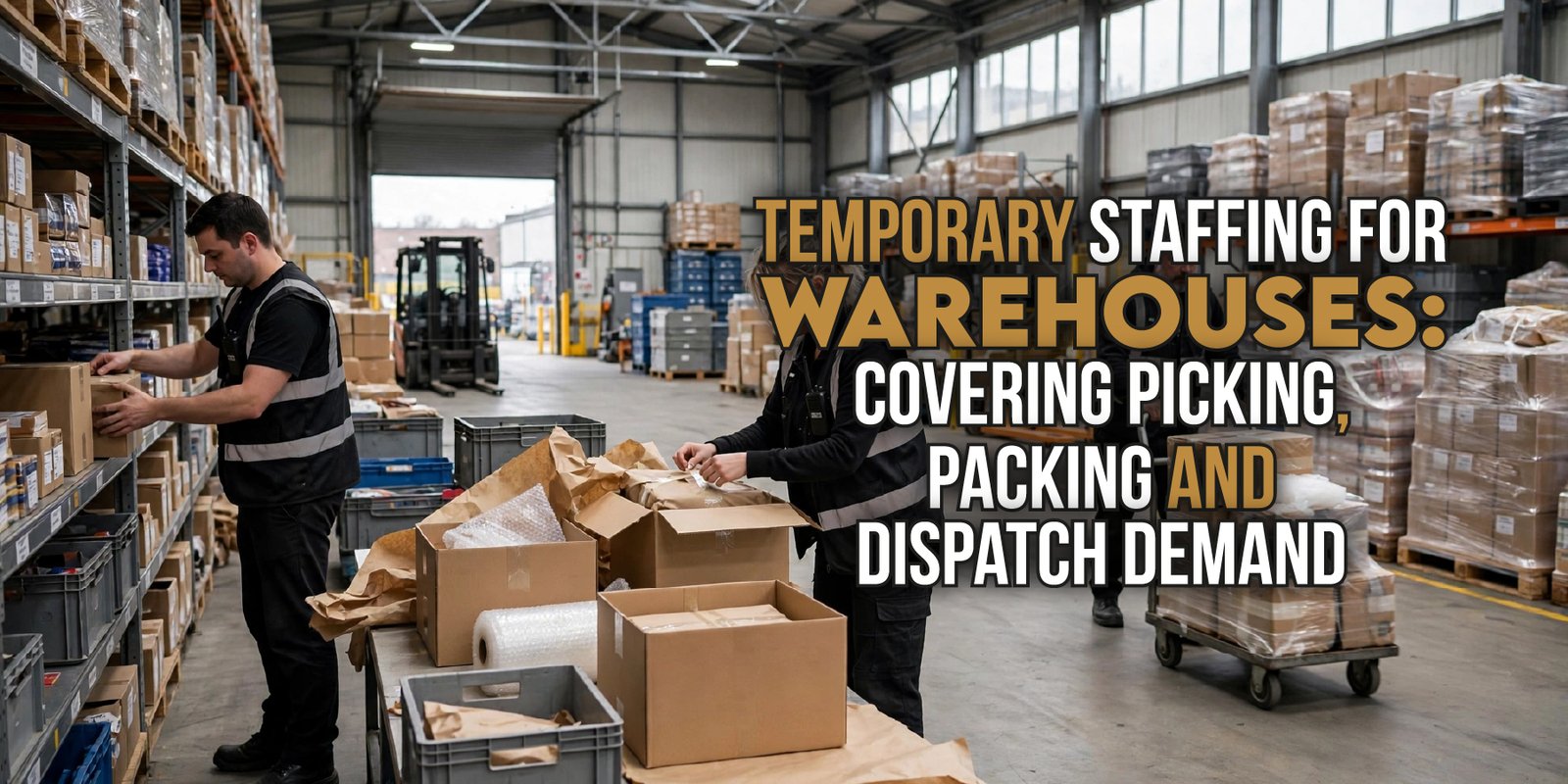
A production line can lose capacity quickly when absence, additional orders or packing demand creates a gap in the rota. Temporary staffing gives manufacturing employers another recruitment option for adding suitable personnel around a defined requirement without automatically treating every production increase as a permanent hiring need.
However, successful temporary staffing starts with much more than requesting a number of “factory workers”. Production managers should define the role, duties, shift, site, duration, equipment requirements and experience needed before recruitment begins.
For manufacturers, the practical question is not simply whether extra people are needed. Instead, it is where pressure exists across production, packing, material handling, quality, warehousing or dispatch, and what type of candidate can realistically support that work.
How Can Temporary Staffing Support Manufacturing?
Temporary staffing can help manufacturers add suitable personnel during production peaks, packing demand, staff absence, additional shifts, seasonal requirements, short projects or new contracts. Its effectiveness depends on clear role definitions, realistic shifts, candidate suitability, site requirements, availability and proper induction rather than simply increasing headcount.
For example, a manufacturer experiencing a short-term order increase may need extra Production Operatives on selected shifts. Another site may have enough production capacity but need additional Packers because finished products are reaching the end of the line faster than the existing packing team can process them.
Therefore, the first step is to identify the operational pressure before choosing a recruitment approach.
What Is Temporary Staffing in Manufacturing?
Temporary staffing in manufacturing means engaging suitable personnel for a defined period, shift pattern, workload peak, absence or operational requirement rather than immediately creating a permanent hire.
The model can apply to production, packing, material handling, warehouse support or other operational functions, depending on the requirement and candidate suitability.
In practice, employers may consider temporary staffing for:
- seasonal production
- large or unexpected orders
- holiday or absence cover
- additional shifts
- short projects
- temporary production-line changes
- new contracts
- packing backlogs
- increased dispatch requirements
Importantly, not every temporary staffing arrangement has identical contractual or employment characteristics. UK government guidance distinguishes temporary agency work from direct permanent or fixed-term employment, so employers should understand the arrangement they are entering rather than assuming every agency model works the same way.
Why Do Manufacturers Use Temporary Staffing?
Manufacturers commonly consider temporary staffing when workforce demand changes faster than permanent headcount requirements.
For instance, a site may face a seasonal increase that lasts several weeks rather than all year. Similarly, a production manager may need short-term cover because employees are absent or because an additional night or weekend shift has been introduced.
Typical reasons include:
- seasonal peaks
- large customer orders
- staff absence
- planned holiday cover
- new production shifts
- weekend production
- night production
- product launches
- short-term projects
- new contracts
- packing pressure
- dispatch deadlines
- temporary capacity increases
However, planned peaks should ideally be identified before they become urgent staffing gaps.
If a manufacturer already knows that a recurring seasonal period increases output, discussing temporary staffing requirements early gives the recruitment process more useful information about dates, roles and shifts.
How Temporary Staffing Helps During Production Peaks
Temporary staffing can provide additional recruitment capacity when higher order volumes, new contracts or seasonal demand create a defined need for more production personnel. However, additional people do not automatically improve productivity. Manufacturers still need clear duties, appropriate supervision, equipment, materials, training and realistic production planning.
Production peaks can affect several parts of an operation.
For example, higher output may require:
- additional Production Operatives
- more line support
- additional Assemblers
- material movement support
- extended shifts
- extra Machine Operators where suitable
- additional quality-related personnel
Therefore, managers should identify which stage of production needs support rather than increasing headcount evenly across the site.
A useful temporary staffing request might specify that four Production Operatives are required for an additional evening line for three weeks. By comparison, “we need four factory staff” leaves major questions unanswered.
Temporary Staffing for Packing and End-of-Line Work
Production pressure often moves downstream.
When manufacturing output increases, finished products still need sorting, checking, packing, labelling where applicable, handling and preparation for the next operational stage. Consequently, temporary staffing for packing can become relevant even when the production line itself has enough personnel.
Packing roles may involve:
- packing finished products
- sorting items
- product preparation
- labelling where required
- end-of-line handling
- preparing goods for dispatch
- moving completed items
- supporting connected warehouse operations
However, employers should not assume that every packing role is identical.
Product type, handling procedures, working environment, packaging standards and equipment can change the candidate requirement significantly.
In addition, packing pressure can originate upstream. If a production line suddenly produces more finished units, the end-of-line team may become the bottleneck even though the original increase occurred in production.
For that reason, temporary staffing plans should consider the complete workflow.
Which Production Workers Can Manufacturers Recruit?
The exact production workers required depend on the factory, process and agency coverage.
H&D Recruitment’s current manufacturing material includes Production Supervisors, Machine Operators, Quality Control personnel, Material Handlers and Assemblers. Its broader manufacturing brief also identifies Production Operatives, Production Line Workers, Packing Operatives and relevant warehouse or engineering support.
Potential manufacturing roles can include:
- Production Operatives for routine manufacturing activities
- Production Line Workers for staged line tasks
- Machine Operators where equipment experience matches the role
- Assemblers for component or product assembly
- Packing Operatives for end-of-line activity
- Material Handlers for material movement
- Quality Control personnel where suitable
- Production Supervisors for relevant team or shift leadership
- Machine Minders where required
- Engineering support where relevant to the requirement
Temporary staffing should match the person to the actual duties. A Machine Operator position should not be treated as equivalent to a general packing role if specific machinery knowledge or experience forms part of the job.
When Can Temporary Factory Staff Help?
Temporary factory staff may be useful when the requirement has a clear short-term or variable operational cause.
Examples include:
- unplanned absence
- planned holidays
- peak production
- additional shifts
- new customer orders
- packing backlogs
- short projects
- new contracts
- site expansion
- changing production schedules
For instance, a short-term order increase may create enough work for extra personnel without establishing a permanent requirement.
On the other hand, a position needed consistently throughout the year may justify a different recruitment approach.
Therefore, employers should identify why they need temporary staffing before deciding whether temporary recruitment is the right format.
What Should Employers Look for in Manufacturing Staff?
Suitable manufacturing staff depend on the role rather than one universal checklist.
Before requesting candidates, employers should consider:
- relevant role experience
- shift availability
- factory or production experience where necessary
- site location
- travel practicality
- machinery experience where required
- certification where applicable
- ability to follow site procedures
- working-environment requirements
- role-specific duties
For example, a candidate may have strong general factory experience but no experience with the machinery required for a particular Machine Operator role.
Similarly, an otherwise suitable candidate may be unable to reach a West London factory for a very early shift.
Therefore, temporary staffing decisions need to consider both capability and practical availability.
What Should Employers Compare Before Using Agency Labour?
The phrase agency labour commonly describes personnel supplied through an agency, but manufacturers should look beyond the headline description when selecting recruitment support.
Compare factors such as:
- understanding of manufacturing roles
- quality of the employer briefing process
- candidate screening
- shift communication
- role matching
- headcount planning
- site information requirements
- induction responsibilities
- contract terms
- communication when requirements change
- quotation clarity
A provider should understand the difference between a Packer, Production Operative and Machine Operator rather than treating all factory positions as interchangeable.
Employers evaluating recruitment options can also review guidance on choosing reliable staff support before defining their requirement.
Temporary, Temp-to-Perm or Permanent Recruitment?
Temporary staffing is one recruitment format. It is not automatically the right choice for every manufacturing requirement.
| Recruitment Format | Typical Use | Employer Consideration |
|---|---|---|
| Temporary | Peaks, absence, projects, extra shifts | Define duration and flexible requirement |
| Temp-to-Perm | Potential longer-term requirement | Review terms and possible conversion |
| Permanent | Established ongoing position | Focus on long-term role definition and selection |
A temporary model may make sense for a seasonal increase. Meanwhile, temp-to-perm can be relevant where a role may develop into a longer-term requirement.
Permanent recruitment may suit an established position that forms part of core headcount.
Ultimately, manufacturers should define the operational problem before selecting the recruitment format.
Manufacturing Roles and Typical Staffing Pressure
| Role | Typical Function | When Extra Staffing May Be Needed |
|---|---|---|
| Production Operative | Routine production activity | Peak output, absence, new shifts |
| Production Line Worker | Supports staged line activity | Order growth, seasonal demand |
| Machine Operator | Operates relevant machinery | Skilled cover or additional lines |
| Assembler | Builds products or components | Project or order demand |
| Packing Operative | Packs and prepares products | End-of-line pressure |
| Material Handler | Moves materials | Increased material flow |
| Quality Control Staff | Supports relevant quality checks | Higher production volume |
| Production Supervisor | Oversees shift or team activity | Additional or extended shifts |
This table illustrates why temporary staffing requirements should be separated by role.
If production output rises but packing capacity remains unchanged, requesting additional Production Operatives alone may not address the actual bottleneck.
How Should Manufacturers Plan Temporary Shift Cover?
Shift details can materially affect candidate suitability.
When planning temporary staffing, employers should provide exact information rather than terms such as “day shift” or “night shift” alone.
Confirm:
- exact start time
- exact finish time
- required days
- break arrangements
- reporting location
- supervisor contact
- expected duties
- assignment duration
- whether shifts rotate
- whether weekend work applies
Night and early shifts can also reduce the realistic candidate pool because transport matters.
For example, a 6 am shift in Hounslow may be practical for one candidate but unsuitable for another who depends on public transport from outside West London.
Consequently, shift planning and candidate travel should form part of the temporary staffing brief.
What Information Should You Give a Temporary Staffing Agency?
A manufacturer should give a temporary staffing agency the site location, role, duties, headcount, start date, expected duration, shifts, required experience, equipment information, relevant certifications, working environment and reporting contact. A detailed brief helps the recruitment provider understand the actual candidate requirement rather than relying on a generic job title.
Before recruitment begins, confirm:
- Site address or postcode
- Role title
- Main duties
- Number of personnel required
- Start date
- Expected end date where known
- Shift start and finish times
- Working days
- Relevant experience
- Machinery or equipment involved
- Certifications where applicable
- PPE requirements
- Working environment
- Reporting contact
- Relevant rate information
- Travel or transport considerations
A clearer brief gives temporary staffing discussions more structure.
For example, “six staff required” tells the recruiter very little. “Four packing operatives for an evening shift and two material handlers for goods movement” gives far more useful information.
How Should Temporary Manufacturing Candidates Be Screened?
Screening should reflect the role.
Potential checks may include:
- identity
- Right to Work
- role suitability
- relevant experience
- work history where appropriate
- required certifications
- machinery experience
- employer-specific requirements
- shift availability
- travel practicality
Not every temporary staffing role requires every check on this list.
For example, a specialised Machine Operator role may need more specific experience verification than a general packing requirement.
Current UK guidance also distinguishes responsibilities between the agency and hirer. Where an employment business supplies temporary workers, government guidance notes responsibilities around working-time and minimum-wage rights, while hirers retain responsibilities including agency workers’ health and safety.
Why Factory Induction Still Matters After Recruitment
Candidate sourcing does not replace site-specific induction.
Even where a recruitment provider has assessed suitability, the manufacturer still needs to explain how its own site operates.
Induction may cover:
- site procedures
- working environment
- reporting lines
- PPE requirements
- emergency arrangements
- break procedures
- machinery rules
- restricted areas
- supervisor contacts
- site-specific expectations
Therefore, temporary staffing should connect recruitment with operational onboarding.
A candidate can understand the general role yet still need site-specific instruction before carrying out duties safely and correctly.
This distinction matters because recruitment identifies a potentially suitable candidate. The host site then manages the person’s work environment, supervision and local operating procedures.
Can Temporary Staffing Help Keep Production Moving?
Temporary staffing can add recruitment capacity when production teams face absence, demand peaks or short-term personnel requirements. However, staffing alone cannot guarantee production continuity because output also depends on planning, equipment, materials, supervision, training, quality processes and site conditions.
This distinction is important.
Additional personnel can address a genuine headcount gap, but they cannot repair a machine failure, solve a material shortage or compensate automatically for unclear processes.
Therefore, manufacturers should treat temporary staffing as one part of operational planning rather than a substitute for production management.
When Manufacturing Staffing Connects With Warehouse Support
Manufacturing does not stop when products leave the production line.
Production can connect directly with:
- picking
- packing
- goods-in
- material movement
- stock handling
- dispatch
- loading
- returns
- warehouse operations
As a result, temporary staffing demand may cross traditional departmental boundaries.
For example, higher production output can increase packing and dispatch activity. Similarly, additional production may require more materials to move from stores or goods-in areas to the line.
H&D Recruitment’s manufacturing page explicitly includes Material Handler and warehouse/logistics support within its broader coverage.
Manufacturers should therefore map where the operational bottleneck actually sits before defining the staffing requirement.
Temporary Staffing Support From H&D Recruitment in Hounslow
H&D Recruitment is based at 4 Bell Parade, Bell Rd, Hounslow TW3 3NU, United Kingdom. Its current website confirms the Hounslow address and positions the business as supporting employers with recruitment across multiple sectors.
Current manufacturing recruitment coverage includes roles such as:
- Production Operatives
- Machine Operators
- Assemblers
- Material Handlers
- Quality Control personnel
- Production Supervisors
- Packing Operatives
- warehouse and logistics support
- engineering support where relevant
From its Hounslow base, H&D Recruitment can discuss temporary staffing, temp-to-perm and permanent recruitment requirements with manufacturing and industrial employers.
The exact scope should depend on the role, site, shift, candidate availability and required checks.
Manufacturing and Operational Staffing Around Hounslow
Hounslow’s location within West London creates practical staffing considerations for employers running early, late, night or weekend operations.
Relevant factors include:
- candidate commute
- site accessibility
- public transport
- shift start and finish times
- factory location
- surrounding warehouse and distribution activity
- Heathrow-area logistics activity
- transport connections across West London and Middlesex
Heathrow is relevant here as a geographical and operational area, not as a statement of any official H&D Recruitment relationship with Heathrow Airport.
For temporary staffing, travel practicality matters because a candidate who fits the role may still be unsuitable if the working pattern makes reliable attendance unrealistic.
How H&D Recruitment Supports Manufacturing Employers
H&D Recruitment’s current manufacturing service supports temporary, temp-to-perm and permanent recruitment and lists production, quality, material-handling and related operational positions.
When discussing temporary staffing, employers should provide:
- role title
- duties
- headcount
- site
- shift pattern
- start requirement
- expected duration
- relevant experience
- required checks
- contract type
This allows the discussion to focus on a defined production requirement rather than general headcount.
Businesses operating across other environments may have separate recruitment needs. For example, H&D Recruitment also provides hospitality staffing solutions for relevant hotel and hospitality operations.
If you are seeking factory, warehouse or related operational employment rather than recruiting personnel, you can instead view current job opportunities.
Temporary Staffing Checklist for Manufacturing Employers
| Check | Why It Matters |
|---|---|
| Role | Defines the type of candidate required |
| Duties | Improves role matching |
| Headcount | Defines the sourcing requirement |
| Site | Affects travel practicality |
| Start date | Sets the recruitment timeframe |
| Shift start/finish | Affects candidate availability |
| Duration | Helps separate temporary from longer-term needs |
| Experience | Defines suitability |
| Machinery | May require specific experience |
| Certification | May be role-specific |
| Working environment | Helps explain expectations |
| PPE/site induction | Clarifies site preparation |
| Supervisor | Gives personnel a reporting contact |
| Peak-demand reason | Helps estimate requirement duration |
| Future requirement | May inform temp-to-perm planning |
Before requesting temporary staffing, managers should complete as much of this information as possible.
A defined brief also makes it easier to adjust requirements later if production demand changes.
Temporary Staffing Mistakes Manufacturing Employers Should Avoid
1. Requesting “factory staff” without defining duties
The phrase covers too many roles. Specify production, packing, machinery, material handling or another function.
2. Giving vague shift times
“Night shift” is not enough. Provide exact start and finish times.
3. Underestimating travel practicality
Early and late shifts can create transport challenges, particularly for sites outside major transport routes.
4. Treating every production role as interchangeable
Production Operatives, Packers and Machine Operators can require different capabilities.
5. Waiting until a predictable peak has started
Where demand is known in advance, start temporary staffing discussions earlier.
6. Ignoring machinery experience
If the role involves specific machinery, explain that requirement from the beginning.
7. Failing to explain site conditions
Working environments can vary significantly across manufacturing operations.
8. Skipping site induction
Recruitment screening does not replace your own site procedures and operational briefing.
9. Failing to define supervision
Personnel need to know who allocates duties and handles operational questions.
10. Assuming temporary staffing guarantees output
Production also relies on equipment, materials, processes, supervision and many other factors.
These mistakes often stem from an incomplete staffing brief rather than the recruitment format itself.
Conclusion
Temporary staffing can help manufacturing employers address defined production, packing, absence and shift-cover requirements without automatically treating every short-term increase as permanent headcount.
However, effective manufacturing staffing starts with operational clarity. Managers should identify the production pressure, separate roles, confirm shifts, define duties, consider candidate travel and explain site requirements before asking a recruitment provider to source personnel.
For production peaks, temporary staffing works best when recruitment planning connects directly to the real factory workflow, from materials and production through packing, warehousing and dispatch.
1. What is temporary staffing in manufacturing?
Temporary staffing in manufacturing means recruiting personnel for a defined period, workload, shift pattern, absence or operational requirement. Employers may use it for production peaks, packing demand, seasonal work, additional shifts or short projects. The role, duration, site conditions, candidate availability and required experience should be defined before recruitment begins.
2. When should a manufacturer use temporary factory staff?
Temporary factory staff may suit periods of short-term or variable demand, such as absence cover, seasonal production, additional shifts, new orders, packing backlogs or temporary projects. However, manufacturers should first determine whether the requirement is genuinely temporary. An established role required continuously may call for temp-to-perm or permanent recruitment instead.
3. What production workers can H&D Recruitment recruit?
H&D Recruitment’s current manufacturing coverage includes Production Supervisors, Machine Operators, Assemblers, Material Handlers and Quality Control personnel, while its broader manufacturing offering also covers production, packing and relevant warehouse or engineering support. Candidate suitability depends on the role, shift, site and actual requirements.
4. Can temporary staffing support packing work?
Yes. Temporary staffing can support defined packing requirements where suitable candidates are available. Packing activity may include preparing finished products, sorting, product handling, labelling where applicable and dispatch preparation. Employers should explain product type, working environment, shifts, duties and handling requirements because not all packing roles are identical.
5. What information should employers provide before requesting staff?
Employers should provide the site, role, duties, headcount, start date, expected duration, working days, exact shifts, experience requirements, machinery information, certifications where relevant, PPE requirements and reporting contact. This information helps a staffing provider understand whether the requirement relates to general production, packing, machine-led work or another manufacturing function.
6. Do temporary manufacturing candidates need experience?
It depends on the role. Some operational positions may accept candidates with suitable transferable experience, while Machine Operator, quality, technical or specialist roles may require specific skills or previous experience. Temporary staffing should therefore use role-specific criteria rather than one universal experience requirement for every person working in manufacturing.
7. What is the difference between temporary and temp-to-perm recruitment?
Temporary recruitment addresses a defined or variable requirement without automatically creating a permanent position. Temp-to-perm begins with a temporary arrangement that may lead to permanent employment subject to the relevant terms and employer decision. Permanent recruitment targets an established ongoing vacancy from the start.
8. Does H&D Recruitment support manufacturing employers in Hounslow?
H&D Recruitment is based at 4 Bell Parade, Bell Rd, Hounslow TW3 3NU and currently promotes manufacturing recruitment alongside its wider staffing services. Employers can discuss production, packing and related operational requirements, subject to role specifications and candidate availability.
9. Can jobseekers apply for factory and production roles?
Candidates interested in production, factory, warehouse or related operational roles can review vacancies where available. Because recruitment demand changes, jobseekers should check current opportunities, role requirements, location, shifts and any experience or certification requirements before applying through H&D Recruitment’s candidate route.
10. How can an employer request temporary staffing from H&D Recruitment?
An employer should first prepare the role, duties, headcount, site postcode, start date, shifts, assignment duration, experience requirements, relevant certifications and working-environment information. The business can then provide this brief to H&D Recruitment so the recruitment discussion focuses on the actual manufacturing requirement.
9. Discuss Your Manufacturing Staffing Requirements
Before requesting temporary staffing, define what is creating pressure on the operation.
Prepare:
- Role type
- Main duties
- Required headcount
- Site or postcode
- Proposed start date
- Shift pattern
- Expected duration
- Relevant experience requirements
- Certifications or checks where applicable
- Working environment and site requirements
For example, requesting “six factory workers” leaves the recruitment team to establish basic information first. By comparison, identifying four Packing Operatives for an evening shift and two Production Operatives for a weekend line gives the requirement a clear operational structure.
Manufacturing employers can discuss your temporary staffing requirements with H&D Recruitment and provide the site, roles, headcount, shifts and expected duration.
Where suitable candidates are available and the requirement matches H&D Recruitment’s coverage, the discussion can then focus on the appropriate recruitment format and candidate profile.