An event can put pressure on service teams within hours as guest arrivals, drinks, food service, room turnaround and closing periods create different personnel requirements. Hospitality staffing solutions work best when organisers define each role around the actual event timetable rather than requesting one general headcount for the entire function.
For weddings, conferences, corporate functions, banquets and private events, staffing decisions should reflect service style, venue layout, guest numbers, shift times and individual responsibilities.
Therefore, good event staffing starts with the event plan itself.
How Can Hospitality Staffing Solutions Support Events?
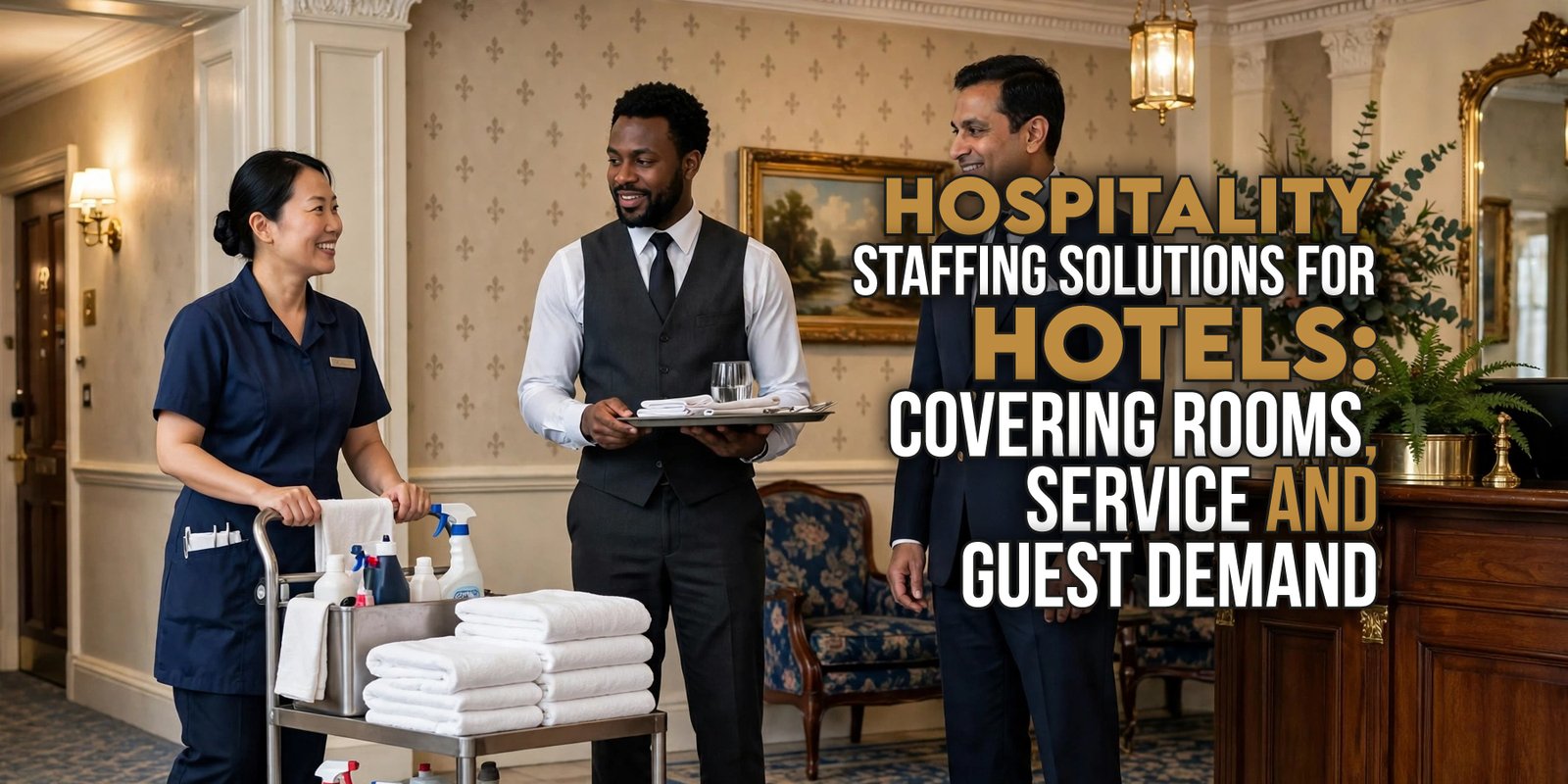
Hospitality staffing solutions can help organisers and venues cover waiting service, banqueting, reception, front-of-house duties, porter support, cleaning, bar support where relevant and other temporary service requirements. Effective staffing depends on the event format, venue, guest numbers, duties, shifts, service expectations and availability of suitable personnel.
For example, a conference may need strong reception support during registration but more waiting staff during lunch.
Similarly, a wedding may need additional food and beverage personnel during dinner while requiring fewer guest-facing team members during quieter periods.
As a result, hospitality staffing solutions should follow the event timetable rather than treating every hour of the function as identical.
What Are Hospitality Staffing Solutions for Events?
Hospitality staffing solutions for events involve sourcing suitable temporary, flexible or longer-term hospitality personnel to support defined service duties, shifts and event requirements. The exact staffing approach depends on the event type, venue, guest numbers, service model, shift length, role requirements and available personnel.
Unlike a standard permanent vacancy, event requirements can rise and fall within a single day.
For instance, guest arrival may create a front-of-house requirement, while dinner service later creates greater demand for waiting personnel.
Therefore, effective hospitality staffing solutions connect:
Event → timetable → service requirement → role → headcount → shift → candidate requirement
The more clearly employers define that chain, the easier it becomes to explain the staffing requirement.
Why Do Events Need Flexible Hospitality Staffing?
Events often create temporary demand that a normal venue rota cannot comfortably absorb.
Weddings, conferences, private dinners, sporting events, corporate functions, seasonal events and large bookings can all increase personnel requirements for a specific day or period.
Hospitality staffing solutions may therefore support employers when demand changes because of:
- increased guest numbers
- large functions
- weddings
- conferences
- banqueting
- private events
- seasonal celebrations
- corporate functions
- weekend demand
- staff absence
- additional event rooms
- extended service hours
However, agency personnel do not replace event planning.
Before requesting support, organisers should identify exactly where the permanent rota has a gap and what duties additional personnel will perform.
For predictable peaks, planning early also allows more time to define roles and assess practical requirements.
What Can Event Hospitality Staff Do?
Event hospitality staff can support a range of guest-facing and operational duties, depending on the employer brief.
Possible responsibilities include:
- waiting service
- table service
- guest-facing assistance
- reception-style support
- banqueting service
- buffet support
- clearing
- porter support
- drinks service where appropriate
- room or venue setup support where relevant
- back-of-house assistance
- service-area organisation
The phrase “event staff” alone does not explain enough.
For example, a waiter assigned to table service may require different experience from a person helping with clearing or general back-of-house activity.
Therefore, hospitality staffing solutions should separate different responsibilities rather than assuming that every hospitality worker can perform every event role.
What Venue Staff Might an Event Need?
The required venue staff depend on how guests move through the event and what services the venue provides.
Potential roles can include:
- Waiters and Waitresses
- Receptionists
- Front-of-house personnel
- Porters
- Hospitality assistants
- Banqueting personnel
- Bartenders where relevant
- Cleaners
- Housekeeping support where relevant
- Back-of-house personnel
- Chefs where relevant
- Room-service or hotel support where applicable
H&D Recruitment’s current candidate and hospitality pages include hospitality roles such as waiters, receptionists, porters, cleaners and related personnel.
However, actual role requirements vary between venues.
A conference hotel may need reception-style support, waiting staff and porters. Meanwhile, a private dinner may concentrate almost entirely on food and beverage service.
Consequently, hospitality staffing solutions should begin with the event format rather than a generic list of workers.
When Should You Use a Waiters Agency?
A waiters agency may be relevant when an organiser needs additional table-service or food-and-beverage personnel for a defined function, subject to staff availability and the provider’s role coverage.
Typical requirements can arise around:
- weddings
- banquets
- conferences
- corporate events
- private dinners
- large restaurant bookings
- seasonal functions
Before requesting staff from a waiters agency, provide the service style, guest numbers, shift times, dress expectations, relevant experience requirements and supervisor information.
For example, plated table service creates a different briefing requirement from a buffet or informal drinks reception.
As a result, hospitality staffing solutions work better when employers describe how service will operate rather than simply saying how many waiters they want.
When Can Temporary Event Staff Help?
Temporary event staff can help cover defined short-term requirements such as one-day events, weekend functions, seasonal periods, staff absence, additional event rooms and temporary increases in bookings.
They may also support a venue whose permanent team can handle normal trading but not an unusually large function.
However, employers should avoid assuming that short notice automatically means suitable personnel will be available.
For hospitality staffing solutions, the practical starting point remains:
- What role is missing?
- What time does the shift start?
- What duties apply?
- Where is the venue?
- What experience is necessary?
- Who will supervise the role?
The clearer those answers are, the more useful the recruitment brief becomes.
How Should You Build an Event Service Team?
A useful approach is to divide the event into service stages.
Guest Arrival
Potential roles may include:
- reception personnel
- hosts
- front-of-house support
- guest-direction assistance
Arrival staffing depends on how concentrated guest entry will be.
For instance, 200 guests arriving within 30 minutes can create a different operational requirement from the same number arriving gradually.
Food Service
Potential roles can include:
- Waiters and Waitresses
- banqueting staff
- catering support
- clearing personnel
Hospitality staffing solutions for food service should account for the service model.
Plated dining, buffets, canapé service and conference lunches all create different workflows.
Drinks Service
Depending on the event, employers may need:
- bartenders
- waiting staff
- drinks-service personnel
Employers should also explain the bar setup, operating hours and division of responsibilities.
Back-of-House Support
Possible duties may include:
- clearing
- cleaning support
- porter duties
- service-area organisation
- kitchen support where appropriate
Back-of-house requirements should not become an afterthought because delays behind the scenes can affect guest-facing service.
Supervisory Structure
Every temporary worker should know:
- who they report to
- where they should report
- what their duties are
- when their shift begins
- what the main service timings are
- who handles operational questions
Therefore, hospitality staffing solutions need a clear reporting structure as well as enough personnel.
Event Hospitality Roles and Typical Duties
| Role | Typical Duties | Key Briefing Information |
|---|---|---|
| Waiter/Waitress | Table and guest service | Service style, sections and timings |
| Banqueting Staff | Function food and drink service | Banquet timetable and table plan |
| Reception Staff | Guest arrival and enquiries | Guest process and venue layout |
| Porter | Venue, luggage or operational support | Reporting area and assigned duties |
| Bartender | Drinks preparation/service where relevant | Bar setup, hours and responsibilities |
| Cleaner | Cleaning and turnaround support | Areas, timing and specific duties |
| Back-of-House Support | Clearing and service support | Workflow and supervisor |
These roles illustrate why hospitality staffing solutions should use defined job requirements.
A person suitable for reception work does not automatically have the experience expected for formal table service. Likewise, a waiter should not be assigned unrelated duties without those responsibilities forming part of the original brief.
Why Event Staffing Should Follow the Event Timetable
Staffing demand rarely remains constant throughout an event.
An organiser may need different headcounts during:
- setup
- guest arrival
- reception
- food service
- breaks
- evening service
- room turnaround
- event close
Consider a conference.
Registration may create the greatest front-of-house pressure from 8 am to 9 am. Afterwards, that demand can fall while refreshments, lunch and room support become more important.
Similarly, a wedding may need fewer service personnel during guest arrival than during a coordinated dinner service.
For this reason, hospitality staffing solutions should map roles against the programme.
A static headcount for a ten-hour event may otherwise ignore when each type of worker is actually required.
How Should Employers Estimate Event Staffing Requirements?
There is no universal waiter-to-guest ratio that suits every function.
Staffing requirements depend on:
- total guest numbers
- service style
- number of rooms
- table service versus buffet service
- bar arrangements
- venue layout
- event duration
- setup requirements
- turnaround periods
- experience expectations
- service standards
- supervisory structure
Guest count is therefore only one input.
For example, two events with 200 guests may require different hospitality staffing solutions if one uses seated multi-course service and the other uses an informal buffet.
Venue layout matters too. A function spread across several floors or rooms may create more movement and supervision requirements than a single-room event.
Employers should therefore describe how the event operates instead of relying on a generic staffing ratio.
What Information Should You Give a Hospitality Staffing Agency?
A hospitality staffing agency should receive the event date, venue, required roles, headcount, exact shift times, duties, guest numbers, service style, dress expectations, experience requirements, reporting point and supervisor details. A precise brief helps the provider understand the actual requirement and assess potentially suitable personnel.
Include:
- Event date
- Full venue address
- Role required
- Headcount
- Shift start time
- Shift finish time
- Main duties
- Expected guest numbers
- Service style
- Dress requirements
- Experience expectations
- Break arrangements
- Staff entrance or reporting point
- Supervisor contact
- Parking or transport information where relevant
- Any role-specific instructions
In practice, hospitality staffing solutions become more focused when the recruitment provider receives this information before sourcing begins.
“Ten event staff required” creates uncertainty.
By comparison, “six waiting staff for plated dinner service, two reception staff for arrivals and two porters for venue support” gives the request much clearer structure.
Why Dress Expectations Must Be Clear Before the Shift
Presentation requirements vary between venues.
One event may require black trousers, a white shirt and specified footwear. Another venue may issue its own uniform or use different front-of-house attire.
Therefore, employers should explain dress expectations before staff arrive.
The brief may cover:
- required uniform
- black-and-white service attire where applicable
- footwear
- grooming expectations
- items supplied by the venue
- venue-specific presentation requirements
There is no single universal event-hospitality dress code.
For hospitality staffing solutions, communicating the requirement in advance reduces avoidable uncertainty at arrival.
Why Temporary Hospitality Staff Still Need a Venue Briefing
Recruitment does not replace venue-specific briefing.
Temporary workers may understand their hospitality role while still needing instructions about the particular event and site.
A venue briefing should cover:
- venue layout
- supervisor details
- service plan
- guest areas
- staff-only areas
- break arrangements
- role boundaries
- emergency procedures where relevant
- staff entrance
- clock-in or attendance process
- event timetable
- escalation contacts
Current HSE guidance makes clear that end-user businesses retain important day-to-day health and safety responsibilities for agency and temporary workers because they control the workplace and direct the work.
Consequently, hospitality staffing solutions should connect candidate sourcing with appropriate venue-level instruction.
Keep Hospitality and Security Roles Clearly Separate
Hospitality and security responsibilities should not be blended simply because both teams work at the same event.
Waiting personnel should concentrate on hospitality duties. Reception-style event support may help guests with directions or check-in processes, but that does not automatically make the role a security function.
Some event security activities require appropriately licensed personnel. SIA guidance explains that whether an event role requires a licence depends on the actual activity, including guarding against unauthorised access, disorder or other licensable security functions.
Therefore, event organisers should clearly separate:
hospitality service → guest experience duties
from:
licensable security → security duties
This distinction is particularly relevant when planning hospitality staffing solutions alongside separate event-security requirements.
How Can Employers Reduce Pressure When Staffing Needs Change?
Earlier planning gives recruitment teams more time to understand roles and assess availability.
Organisers can reduce avoidable pressure by:
- forecasting known event peaks
- reviewing bookings early
- checking rota gaps
- confirming guest numbers
- preparing role briefs
- identifying key service timings
- confirming supervisors
- communicating changes promptly
For predictable weddings, conferences or corporate functions, planning ahead to reduce hiring pressure can help employers organise staffing requirements before the event approaches.
However, guest numbers and operational plans can still change.
When they do, update the hospitality staffing solutions provider with the new headcount, roles and shift details rather than assuming the original staffing plan still fits.
What Should Employers Do When an Event Rota Has Gaps?
When a rota develops a gap, focus first on defining the missing requirement.
- Confirm the missing roles.
- Confirm exact shift times.
- Identify essential experience.
- Confirm the venue address.
- Provide the required headcount.
- Assign a supervisor.
- Contact the staffing provider.
- Keep expectations realistic.
For unexpected requirements, employers may also review H&D Recruitment’s information around planning urgent staffing cover.
Nevertheless, short-notice requests remain subject to worker availability, role requirements and the practicality of the shift.
Strong hospitality staffing solutions should never depend on unsupported assumptions that every last-minute gap can automatically be filled.
Hospitality Staffing Solutions From H&D Recruitment in Hounslow
H&D Recruitment is based at 4 Bell Parade, Bell Rd, Hounslow TW3 3NU. Its current website positions hospitality alongside warehouse and security recruitment, while its current candidate journey includes a dedicated Hospitality sector.
Current H&D Recruitment hospitality content includes roles such as:
- Waiters
- Housekeepers
- Room Attendants
- Cleaners
- Porters
- Receptionists
- front-of-house personnel
- related hospitality roles depending on requirements
The live Find a Job page also identifies waiter, chef, receptionist, porter and cleaner roles within hospitality.
Employers can therefore discuss hospitality staffing solutions for relevant hospitality and event requirements, subject to the role, shift, venue and available candidates.
Hospitality Staffing Around Hounslow and West London
Hounslow and wider West London include hotels, restaurants, event venues, conference facilities and businesses serving a varied hospitality market.
When planning staff, practical local considerations include:
- early starts
- late finishes
- weekend shifts
- venue location
- candidate travel
- night transport
- parking or site access
- staff entrance arrangements
Heathrow-area hotels and hospitality businesses can also form part of the wider geographic employment market.
However, that geographical reference does not imply an official relationship between H&D Recruitment and Heathrow Airport.
For hospitality staffing solutions, location matters because a late-finishing event may reduce the realistic candidate pool if public transport options become limited.
How H&D Recruitment Supports Hospitality and Event Employers
H&D Recruitment’s current hospitality staffing information covers hotels, restaurants and venues and identifies roles including housekeepers, cleaners, porters, waiters and receptionists.
For event-related requirements, employers should prepare:
- event date
- venue
- required roles
- headcount
- shift times
- duties
- guest numbers
- service style
- experience expectations
- dress requirements
- supervisor details
These details help keep hospitality staffing solutions tied to the actual service requirement.
Employers can discuss your event staffing requirements with H&D Recruitment and provide the relevant venue, role and shift details.
If you are looking for hospitality work rather than recruiting personnel, use the candidate route to view current hospitality jobs.
Event Hospitality Staffing Checklist
| Check | Why It Matters |
|---|---|
| Event type | Defines likely service requirements |
| Date | Sets the staffing window |
| Venue | Affects travel and briefing |
| Guest numbers | Helps assess workload |
| Service style | Changes role requirements |
| Roles | Defines candidate profiles |
| Headcount | Guides the recruitment requirement |
| Shift start/finish | Affects availability |
| Dress requirements | Prevents uncertainty |
| Experience | Supports candidate matching |
| Reporting point | Helps staff arrive correctly |
| Supervisor | Gives personnel clear direction |
| Breaks | Supports rota planning |
| Venue layout | Affects service workflow |
| Late finish | Affects candidate travel practicality |
Using this checklist before requesting hospitality staffing solutions gives organisers a more complete recruitment brief.
It also creates a useful reference when guest numbers or event timings change.
Hospitality Staffing Mistakes Event Organisers Should Avoid
1. Requesting “event staff” without defining roles
Specify whether you require waiting, reception, porter, cleaning or another type of personnel.
2. Giving only guest numbers
Guest numbers matter, but service style and venue layout can change the staffing requirement significantly.
3. Providing vague shift times
“Evening event” does not explain whether staff work from 4 pm to 10 pm or until 2 am.
4. Ignoring venue access
Staff need clear information about entrances, reporting points and practical travel.
5. Failing to explain dress expectations
Communicate presentation requirements before the shift.
6. Not assigning a supervisor
Temporary personnel should know who directs their work.
7. Treating waiting and security personnel as interchangeable
They perform different functions, and certain security duties can require SIA licensing.
8. Waiting too long to plan predictable peaks
Where an event date is already known, start hospitality staffing solutions planning before the rota reaches crisis point.
9. Forgetting late-finish transport
A candidate may suit the role but have no realistic way to travel home after the shift.
10. Assuming temporary personnel need no briefing
Even experienced workers need event-specific information about the venue, timetable and duties.
Conclusion
Hospitality staffing solutions can help event organisers build service teams around weddings, conferences, banquets, corporate functions and other periods of increased guest demand.
However, useful event staffing begins with operational detail.
Employers should map the event timetable, define each role, confirm shift times, explain the service model, consider travel practicality and assign a supervisor before requesting personnel.
Ultimately, hospitality staffing solutions work best when the staffing plan follows the real event journey:
Guest arrival → reception → service → clearing → turnaround → event close
That approach gives both the employer and recruitment provider a clearer understanding of where people are needed and what they need to do.
8. FAQ Section
1. What are hospitality staffing solutions for events?
Hospitality staffing solutions for events involve recruiting temporary, flexible or longer-term personnel for defined hospitality duties such as waiting service, reception, banqueting, porter support and cleaning. Requirements depend on the venue, guest numbers, event timetable, service style, shifts and available personnel, so organisers should prepare a detailed event brief before requesting staff.
2. What roles can event hospitality staff cover?
Event hospitality staff may support waiting service, reception, banqueting, clearing, porter duties, front-of-house activity, cleaning and drinks service where relevant. The actual responsibilities should appear clearly in the employer brief. Employers should not assume that every hospitality worker has the experience or skills required for every event role.
3. Can H&D Recruitment provide waiters for events?
H&D Recruitment’s current hospitality coverage includes Waiters and Waitresses, and its broader hospitality recruitment content supports hotels, restaurants and venue-related staffing. Whether suitable waiting personnel are available for a particular event depends on the date, venue, shift, role requirements and current candidate availability.
4. When should a venue use temporary event staff?
Temporary event staff may help when a venue faces a one-day function, busy weekend, seasonal event, large booking, staff absence or temporary increase in service demand. Employers should first identify the exact staffing gap and determine whether temporary recruitment fits the duration and type of requirement.
5. What information should organisers provide before requesting staff?
Provide the date, full venue address, roles, headcount, shift start and finish, duties, guest numbers, service style, dress expectations, experience requirements, reporting point and supervisor contact. This gives a provider of hospitality staffing solutions enough operational context to understand what type of personnel the event requires.
6. Can hospitality staff support weddings and conferences?
Yes, where suitable staff are available and the duties fit their roles. Weddings may require waiting, banqueting, reception or porter support, while conferences can require registration-style guest assistance, refreshments and lunch service. The staffing pattern should follow each event’s timetable rather than assuming that the same headcount is required all day.
7. Do temporary hospitality staff need experience?
That depends on the role. Some general support positions may have different requirements from formal waiting service, reception or specialist food-and-beverage roles. When requesting hospitality staffing solutions, employers should distinguish essential experience from preferences so the recruitment brief accurately reflects the work.
8. Does H&D Recruitment support hospitality employers in Hounslow?
H&D Recruitment is based at 4 Bell Parade, Bell Rd, Hounslow TW3 3NU, and its current website includes hospitality recruitment alongside warehouse and security. Employers can discuss relevant hospitality staffing requirements subject to the specific role, location, shift and candidate availability.
9. Can jobseekers apply for hospitality roles?
Yes. H&D Recruitment’s current Find a Job section includes hospitality opportunities such as waiter, chef, receptionist, porter and cleaner roles. Vacancies change, so candidates should review current requirements, working location and shift details before applying.
10. How can employers request event staffing support?
Employers should prepare the event date, venue, roles, headcount, shifts, guest numbers, service style, duties, experience requirements and supervisor information. They can then provide this information when requesting hospitality staffing solutions, allowing the recruitment discussion to focus on the actual event requirement and potentially suitable personnel.
9. Plan Your Event Staffing With H&D Recruitment
Before requesting hospitality staffing solutions, prepare the operational details that determine who you actually need.
Confirm:
- Event date
- Venue and postcode
- Expected guest numbers
- Required roles
- Headcount by role
- Shift start and finish times
- Service style
- Relevant experience requirements
- Dress expectations
- Reporting point
- Supervisor contact
- Important event timings
For example, avoid requesting “15 event staff” when the actual requirement is eight waiting staff for dinner, three reception personnel for guest arrival and four team members supporting clearing and turnaround.
A role-by-role brief gives recruitment discussions a much stronger foundation.
Employers can discuss your hospitality staffing requirements with H&D Recruitment and provide details about the venue, event timetable, duties and required headcount.
Candidate availability cannot be guaranteed. However, clear information helps keep hospitality staffing solutions focused on the real requirements of the event.