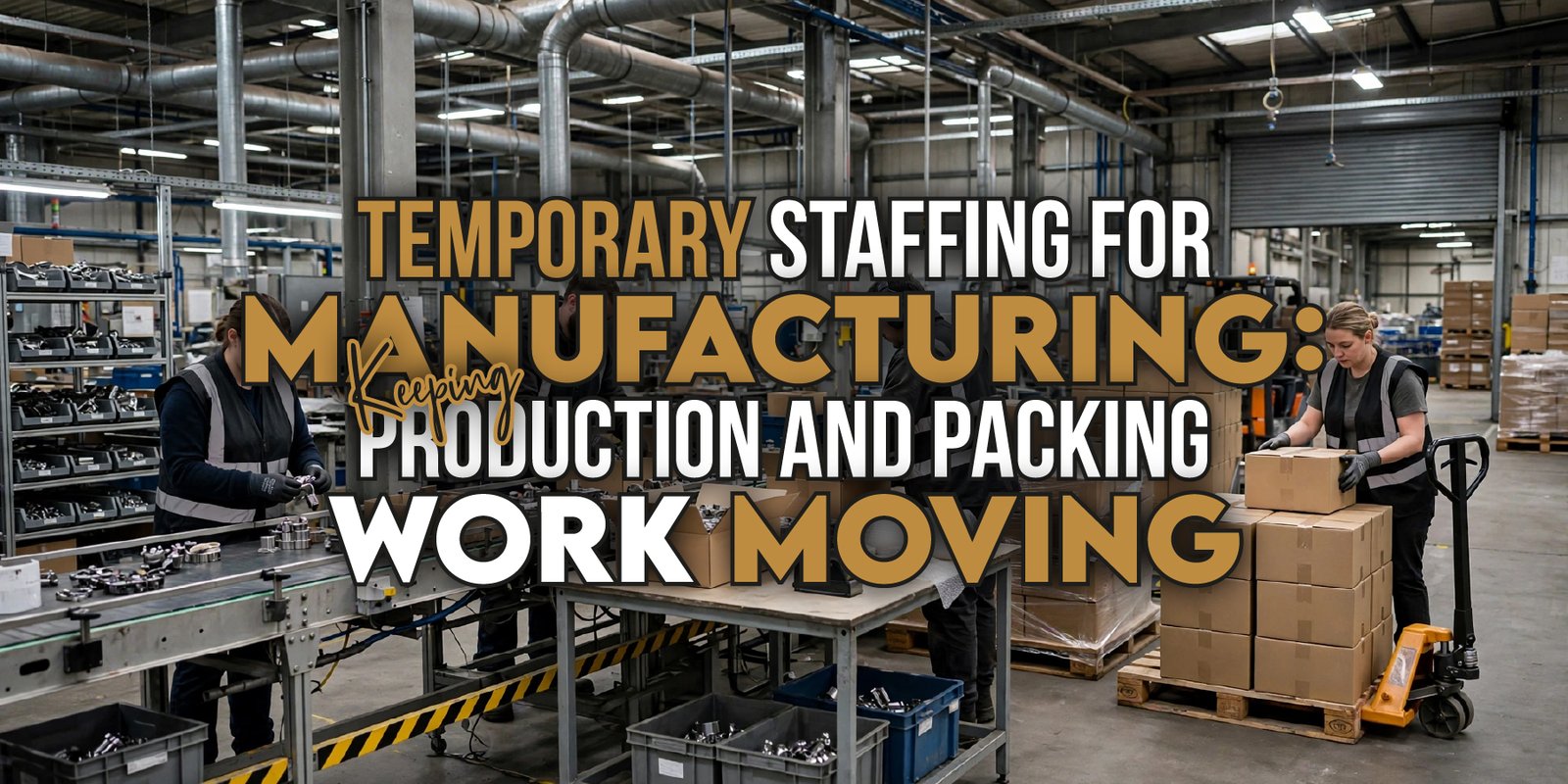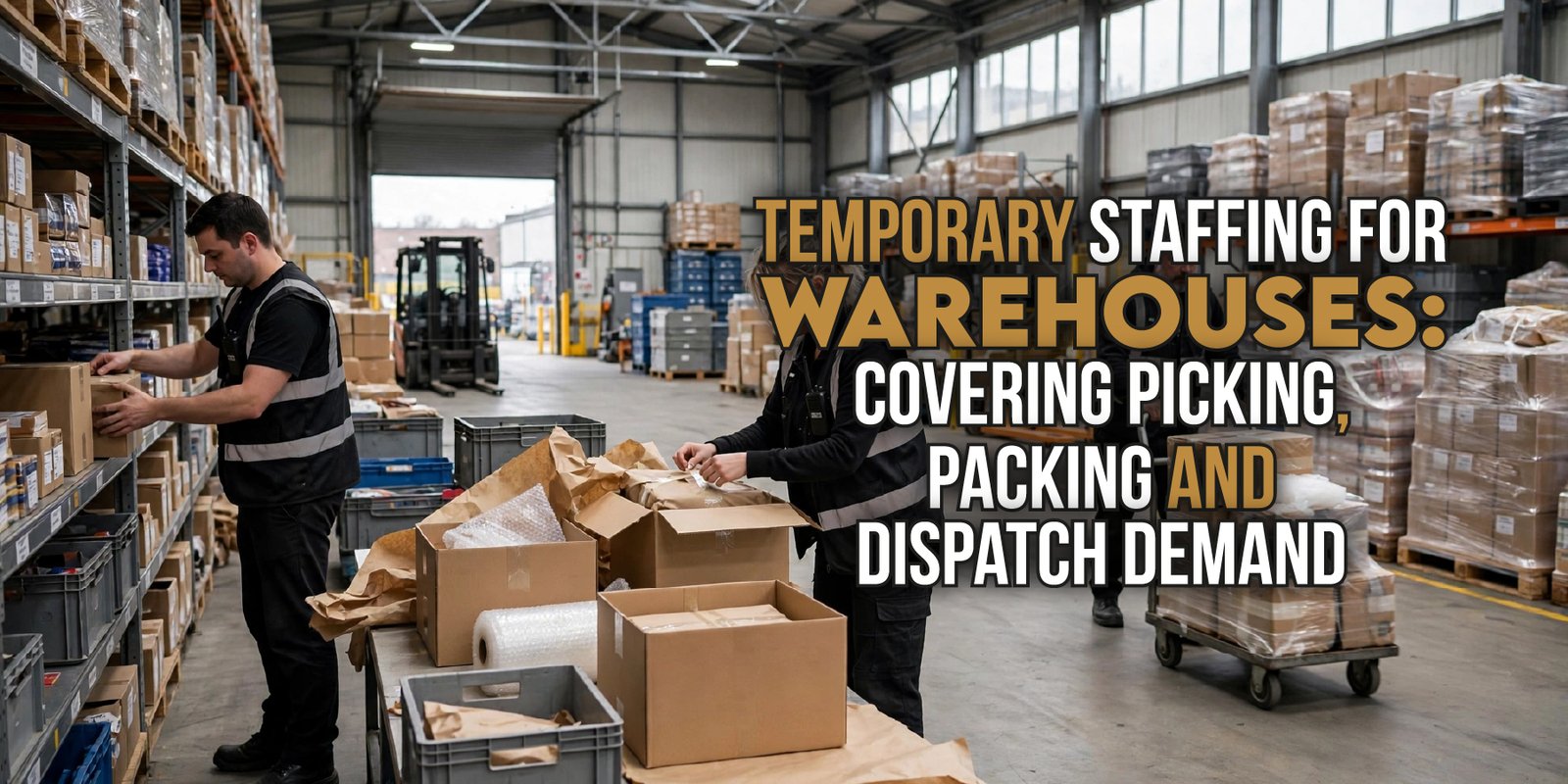
A factory receives additional orders for the evening line. The day shift has enough production workers, yet the next shift needs extra Production Operatives, two packing workers and one Machine Operator. Therefore, a factory staffing agency can help the employer turn that pressure into a clear staffing request.
Flexible factory staffing is not about filling gaps with any available worker. Instead, it is about matching role, headcount, shift, experience and line requirement to the real production plan. At H&D Recruitment, we support factories and manufacturers with temporary, temp-to-perm and permanent recruitment across production, packing and related operational roles. A factory staffing agency gives that support more structure when production plans keep changing.
What Does a Factory Staffing Agency Do?
A factory staffing agency helps employers define roles, source workers, screen candidates, recruit temporary labour, recruit permanent workers, support production lines, support packing requirements and coordinate placement according to the agreed requirement. In practice, the process works best when the factory explains the work clearly before recruitment starts.
The usual process follows requirement, sourcing, screening, shortlist, employer review and placement. However, a factory staffing agency still needs accurate site information, realistic shifts and a clear decision-maker. Otherwise, avoidable delays can appear before the shortlist even reaches the employer. A factory staffing agency works best when employer information is complete.
A strong factory staffing agency should also separate urgent labour from long-term workforce planning. For example, temporary production support may suit a peak order, while temp-to-perm may suit a recurring role that could become permanent.
What Roles Can a Factory Staffing Agency Recruit?
A factory staffing agency can recruit production operatives, production line workers, packers, assemblers, machine operators, material handlers, quality inspectors, production supervisors and engineering support where the role fits the agency’s coverage. Exact suitability depends on duties, site conditions, shift pattern and candidate availability. A factory staffing agency should never treat every operational role as identical.
| Role | Typical Function | When Businesses May Need It |
|---|---|---|
| Production Operative | Supports routine production tasks | Extra line capacity or absence cover |
| Production Line Worker | Works on staged production activity | Output peaks or new shift patterns |
| Machine Operator | Operates machinery where suitable | Skilled machine-led production roles |
| Assembler | Builds or assembles products or parts | Assembly lines and project demand |
| Packing Operative / Packer | Packs, sorts or prepares goods | End-of-line packing pressure |
| Material Handler | Moves materials around the site | Production flow and stock movement |
| Quality Inspector | Checks product quality where authorised | Quality-control support |
| Production Supervisor | Oversees team activity | Experienced shift or line leadership |
| Engineering Support | Supports technical operations where relevant | Maintenance or process-related support |
From its Hounslow base, H&D Recruitment can discuss requirements for Production Operatives, Machine Operators, Assemblers, Material Handlers, Quality personnel and other suitable factory roles. In addition, its wider recruitment coverage can support relevant picker, packer and warehouse-related staffing when that work connects with production and end-of-line operations.
Production Line Workers for Flexible Factory Operations
Production line workers support staged manufacturing tasks such as preparing materials, assembly, product handling, line support, packing and quality-related checks where authorised. Therefore, factories should describe the line, pace, duties and supervision process before asking a factory staffing agency to source candidates.
A production line is rarely one generic task. For example, one worker may support assembly, while another may move materials or prepare finished items. Because of that, a factory staffing agency needs detail beyond the phrase “production staff needed”.
On production lines, shift timing also matters. A day shift may attract different availability from a night shift, while weekend work can require earlier planning. Therefore, production managers should share realistic shift details before recruitment begins. A factory staffing agency can then focus on realistic availability and role fit.
Packing Staff for Production and End-of-Line Requirements
Packing staff in a factory may pack finished products, sort goods, label items where required, prepare products for dispatch, follow quality requirements and support production flow. However, packing roles should still match the product type, line process, handling needs and site instructions.
Packing can become the hidden bottleneck when production increases. For example, more output can create more packing, more handling and more end-of-line checks. Therefore, a factory staffing agency should understand whether the employer needs production labour, packing staff or both. A factory staffing agency can also help employers separate packing capacity from general warehouse support.
H&D Recruitment’s wider warehouse and picker-packer recruitment coverage can support relevant packing requirements where suitable. However, factory employers should connect packing staff to the production workflow instead of treating every warehouse role as the same as factory work.
Production Workers vs Packing Staff
Production workers and packing staff can support the same operation, but their duties are not always interchangeable. Therefore, factories should define each role separately before contacting a factory staffing agency.
| Factor | Production Workers | Packing Staff |
| Primary function | Support manufacturing or assembly activity | Pack, sort and prepare finished goods |
| Workflow position | Often earlier or mid-line | Often end-of-line |
| Responsibilities | Assembly, handling, line support | Packing, labelling and dispatch preparation |
| Shift demand | Linked to output requirement | Linked to finished-product flow |
| Skills or experience | Production environment experience | Accuracy, pace and product handling |
| Staffing requirement | Production headcount | Packing headcount |
This distinction protects the employer and the candidate. In addition, it helps a factory staffing agency shortlist people who understand the correct environment. A factory staffing agency should confirm the difference before candidate sourcing starts.
How Does a Factory Workers Agency Support Production Managers?
A factory workers agency supports production managers by sourcing candidates, shortlisting suitable workers, discussing staffing flexibility and helping with temporary or longer-term hiring. However, the value depends on the quality of the employer’s brief.
For example, a production manager may need four workers on one line and two packing operatives on another. Instead of sending one broad request, the employer should split the requirement by role, shift, department and experience level. As a result, the factory staffing agency can search with more precision. A factory staffing agency can also compare temporary cover against longer-term recruitment needs.
When Should a Factory Use Temporary Labour?
A factory should use temporary labour when it needs support for peak orders, seasonal demand, absence cover, short projects, additional shifts, temporary vacancies or fluctuating production volume. However, temporary labour is not automatically cheaper or better; it should match the operational requirement and contract terms.
Temporary labour can help during a production increase or packing-line peak. Meanwhile, permanent recruitment may suit a role that the factory needs every week. A factory staffing agency can discuss both options, but the employer should define the reason for hiring first. A factory staffing agency should also explain how service scope affects the recruitment process.
Temporary vs Temp-to-Perm vs Permanent Factory Staffing
A factory staffing agency should help employers compare temporary, temp-to-perm and permanent staffing without pushing one model for every case. Instead, the right model depends on duration, workload, budget, supervision and long-term need.
| Factor | Temporary | Temp-to-Perm | Permanent |
| Purpose | Short-term cover or fluctuating demand | Trial period before a longer-term decision | Long-term workforce need |
| Duration | Defined or changing assignment | Temporary start with possible permanent route | Ongoing role |
| Flexibility | Higher | Medium | Lower after hire |
| Hiring objective | Cover output pressure | Assess suitability over time | Build internal headcount |
| Suitable need | Peaks, absences, projects | Repeated need with uncertainty | Core recurring role |
| Workforce planning | Useful for variable production | Useful during growth | Useful for stable teams |
Therefore, factories should avoid choosing a staffing model by habit. A factory staffing agency can help compare models only after the work requirement is clear. Instead, they should define the production problem first, then ask the factory staffing agency which model best fits the requirement.
What Does Manufacturing Recruitment Support Include?
Manufacturing recruitment support includes defining requirements, sourcing candidates, screening applicants, shortlisting suitable workers and helping employers compare temporary, temp-to-perm or permanent recruitment options. It may also cover specialist factory roles where the agency supports that skill area.
In practice, manufacturing recruitment support should begin with the production plan. The agency needs to know the role, line, shift, site, skills and start requirement. For this reason, a factory staffing agency should always ask practical operational questions before recommending candidates. A factory staffing agency should also challenge vague role descriptions respectfully.
Staffing Day, Night and Weekend Factory Shifts
Day, night and weekend factory shifts require clear planning because availability, travel, supervision and site access can differ. Therefore, employers should tell a factory staffing agency the exact working days, start times, finish times, break pattern and reporting contact.
H&D Recruitment can discuss urgent and planned factory staffing requirements. However, recruitment timing depends on the role, shift pattern, headcount, site requirements, required checks and candidate availability. That is why clear shift information matters from the first conversation. A factory staffing agency can plan sourcing more sensibly when shift details are confirmed.
Factory Staffing for Peak Production Periods
Factory staffing for peak production works best when employers forecast demand, define required output, confirm the line, calculate headcount, set the shift, agree a start date, choose the temporary staffing model and review performance after the assignment.
During peak demand, the biggest mistake is waiting until the final moment. Instead, factories should share expected volumes, line pressure and packing requirements early. A factory staffing agency can then discuss sourcing needs before the pressure becomes harder to manage. A factory staffing agency can also help employers review whether temporary cover is enough.
Adding Packing Capacity When Production Increases
More production often creates more packing, more handling and more end-of-line work. Therefore, factories should not increase production headcount without reviewing packing headcount too.
For packing lines, the employer should define product type, packing method, labelling needs, pace, quality expectations and supervisor contact. In addition, the factory staffing agency should understand whether the role needs packing staff only or workers who can support both packing and production tasks.
Covering Factory Absences With Temporary Staff
Factory absences become easier to manage when the employer keeps a current role brief, shift pattern, site requirement, experience criteria and induction process ready. As a result, the recruitment team does not need to rebuild the requirement during an already busy shift.
Temporary cover may help with short-term absence, holiday cover or temporary vacancies. However, a factory staffing agency still needs enough information to match workers to the right line and working environment. A factory staffing agency should know the supervisor contact before shifts begin.
What Should You Tell a Factory Staffing Agency?
A factory should tell a staffing agency the role, headcount, shift, site, start requirement, skills, experience, contract type, working conditions and required checks. Most importantly, the factory should explain the line or department where the worker will operate.
| Requirement | Information to Provide |
| Role | Production operative, packer, assembler or other role |
| Department / line | Production line, packing line or support area |
| Headcount | Number of workers required |
| Shift | Day, night, weekend or rota pattern |
| Working days | Exact days and expected hours |
| Site | Address, access details and reporting point |
| Start requirement | Urgent, planned, seasonal or project-based |
| Contract type | Temporary, temp-to-perm or permanent |
| Experience | Essential background and desirable experience |
| Working environment | Pace, product type and physical requirements |
| PPE / site rules | Required items or site expectations |
| Pay / terms | Confirmed terms for the role |
| Interview | Shortlist review or interview process |
| Decision-maker | Person who approves candidates |
A factory staffing agency can shortlist more effectively when this table is complete. Therefore, employers should prepare it before making the first request. A factory staffing agency can use the same brief to improve future staffing conversations.
What Should a Factory Staffing Agency Check?
A factory staffing agency should check identity, Right to Work, role suitability, relevant experience, required skills and employer-specific requirements. However, it should not invent licences or certificates that the role does not legally or operationally require.
For example, some machine roles may need relevant experience, while general packing roles may need attention to detail and site-readiness. Therefore, the agency and employer should agree what matters for each role. A factory staffing agency should keep these checks practical and role-specific.
Right-to-Work Checks for Factory Workers
UK employers must check that a job applicant is allowed to work in the UK before employing them. This section gives general information only and does not replace legal or immigration advice.
For factory workers, the Right-to-Work process should sit alongside role suitability, site requirements and onboarding. In addition, employers should review current guidance and confirm responsibilities before any placement starts.
Why Factory Induction Still Matters After Recruitment
Factory induction still matters because recruitment does not replace site-specific instruction. Employers should explain working procedures, reporting lines, site rules, PPE where required, break arrangements and supervisor contacts before the worker begins.
A factory staffing agency may support candidate sourcing and screening. However, the factory remains responsible for explaining its own operational environment and safe working expectations. Therefore, induction should never become an afterthought. A factory staffing agency can source candidates, but the factory must explain site procedures clearly.
How H&D Recruitment Supports Factory Staffing
At H&D Recruitment, we help UK manufacturers and factories recruit across production, packing and related operational roles. Current manufacturing recruitment information supports roles such as Production Operatives, Production Supervisors, Machine Operators, Assemblers, Quality Control personnel, Material Handlers, machine minders and engineering support where relevant.
From our Hounslow base, we can discuss staffing requirements for production lines, packing requirements and connected warehouse or logistics support. Where production demand also creates picking, packing or operational work, our wider recruitment coverage can support relevant roles where suitable. A factory staffing agency should connect these related roles to the actual workflow.
Factory Staffing Agency in Hounslow
A factory staffing agency in Hounslow can help local employers discuss flexible production and packing labour with a team based in the area. H&D Recruitment’s current office address is 4 Bell Parade, Bell Road, Hounslow, TW3 3NU, United Kingdom.
This local connection can help employers in Hounslow, Middlesex, West London and London start clearer staffing conversations. However, employers should still define the site, shift and job duties before requesting factory staff. A factory staffing agency in Hounslow still needs the same operational detail as any national requirement.
Factory Recruitment Support Across the UK
Factory recruitment support across the UK may involve individual factories, production plants, engineering workshops and multi-site operations where the agency supports the requirement. However, every location still needs its own role brief. A factory staffing agency can support multi-site conversations more clearly when each site has separate details.
For multi-site factory staffing, employers should standardise job titles where duties match. Meanwhile, they should keep site-specific details separate, including shifts, supervisor contacts, access instructions and headcount.
What If Your Business Group Needs Staff Across Different Operations?
Some business groups need staffing across manufacturing, warehousing, housekeeping and hotels. However, each sector requires the correct role profile, screening approach and recruitment process.
For example, factory workers and housekeepers are not interchangeable. A business that manages separate facilities may need housekeeping staff recruitment for one site and factory labour for another.
Likewise, a hospitality division may need support from a hotel staff agency, while this guide remains focused on production and packing-line staffing.
Need More Staff for a Production or Packing Line?
Factories preparing for extra orders should share the site or postcode, role, production line or packing function, headcount, shift, start requirement, contract type, required experience and site requirements. Then the recruitment conversation can begin with the detail that matters. A factory staffing agency can respond more usefully when the employer explains the full workflow.
To plan a practical staffing request, employers can discuss your factory staffing requirements with H&D Recruitment before the production peak becomes urgent.
What Should You Compare Between Factory Staffing Agencies?
Employers should compare factory and manufacturing experience, production-role coverage, packing-role coverage, screening, temporary and permanent options, shift understanding, communication, geographic coverage, terms, account support and replacement arrangements where applicable.
| Comparison Area | What to Ask |
| Factory experience | Do you recruit for production environments? |
| Role coverage | Which factory roles can you discuss? |
| Packing support | Can you recruit packing staff where suitable? |
| Screening | How do you assess role suitability? |
| Staffing model | Do you offer temporary, temp-to-perm and permanent routes? |
| Shift support | Can you discuss day, night or weekend patterns? |
| Communication | Who manages the employer relationship? |
| Terms | What fees and conditions apply? |
| Reviews | How do we review worker suitability? |
No factory staffing agency should be chosen only because it sounds fast. A factory staffing agency should be compared on relevance, screening and communication. Instead, employers should compare service scope, process clarity and candidate fit.
Is the Cheapest Factory Staffing Agency Always the Right Choice?
No. The cheapest factory staffing agency is not always the right choice, although a higher-cost agency is not automatically better either.
Factories should compare recruitment scope, candidate suitability, screening, communication, staffing model, terms and total staffing cost. Most importantly, they should ask whether the agency understands production and packing workflows. A factory staffing agency that understands those workflows can ask better questions.
Questions Employers Should Ask Before Choosing an Agency
Before selecting a factory staffing agency, employers should ask direct questions.
- Which factory roles do you recruit?
- Do you supply production line workers?
- Can you recruit packing staff?
- Do you provide temporary factory workers?
- Do you support temp-to-perm?
- Do you recruit permanent staff?
- Which areas do you cover?
- Can you discuss day and night shifts?
- How do you screen candidates?
- How do you check Right to Work?
- How do you assess role suitability?
- What information do you need from us?
- What can delay recruitment?
- How do you handle changing headcount?
- What fees or terms apply?
- What is included in the service?
- Can you support peak production planning?
- Who manages the employer relationship?
These questions help employers compare a factory workers agency without relying on claims alone. A factory staffing agency should answer them with clear service boundaries.
Common Factory Staffing Mistakes
A factory staffing agency can support recruitment, but the employer still needs to prepare the requirement. Therefore, avoid these common mistakes.
| Mistake | Why It Causes Problems | Better Approach |
| Vague job titles | Candidates may not match the work | Define the role clearly |
| Undefined production line | Recruiters cannot assess fit | Explain the line or department |
| Unclear headcount | Planning becomes harder | Confirm numbers early |
| Unclear shift pattern | Candidate availability may not match | Share exact shifts |
| Changing start dates | Shortlists can become outdated | Set realistic timing |
| No packing requirement | End-of-line pressure remains | Define packing capacity |
| Treating roles as identical | Workers may not suit duties | Split production and packing roles |
| Unnecessary experience demands | Shortlists may narrow too far | Separate essential and desirable |
| Slow feedback | Candidates may move on | Review shortlists quickly |
| No induction plan | First-shift confusion increases | Prepare site induction |
Ultimately, avoiding these issues helps the factory staffing agency focus on candidate suitability rather than chasing missing information. A factory staffing agency can only improve the process when the brief is accurate.
Factory Staffing Agency Checklist
Use this factory staffing agency checklist before requesting workers.
-
Define factory or site
-
Define department
-
Define production line
-
Define packing line where relevant
-
Define role and duties
-
Define headcount
-
Define shift and working days
-
Define expected start
-
Define temporary, temp-to-perm or permanent need
-
Define essential experience
-
Define desirable skills
-
Define working environment
-
Define PPE requirements where relevant
-
Define site requirements
-
Define pay or terms
-
Define interview process
-
Define decision-maker
-
Define candidate documentation requirements
-
Confirm Right-to-Work process
-
Confirm screening approach
-
Confirm role suitability checks
-
Confirm shortlist process
-
Confirm onboarding and induction responsibility
-
Confirm supervisor contact
-
Confirm reporting method
-
Confirm headcount-change process
-
Confirm agency contact
-
Confirm replacement terms where applicable
-
Confirm fees and terms
-
Plan peak requirements early
-
Review staffing performance
A factory staffing agency can respond more effectively when this information is ready. As a result, employers start with a clear production requirement instead of a vague staffing request. A factory staffing agency can then support flexible labour planning with fewer assumptions.
Looking for Factory, Production or Packing Work?
Candidates looking for factory, production, packing, warehouse or related operational work can review suitable roles through H&D Recruitment where available. However, role availability can change, so candidates should check current opportunities before applying.
You can find factory and production jobs with H&D Recruitment and explore roles that match your experience.
Frequently Asked Questions
What does a factory staffing agency do?
A factory staffing agency helps employers define staffing requirements, source workers, screen candidates, recruit temporary labour, recruit permanent workers and support production or packing-line placement. The process works best when the factory gives a clear brief covering role, headcount, shift, site, start requirement and experience.
What workers can a factory staffing agency provide?
A factory staffing agency may provide production operatives, production line workers, packers, assemblers, machine operators, material handlers, quality inspectors, production supervisors and engineering support where suitable. Exact recruitment depends on the role, site, shift, candidate availability and required checks.
What is a factory workers agency?
A factory workers agency helps employers recruit people for factory, production and packing environments. It may support temporary labour, temp-to-perm hiring and permanent recruitment. However, employers should define the role clearly before asking the agency to source candidates.
What do production line workers do?
Production line workers support staged manufacturing processes. Their duties may include preparing materials, assembly, product handling, packing, line support and quality-related checks where authorised. However, the exact role depends on the factory, product type, line process and supervisor instructions.
What do packing staff do?
Packing staff may pack products, sort items, label goods where required, prepare products for dispatch, follow quality requirements and support production flow. In a factory setting, packing staff often support end-of-line activity after production has created finished or semi-finished goods.
Can a staffing agency provide temporary factory workers?
Yes, a staffing agency may provide temporary factory workers where it supports that role and area. Temporary staffing can help with seasonal demand, absence cover, production peaks, additional shifts and project-based needs. However, employers should confirm duties, shifts and contract terms first.
When should factories use temporary labour?
Factories should consider temporary labour during peak orders, seasonal demand, absences, short projects, additional shifts, temporary vacancies or fluctuating production volume. However, they should not assume temporary staffing is always the cheapest choice. Instead, they should compare the role, duration, workflow and service terms.
What is temp-to-perm factory recruitment?
Temp-to-perm factory recruitment starts with a temporary assignment that may lead to permanent employment if the employer and worker agree. This model can help factories assess longer-term suitability. However, terms should be clear before the assignment begins.
Can agencies recruit night-shift factory workers?
Agencies may recruit night-shift factory workers where the role, location, shift pattern and candidate availability fit. Employers should share the exact start time, finish time, working days, break pattern, transport considerations and supervisor contact before asking a factory staffing agency to source candidates.
What should a factory staffing brief include?
A factory staffing brief should include the role, department, production line, packing requirement, headcount, shift, site, start date, contract type, experience, skills, working conditions, required checks, pay or terms, interview process and decision-maker. Clear briefs reduce avoidable recruitment delays.
What checks should candidates complete?
Candidate checks may include identity, Right to Work, role suitability, experience, relevant skills and employer-specific requirements. However, checks vary by role and site. Employers should not assume every factory role requires the same certificate, licence or documentation.
Does H&D Recruitment provide factory staffing in Hounslow?
H&D Recruitment is based in Hounslow at 4 Bell Parade, Bell Road, Hounslow, TW3 3NU. The team can discuss staffing requirements with employers in Hounslow, Middlesex, West London, London and wider areas where supported by current service coverage.
Does H&D Recruitment support production and packing roles?
H&D Recruitment’s current manufacturing and operational recruitment coverage includes production roles, machine operators, assemblers, quality personnel, material handlers and related support. In addition, wider picker, packer and warehouse coverage may support packing-related requirements where they fit the factory workflow.
How can candidates find factory jobs with H&D Recruitment?
Candidates can review current job opportunities with H&D Recruitment and apply for suitable roles where available. Factory, production, packing, warehouse and related operational vacancies may change over time. Therefore, candidates should check current listings before assuming a specific role is open.
How can employers request factory staff?
Employers can request factory staff by sharing role, production line, packing requirement, headcount, shift, site, start requirement, contract type, experience, working conditions and required checks. This gives H&D Recruitment a clearer brief for discussing suitable recruitment support.
Conclusion
A factory staffing agency can help employers build flexible production and packing capacity when the requirement is clear. Production, packing, role, headcount, shift, skills, screening, shortlist, placement, induction and review all matter.
However, flexible labour works best when employers define the production requirement, packing requirement, shift and headcount before recruitment begins. A factory staffing agency then has a stronger foundation for sourcing suitable workers without creating avoidable delays.
Discuss Your Factory Staffing Requirements With H&D Recruitment
H&D Recruitment can discuss current requirements for Production Operatives, Production Line Workers, Machine Operators, Assemblers, Packers, Material Handlers, Quality personnel, Production Supervisors and other supported factory roles. From Hounslow, the team can review your production line, packing needs, headcount, shift pattern and contract model.
To plan your next production or packing workforce requirement, request factory staffing support