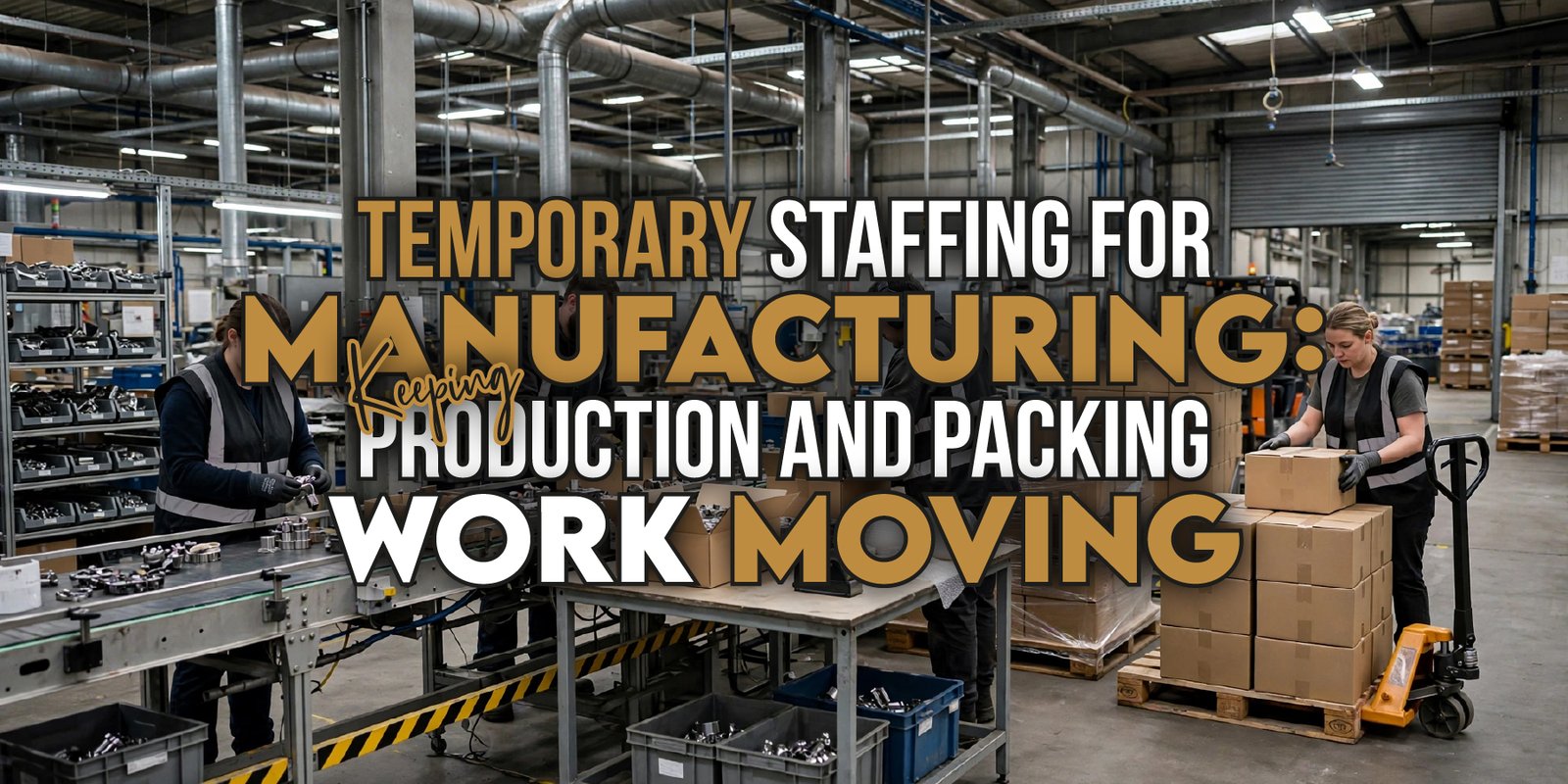
A busy factory can face extra orders, several absences, a new evening shift and growing packing demand in the same week. Therefore, production operative recruitment should start with more than a request for “extra workers”. The employer needs the right duties, headcount, shift pattern and site requirement clearly defined.
Good production operative recruitment helps factories match people to real production work. At H&D Recruitment, we support manufacturers with temporary, temp-to-perm and permanent recruitment across production and factory roles, where current role requirements and candidate availability allow. This makes production operative recruitment more useful when factories need both planned and responsive staffing conversations.
What Is Production Operative Recruitment?
Production operative recruitment involves sourcing and screening people for manufacturing roles that support production lines, assembly, product handling, packing where relevant, quality-related processes and general factory operations. In practice, it works best when the employer defines the requirement before sourcing begins.
The process normally follows requirement, sourcing, screening, shortlist, employer review and placement. In this model, production operative recruitment gives each stage a clear purpose. However, production operative recruitment should not focus only on speed. The quickest available worker is not automatically the most suitable worker for a busy production environment.
A clear brief gives recruiters a stronger starting point. Therefore, production operative recruitment should connect duties, headcount, shift, site, experience, contract type and working environment before candidates are shortlisted.
What Does a Production Operative Do?
A production operative supports production processes, handles materials, assembles products, prepares goods, packs items where relevant, carries out authorised quality checks and follows site procedures. The exact duties depend on the factory, product, line process, training and supervisor instructions.
Some production operatives work on assembly lines. Meanwhile, others support materials, packing, product movement or simple quality checks. For this reason, production operative recruitment should never treat every production role as the same.
Employers should explain what the worker will do during the shift. In addition, they should describe the pace, working environment, reporting contact and any site-specific expectations. This detail keeps production operative recruitment aligned with real factory work.
How Does a Production Operatives Agency Support Factories?
A production operatives agency supports factories by sourcing candidates, screening applicants, creating shortlists and helping employers compare temporary, temp-to-perm or permanent recruitment routes. However, the agency needs a clear role brief before it can assess suitability properly.
A production operatives agency can help during peak demand, absence cover, changing shift patterns or longer-term hiring. Therefore, production operative recruitment works best when the employer explains the production pressure behind the vacancy.
For example, a factory may need four workers for an evening line, two assemblers for a project and one material handler for stock movement. Instead of one broad request, the employer should split each requirement clearly. That split makes production operative recruitment more accurate.
Where Production Operatives Fit Into Factory Recruitment
Factory recruitment covers several operational roles, and production operatives often sit at the centre of the production floor. They may work alongside Machine Operators, Assemblers, Material Handlers, Quality Control personnel, Production Supervisors and packing or warehouse support where relevant.
However, production operative recruitment should stay focused on the production operative role. A Machine Operator may need specific machine experience, while a Quality Control role may require different attention and documentation. Therefore, employers should avoid merging every factory requirement into one job title. Clear separation also protects production operative recruitment from becoming too broad.
At H&D Recruitment, current manufacturing recruitment coverage includes Production Operatives alongside Machine Operators, Assemblers, Quality Control personnel, Material Handlers and Production Supervisors. In addition, wider warehouse or logistics support may connect with production operations where the requirement fits.
Manufacturing Workers Needed Around a Production Line
Manufacturing workers around a production line may include production operatives, machine operators, assemblers, material handlers, quality personnel, supervisors and engineering support. Each role supports a different part of the workflow, so employers should define the difference before recruitment begins.
| Role | Main Function | When It May Be Needed |
|---|---|---|
| Production Operative | Supports line, assembly, packing or product handling | Busy shifts, absence cover or extra orders |
| Machine Operator | Runs or supports machine-led production where suitable | Skilled production requirements |
| Assembler | Builds products, components or sections | Assembly projects or repeat line work |
| Material Handler | Moves materials around the site | Production flow and stock support |
| Quality Control | Supports product checks where authorised | Quality-focused production environments |
| Production Supervisor | Oversees line or shift activity | Team leadership and shift control |
| Engineering Support | Supports technical or process needs where relevant | Skilled maintenance or process support |
This table helps employers avoid vague requests. As a result, production operative recruitment becomes more accurate and easier to compare across agencies. It also shows why production operative recruitment should connect with the wider line structure.
When Should Factories Use Temporary Production Staff?
Factories should use temporary production staff for production peaks, seasonal demand, absences, additional shifts, short-term projects, temporary vacancies and changing order volume. However, temporary staff are not automatically cheaper or better. The right model depends on duration, duties, supervision and business need.
Temporary production staff can help when a factory needs extra capacity without immediately creating a permanent role. For many employers, production operative recruitment starts as a temporary requirement before the longer-term need becomes clear. Meanwhile, permanent recruitment may suit a stable recurring position.
During production peaks, earlier planning matters. If the employer shares shift details, headcount and start requirements early, recruiters can review the requirement with fewer avoidable delays.
Temporary vs Temp-to-Perm vs Permanent Production Recruitment
Production operative recruitment can use temporary, temp-to-perm or permanent models. Instead of choosing one model by habit, employers should match the staffing route to the production requirement.
| Factor | Temporary | Temp-to-Perm | Permanent |
| Purpose | Short-term support or cover | Trial period before a longer-term decision | Ongoing role |
| Duration | Defined or changing assignment | Temporary start with possible permanent route | Long-term employment need |
| Flexibility | Higher | Medium | Lower after hire |
| Employer objective | Cover immediate or variable demand | Assess fit over time | Build stable internal headcount |
| Suitable scenario | Absences, peaks, short projects | Repeated need with uncertainty | Core production role |
| Workforce planning | Useful for changing demand | Useful during growth | Useful for stable teams |
This comparison helps employers prepare better questions. In addition, it helps a production operatives agency recommend a route that fits the real demand. Production operative recruitment becomes easier when the staffing model is agreed early.
Recruiting Production Operatives for Different Shifts
Recruiting production operatives for day, night and weekend shifts requires accurate shift information from the start. Therefore, employers should share the working days, start time, finish time, break pattern, reporting contact and site access requirements before sourcing begins.
H&D Recruitment can support both urgent and planned production staffing requirements, although timing depends on the role, shift, site requirements, required checks and candidate availability. As a result, production operative recruitment should avoid fixed-time promises and focus on preparation.
For night shifts or weekend production, travel and availability may influence candidate fit. Therefore, production operative recruitment should include practical shift details from the beginning. Therefore, production managers should confirm realistic shift requirements before asking an agency to shortlist workers.
Production Operative Recruitment for Peak Demand
Production operative recruitment for peak demand should follow forecast, production requirement, line, headcount, shift, start requirement, temporary cover and review. This structure helps factories plan labour around the actual workload instead of reacting with vague requests.
During peak demand, a factory may increase output on one line and create extra packing pressure downstream. Therefore, employers should review both production and support roles before requesting staff.
Earlier workforce planning can reduce avoidable pressure. However, it does not guarantee immediate worker availability. It simply gives production operative recruitment a stronger starting point. A clear production requirement simply gives recruiters a better foundation.
Covering Production Absences Without Rebuilding the Hiring Brief
Factories can cover repeated absences more smoothly when they keep an updated role specification, shift pattern, site information, skill requirement, induction process and supervisor contact ready. Therefore, production operative recruitment should not start from zero every time an absence appears.
A saved brief helps the employer explain the role quickly. In addition, it helps the agency understand whether the replacement needs production experience, assembly awareness, packing capability or general factory readiness.
This preparation matters on busy shifts. When details already exist, production operative recruitment can move into sourcing and shortlisting faster. It also keeps production operative recruitment consistent across repeated cover requests.
What Skills Should Employers Look for in Production Operatives?
Employers should look for production operatives who can follow procedures, arrive reliably, communicate clearly, work well with others and pay attention to detail. Depending on the role, relevant factory experience, physical suitability and product-handling awareness may also matter.
However, not every production job requires the same background. Some roles may suit candidates who can learn through employer training, while others need previous factory experience because of pace, product handling or process requirements.
Production operative recruitment should separate essential skills from desirable skills. That separation keeps production operative recruitment realistic. Otherwise, employers may make the shortlist too narrow or attract candidates who do not match the real work.
Do Production Operatives Need Previous Factory Experience?
Some production operative roles may accept candidates without previous factory experience if the employer provides suitable training and the task allows it. However, other environments may require prior experience because of pace, specialist equipment, product handling, quality expectations or site procedures.
Therefore, employers should define experience requirements carefully. Instead of saying “experienced only”, they should explain the type of experience that matters.
This makes production operative recruitment more practical. It also helps candidates understand whether the role suits them before they apply. As a result, production operative recruitment attracts better-matched applicants.
What Should Employers Tell a Production Operatives Agency?
Employers should tell a production operatives agency the role, duties, headcount, shift, site, start requirement, experience, skills, contract type and working conditions. Most importantly, the brief should explain what the production operative will actually do on shift.
| Requirement | What to Define |
| Job title | Production Operative or more specific role |
| Production department | Line, assembly, packing or support area |
| Duties | Daily responsibilities and supervisor expectations |
| Headcount | Number of workers needed |
| Shift | Day, night, weekend or rota pattern |
| Working days | Exact days and expected hours |
| Site | Address, access and reporting point |
| Start requirement | Urgent, planned, seasonal or project-based |
| Contract type | Temporary, temp-to-perm or permanent |
| Experience | Essential and desirable background |
| Skills | Handling, assembly, line work or other requirements |
| Environment | Pace, product type and working conditions |
| PPE / site rules | Relevant site expectations |
| Pay / terms | Confirmed role terms |
| Interview process | Shortlist, call, interview or assessment |
| Decision-maker | Person who approves the next step |
A strong brief supports better production operative recruitment. In practice, it helps recruiters avoid guesswork and gives employers a more relevant shortlist. This is why production operative recruitment should begin with the brief, not the vacancy title.
What Can Delay Production Operative Recruitment?
Production operative recruitment can slow down when employers provide vague duties, unclear shifts, changing headcount, moving start dates or incomplete site details. However, these issues are avoidable when the employer prepares the role properly.
Other delays include unnecessary experience requirements, slow feedback, unclear working conditions, unclear pay or terms and specialist requirements that appear late. For this reason, factories should prepare the brief before the shift becomes urgent.
This is not about blaming candidates. Instead, it helps employers understand how their own planning affects factory recruitment.
How Can Factories Improve Production Operative Recruitment?
Factories can improve production operative recruitment by defining the role, headcount, shift, site, start requirement, skills, terms, screening needs and employer decision-maker before sourcing begins. Clear requirements reduce avoidable delays, although they do not guarantee a fixed recruitment time.
Use this framework:
- Confirm the production requirement.
- Define the role and duties.
- Confirm headcount.
- Share the site and shift.
- Separate essential and desirable skills.
- Explain contract type.
- Confirm screening expectations.
- Give fast employer feedback.
As a result, production operative recruitment becomes more structured. In addition, the agency can shortlist candidates against real operational needs rather than unclear assumptions.
What Should Be Checked Before a Production Operative Starts?
Before a production operative starts, employers and recruiters should consider identity, Right to Work, role suitability, relevant experience, required skills, employer requirements and role-specific checks where applicable. However, not every production role requires the same documents, licence or certificate.
The employer should confirm which checks matter for its site. Meanwhile, the agency can discuss screening and suitability based on the agreed requirement. Production operative recruitment should keep checks relevant to the actual role.
Right-to-Work Checks for Production Workers
Employers must check that a job applicant can work in the UK before employing them. This section gives general information only and does not replace legal or immigration advice.
Right-to-Work checks should sit alongside role suitability, site requirements and employer induction. Therefore, factories should review current guidance and responsibilities before employment or placement begins.
Why Site Induction Still Matters After Recruitment
Site induction still matters after recruitment because every factory has its own working procedures, site rules, supervisor contacts, PPE requirements and operational expectations. Therefore, the employer should explain these details before the worker begins.
A recruiter can support sourcing, screening and shortlisting. However, the employer still needs to explain its own production environment. This makes induction an important part of production operative recruitment, not an optional extra. It also helps production operative recruitment connect recruitment planning with real site readiness.
How H&D Recruitment Supports Production Operative Recruitment
At H&D Recruitment, we support manufacturers with temporary, temp-to-perm and permanent recruitment across factory and production roles. Current manufacturing recruitment coverage includes Production Operatives alongside Machine Operators, Assemblers, Quality Control personnel, Material Handlers, Production Supervisors and engineering support where relevant.
From our Hounslow base, employers can discuss planned workforce requirements and more urgent production staffing needs, subject to role requirements and candidate availability. Therefore, production operative recruitment with H&D should start with headcount, shift, site and experience details.
H&D Recruitment also works across related operational staffing areas. However, production operative recruitment should remain focused on the production role, not a generic factory or warehouse vacancy.
Production Operative Recruitment in Hounslow
Production operative recruitment in Hounslow can support employers that need practical discussions about production roles, shifts, headcount and operational staffing. H&D Recruitment is based at 4 Bell Parade, Bell Road, Hounslow, TW3 3NU, United Kingdom.
For employers in Hounslow, Middlesex, West London and London, a local recruitment conversation can help clarify requirements before sourcing begins. However, the article should not invent local factory contracts, placement numbers or client claims.
Production Recruitment Across the UK
Production recruitment across the UK can involve individual factories, production plants and multi-site manufacturing operations where the recruitment coverage supports it. However, every site should still have its own staffing brief.
For multi-site operations, employers should standardise job titles where duties match. Meanwhile, they should separate site-specific details such as shift patterns, supervisor contacts, access routes and headcount.
Production operative recruitment becomes easier to manage when each site owns its own brief. In addition, central workforce planners can compare needs more clearly. This keeps production operative recruitment structured across multiple locations.
What If Your Business Group Needs Staff Across Different Operations?
Some business groups have separate staffing needs across manufacturing, warehousing, hospitality and hotel operations. However, each sector needs its own role profile, screening approach and recruitment process.
For example, production operatives are not interchangeable with front-of-house hospitality staff. A wider group may use waiter and waitress staffing for one operation and production recruitment for another.
Likewise, a hotel division may need a hotel staff agency, while this article remains focused on factory and manufacturing workforce requirements.
Need Additional Production Operatives?
If your factory needs extra production capacity, share the site or postcode, role, headcount, production department, shift pattern, expected start, contract type, experience requirements and site requirements. Then the recruitment conversation can start with the information that matters.
For planned or urgent requirements, employers can discuss your production staffing requirements with H&D Recruitment before the production pressure becomes harder to manage.
What Should Employers Compare Between Production Recruitment Agencies?
Employers should compare manufacturing-sector knowledge, role coverage, production experience, screening, temporary and permanent models, communication, shift support, geographic coverage, terms, account management and replacement arrangements where applicable. No agency should be described as objectively best without evidence.
| Comparison Area | What to Ask |
| Manufacturing knowledge | Do you recruit production roles? |
| Role coverage | Which manufacturing workers do you support? |
| Production experience | Do you understand line-based work? |
| Screening | How do you assess suitability? |
| Staffing models | Do you support temporary, temp-to-perm and permanent roles? |
| Shift support | Can you discuss day, night or weekend shifts? |
| Communication | Who manages the account? |
| Terms | What fees and conditions apply? |
| Review | How will performance feedback be handled? |
This comparison keeps the decision practical. Therefore, production operative recruitment should be judged by role fit, process clarity and communication rather than headline claims.
Is the Cheapest Production Operatives Agency Always the Right Choice?
No. The cheapest production operatives agency is not always the right choice, although a higher-cost agency is not automatically better either.
Employers should compare role suitability, screening, recruitment scope, communication, staffing model, service terms and total labour cost. In addition, they should check whether the agency understands production roles rather than only general labour.
Production operative recruitment affects shift performance, supervision and onboarding. Therefore, a narrow price-only decision can miss important operational details.
Questions Employers Should Ask Before Choosing an Agency
Before choosing a production recruitment partner, employers should ask direct questions.
- Do you recruit Production Operatives?
- Which manufacturing roles do you cover?
- Do you provide temporary production staff?
- Do you support temp-to-perm recruitment?
- Do you recruit permanent production workers?
- Can you support day and night shifts?
- What information do you need from us?
- How do you screen candidates?
- How do you check Right to Work?
- How do you assess role suitability?
- Can you support peak production periods?
- What can delay recruitment?
- What happens if our headcount changes?
- How does shortlisting work?
- What fees or terms apply?
- What is included in your service?
- Who manages the account?
- What ongoing support is available?
These questions help employers compare production operative recruitment services without relying only on promotional claims. They also make production operative recruitment easier to judge before choosing an agency.
Common Production Recruitment Mistakes
Production operative recruitment can become harder when employers leave too many details unclear. Therefore, factories should avoid these mistakes.
| Mistake | Why It Causes Problems | Better Approach |
| Vague job description | Candidates may not understand the role | Define duties clearly |
| Unclear headcount | Planning becomes difficult | Confirm worker numbers |
| Unclear shift pattern | Availability may not match | Share exact shift details |
| Repeated date changes | Shortlists can become outdated | Set realistic timing |
| No environment details | Candidate fit may suffer | Explain the production setting |
| Overstated experience needs | Shortlist may narrow too far | Separate essential and desirable |
| Slow feedback | Candidates may move on | Review shortlists quickly |
| No decision-maker | Approval slows down | Name the approver |
| No induction plan | First shift becomes unclear | Prepare site induction |
| Choosing only by price | Role suitability may be missed | Compare full recruitment scope |
In addition, employers should avoid assuming every production worker suits every factory. Production operative recruitment needs a role-specific approach.
Production Operative Recruitment Checklist
Use this production operative recruitment checklist before asking an agency to source workers.
-
Define site
-
Define production department
-
Define job title
-
Define duties
-
Define headcount
-
Define shift
-
Define working days
-
Define expected start
-
Define contract type
-
Define temporary or permanent requirement
-
Define temp-to-perm if relevant
-
Define essential experience
-
Define desirable experience
-
Define required skills
-
Define working environment
-
Define physical requirements where genuinely relevant
-
Define PPE or site requirements
-
Define pay or terms
-
Define interview process
-
Define decision-maker
-
Define candidate documentation
-
Confirm Right-to-Work process
-
Confirm role-suitability checks
-
Confirm shortlist process
-
Confirm employer review
-
Confirm induction responsibility
-
Confirm supervisor
-
Confirm reporting
-
Confirm headcount-change process
-
Confirm agency contact
-
Confirm replacement terms where relevant
-
Confirm fees or terms
-
Review workforce requirements regularly
This checklist keeps production operative recruitment practical. As a result, factories can provide the information an agency needs before sourcing begins.
Looking for Production or Factory Work?
Candidates looking for production, manufacturing, assembly, warehouse, logistics or related factory operations can review opportunities with H&D Recruitment where available. However, specific vacancies change over time.
You can find production and factory jobs with H&D Recruitment and review suitable roles before applying.
Frequently Asked Questions
What is production operative recruitment?
Production operative recruitment is the process of sourcing, screening and shortlisting people for factory and manufacturing roles that support production lines, assembly, materials handling, packing where relevant and general operations. It works best when employers define duties, headcount, shift pattern, site details and experience requirements before recruitment starts.
What does a production operative do?
A production operative supports factory production by following site procedures, handling materials, preparing goods, assembling products, packing where relevant and carrying out authorised quality checks. However, duties vary by factory, product type, shift, department and supervisor instructions.
What is a production operatives agency?
A production operatives agency helps manufacturing employers source, screen and shortlist suitable workers for production roles. It may support temporary staffing, temp-to-perm recruitment and permanent hiring where those models fit the employer’s requirements and the agency’s current service coverage.
What is factory recruitment?
Factory recruitment covers hiring for roles in production, assembly, machine operation, quality control, materials handling, packing and related manufacturing work. Production operative recruitment is one part of factory recruitment because it focuses specifically on workers who support the production process.
What manufacturing workers can a recruitment agency provide?
A recruitment agency may provide manufacturing workers such as Production Operatives, Machine Operators, Assemblers, Material Handlers, Quality Control personnel, Production Supervisors and engineering support where relevant. Exact support depends on the role, site, shift, availability and required checks.
When should factories use temporary production staff?
Factories may use temporary production staff during seasonal demand, peak production periods, absence cover, additional shifts, short-term projects, temporary vacancies or fluctuating order volume. However, temporary staffing should fit the operational need and should not be treated as automatically cheaper than other options.
Do production operatives need previous factory experience?
Some production operative roles may accept candidates without previous factory experience if training is suitable and duties allow it. However, other roles may require prior experience because of pace, product handling, equipment, processes or quality requirements. Employers should define the experience they genuinely need.
Can agencies recruit production workers for night shifts?
Agencies may recruit production workers for night shifts where the role, location, shift pattern, candidate availability and required checks fit. Employers should confirm the exact hours, working days, transport considerations, supervisor contact and site access before asking an agency to source workers.
What should a production operative job brief include?
A production operative job brief should include the job title, duties, headcount, production department, shift, working days, site, start requirement, contract type, experience, skills, working conditions, PPE or site requirements, pay or terms, interview process and decision-maker.
What checks should be completed before a production operative starts?
Checks may include identity, Right to Work, role suitability, relevant experience, required skills and employer or site-specific requirements. However, checks vary by role and site. Employers should review current legal responsibilities and should avoid assuming all production roles need the same certificate or licence.
How can factories improve recruitment speed?
Factories can improve recruitment efficiency by giving a clear role, shift, headcount, site, start requirement, skills, terms, screening needs and decision-maker before sourcing begins. This does not guarantee timing, but it can reduce avoidable delays and improve shortlist relevance.
Does H&D Recruitment recruit Production Operatives in Hounslow?
H&D Recruitment is based in Hounslow and supports manufacturing recruitment where current service coverage fits the requirement. Employers can discuss Production Operatives, Machine Operators, Assemblers, Quality Control personnel, Material Handlers and other suitable production roles with the team.
Does H&D Recruitment support manufacturing employers across the UK?
H&D Recruitment’s current manufacturing content references support for manufacturers across the UK. However, employers should still share the exact site, shift pattern, headcount, contract type and role requirements so the recruitment team can assess the requirement properly.
How can candidates look for production jobs?
Candidates can look for production jobs by checking current opportunities through H&D Recruitment and applying for suitable roles where available. Production, manufacturing, assembly, packing, warehouse and logistics opportunities may change, so candidates should review current listings first.
How can employers request production staff from H&D Recruitment?
Employers can request production staff by sharing their site, role, headcount, shift, production department, start requirement, contract type, experience needs and working conditions. This gives H&D Recruitment a clearer basis for discussing production operative recruitment support.
Conclusion
Effective production operative recruitment starts with a clear role, realistic requirements and a staffing plan aligned with the factory’s production needs. Role, duties, headcount, shift, site, experience, screening, shortlist, placement, induction and review all matter.
However, the quickest available worker is not automatically the most suitable worker. Therefore, employers should define the production requirement before expecting a relevant shortlist.
Discuss Your Production Staffing Requirements With H&D Recruitment
H&D Recruitment can discuss currently supported roles such as Production Operatives, Machine Operators, Assemblers, Material Handlers, Quality Control personnel, Production Supervisors and other suitable manufacturing staff. From Hounslow, the team can review your site, shift, headcount and contract model before discussing suitable recruitment support. This gives production operative recruitment a clear commercial route for employers.
To plan your next production requirement, request production operative recruitment support