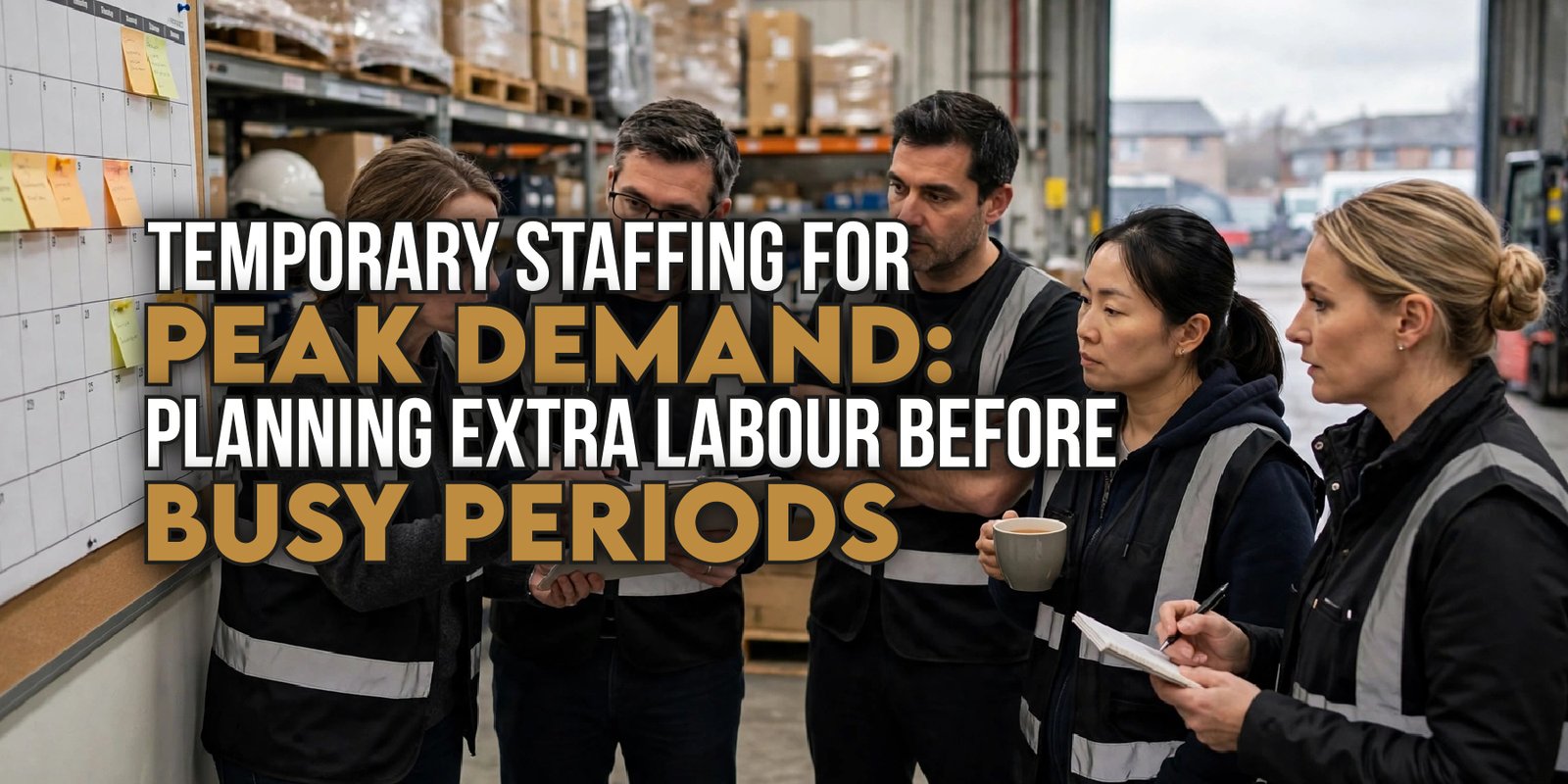
A promotional campaign launches on Friday, and by Monday the picking queue is growing faster than the dispatch team can clear it. For warehouse managers, peak season staffing is not simply about increasing the number of people on site. It means matching the right roles to actual order volumes, shift patterns and operational bottlenecks. A warehouse can have sufficient packers but still miss dispatch targets because goods-in, picking or loading needs attention.
Christmas, Black Friday, online sales, unexpected orders and returns periods can each create different pressures. Therefore, employers need a practical staffing plan that separates tasks, forecasts demand and allows time for suitable recruitment. This guide covers how to plan additional warehouse capacity and discuss relevant options with H&D Recruitment.
Quick Answer: How Does Peak Season Staffing Help Warehouses?
Peak season staffing helps warehouses respond to temporary increases in orders by adding suitable people for picking, packing, stock handling and dispatch. Managers should forecast workload by process, compare available shift capacity and identify specific gaps. Early temporary recruitment planning helps clarify duties, hours, induction and supervision, although candidate availability and suitability still need checking.
What Is Peak Season Staffing in Warehouses?
Peak season staffing means arranging additional recruitment or shift capacity for a defined period of higher warehouse activity. Unlike hiring for an ongoing vacancy, it focuses on temporary operational requirements, such as a promotional sale or a backlog that has a clear end point.
Why Do Warehouses Need Additional Staff During Peak Periods?
Order patterns can change quickly. E-commerce campaigns may increase parcel volumes, while seasonal retail promotions create pressure on packing and dispatch. Meanwhile, absences or equipment constraints can reduce the capacity available on an otherwise ordinary day.
Common triggers for peak season staffing include Christmas orders, Black Friday, promotional campaigns, returns surges, staff holidays and one-off fulfilment projects. These do not affect every site equally. Consequently, warehouse managers should identify their own busiest processes instead of copying a generic seasonal headcount.
How Can Warehouse Managers Forecast Peak Staffing Requirements?
A useful peak season staffing forecast starts with the work that must pass through each stage of the warehouse. Compare expected orders with the hours available for picking, packing, checking and dispatch. Then consider when parcels must leave the site.
Estimate workload by process
Review previous peaks where reliable records exist, plus confirmed orders and current campaign plans. Identify the expected number of order lines, handling complexity, packing requirements and dispatch cut-off times. Next, use your own observed task rates, not an invented industry average, to estimate the hours each stage needs.
Identify the actual capacity gap
Subtract planned staff hours from the task hours required for each shift. Allow for breaks, training, supervision and planned absence. A site may need picker support on one shift but additional loaders on another.
Seasonal Warehouse Staff for Picking and Packing
Picking and packing are connected activities, but they demand different instructions and checks. For peak season staffing, seasonal warehouse staff should understand which process they are joining and what level of experience the employer requires.
Picking duties
During peak season staffing, pickers locate the specified items and quantities, often using warehouse management systems, scanners or pick lists. Accuracy matters because a wrong item can create additional checking and returns work. Therefore, managers should explain the systems, picking locations, replenishment arrangements and any relevant handling restrictions.
Packing duties
As part of peak season staffing, packers verify items, select appropriate packaging, prepare labels and follow the site’s dispatch requirements. Meanwhile, some warehouse operatives may also support sorting or scanning, depending on the agreed role and induction.
Picker Packer Cover for Busy Warehouse Shifts
Picker packer cover helps address short-term gaps in order preparation, but employers need to specify which responsibilities belong to the assignment. Simply asking for additional people may lead to a mismatch between the work and the proposed candidates.
Before requesting peak season staffing, list the exact shifts, whether the role involves picking or packing, the expected physical tasks and any scanning experience required. Include the supervisor, postcode, reporting entrance and expected assignment length.
Fulfilment Staffing for E-Commerce and Retail Operations
Peak season staffing for fulfilment can extend beyond placing items into boxes. A warehouse may need capacity for goods-in, scanning, stock movement, checking, labelling, order consolidation and returns processing.
Dispatch and Loading Support During Peak Demand
Peak season staffing for dispatch is often governed by collection schedules and carrier cut-offs. Extra picking capacity will not help if parcels cannot be staged, checked or loaded in time.
Peak season staffing for goods-out may cover dispatch preparation, sorting by route, staging parcels, loading and unloading. Forklift and reach truck duties require appropriate training, competence and workplace authorisation. The Health and Safety Executive provides relevant guidance on lift-truck operator training; employers should assess what is required for their specific equipment and site.
Temporary vs Permanent Warehouse Staffing
Different peak season staffing recruitment models suit different demand patterns. When considering peak season staffing, estimate whether the requirement will disappear after a promotional campaign or continue throughout normal operations.
| Staffing model | Typical requirement | Main advantage | Important consideration |
|---|---|---|---|
| Temporary recruitment | Black Friday, Christmas or defined backlog | Capacity for a limited assignment | Candidate suitability, dates and availability |
| Part-time recruitment | Predictable busy evenings or weekends | Recurring coverage on selected shifts | Stable scheduling and supervision |
| Full-time recruitment | Continuing operational vacancy | Long-term team continuity | Training and ongoing work requirements |
| Combined approach | Core team plus variable order peaks | Flexibility alongside existing expertise | Clear task allocation and handovers |
How Can Peak Season Staffing Reduce Recruitment Pressure?
Peak season staffing recruitment becomes more difficult to organise when managers cannot explain exactly what they need. An early brief helps separate genuine vacancies from temporary changes in workload.
For employers refining their processes, H&D Recruitment’s guide to ways to reduce hiring pressure explores related recruitment planning considerations.
Warehouse Staffing in Hounslow and Near Heathrow
Warehouses and distribution operations in Hounslow, the Heathrow area and West London may need early starts, late finishes or weekend shifts. The practical challenge is not only finding the appropriate role but confirming how the person reaches the correct site and reporting point.
H&D Recruitment is based at 4 Bell Parade, Bell Road, Hounslow, TW3 3NU. The business supports relevant warehouse and logistics recruitment enquiries, subject to role requirements and candidate availability.
For local peak season staffing, include the full site postcode, entry gate, transport considerations, start times and supervisor contact.
What Should Employers Confirm Before Booking Seasonal Warehouse Staff?
A complete peak season staffing recruitment brief should answer four questions: what work needs doing, who is suitable, when the shift runs and how the assignment will be managed.
| Information | What to confirm | Why it matters |
|---|---|---|
| Duties | Picking, packing, goods-in, returns or dispatch | Matches people to actual tasks |
| Headcount | Number required by role and shift | Prevents over- or under-booking |
| Schedule | Dates, hours, breaks and duration | Supports accurate recruitment discussions |
| Experience | Scanner systems or specific equipment competence | Distinguishes essential requirements |
| Site | Full address, entrance and reporting contact | Supports arrival arrangements |
| Induction | Safety briefing, PPE and supervision | Clarifies workplace responsibilities |
| Terms | Rates, amendments and absence reporting | Avoids avoidable misunderstandings |
The HSE explains that agencies, employment businesses and end-user businesses must communicate about workplace risks and responsibilities. Consequently, induction and safe systems of work should never be left as assumptions.
Common Peak Season Warehouse Staffing Mistakes
- Recruiting too late: Starting peak season staffing discussions after the queue has already overwhelmed normal shifts.
- Estimating one overall headcount: Ignoring separate picking, packing and dispatch requirements.
- Vague job descriptions: Describing all positions as general warehouse duties despite different tasks.
- Missing shift details: Omitting breaks, reporting points or late-finish arrangements.
- Assuming equipment competence: Treating warehouse experience as automatic authorisation to operate a lift truck.
- Skipping induction: Failing to explain site procedures, workplace risks and supervision.
- Forgetting returns: Planning outbound orders while overlooking January returns or post-sale processing.
How H&D Recruitment Supports Warehouse Employers
H&D Recruitment supports warehouse and logistics recruitment for roles including warehouse operatives, pickers, packers, loaders, unloaders, dispatch personnel, returns assistants and relevant specialist or supervisory positions.
Employers can discuss temporary, part-time, full-time or appropriate longer-term requirements according to the site, experience needed, headcount and shift pattern. However, peak season staffing options depend on suitable candidate availability and the agreed role.
If you are planning a seasonal increase, discuss your warehouse staffing requirements with the H&D Recruitment team before confirming arrangements.
Staffing Requirements Beyond Warehouses
Some organisations also operate hospitality venues, hotels or event spaces, where recruitment needs differ from picking, packing and dispatch. H&D Recruitment supports relevant hospitality staffing solutions, but employers should prepare separate role briefs for each sector.
Warehouse Job Opportunities for Candidates
Jobseekers interested in peak season staffing for warehouse, picking, packing or related logistics roles can explore warehouse job opportunities. Individual vacancies, experience requirements and availability may change, so check the current details before applying.
Peak Season Warehouse Staffing Checklist
Use this peak season staffing checklist before requesting additional warehouse recruitment:
- Confirm the site, department and operational bottleneck.
- Identify each required role and its actual duties.
- Estimate headcount separately for picking, packing, dispatch and returns.
- Set shift dates, start and finish times, breaks and assignment duration.
- Specify experience, equipment competence and required checks.
- Explain PPE, site induction, supervision and reporting procedures.
- Confirm the entrance, parking or transport instructions and supervisor contact.
- Discuss absence reporting, schedule changes and commercial terms.
- Prepare a fallback plan for unexpected order increases.
- Review actual task demand and staffing arrangements after the peak.
Frequently Asked Questions
What is peak season staffing in warehouses?
Peak season staffing involves adding suitable recruitment capacity for temporary increases in warehouse activity. These periods may include Black Friday, Christmas orders, promotional campaigns or returns backlogs. Managers should identify the roles and shifts where demand exceeds existing capacity rather than assuming every department needs the same additional headcount.
Why do warehouses need seasonal staff?
For peak season staffing, warehouses may need seasonal warehouse staff when order volumes, dispatch deadlines or absences create work that the normal rota cannot cover. The requirement varies by site. Therefore, employers should compare expected tasks with available shift hours and request specific roles for the actual operational gap.
When should employers arrange additional pickers and packers?
Begin peak season staffing planning when reliable order forecasts or confirmed campaigns suggest additional capacity may be necessary. Recruitment lead times depend on location, working hours, experience requirements and candidate availability. Early conversations help employers prepare accurate briefs, although no particular timeframe guarantees suitable candidates.
Can temporary staff help with dispatch backlogs?
During peak season staffing, temporary personnel may support sorting, goods-out preparation, staging and appropriate loading duties. However, managers should identify the true constraint before requesting extra people. A delayed carrier collection or equipment limitation cannot automatically be solved by adding staff, and machinery roles require suitable training and authorisation.
What is picker packer cover?
Picker packer cover means arranging additional people for defined order picking or packing tasks, often during a busy shift or absence. Employers should clarify whether duties involve scanning, item selection, checking, packaging or labelling. A precise brief allows a recruitment provider to discuss relevant suitability rather than assuming all warehouse roles are interchangeable.
How can warehouses estimate extra staffing requirements?
For peak season staffing, estimate the workload by stage, using expected orders and task times drawn from your own records. Next, compare task hours with the existing rota while considering breaks, training and shift cut-offs. Update the estimate when forecasts change, especially if one department becomes a bottleneck.
What should employers provide before requesting warehouse staff?
For peak season staffing, provide the role description, headcount, site postcode, shift dates, hours and expected assignment duration. Additionally, identify scanning experience, equipment requirements, PPE, induction arrangements and supervisor details. This information helps recruitment providers assess the request and discuss appropriate candidates and booking terms.
Can H&D Recruitment help with warehouse staffing in Hounslow?
H&D Recruitment is based in Hounslow and supports warehouse and logistics recruitment enquiries across relevant roles. Employers can explain the site location, duties, shift pattern and required start date. Available recruitment arrangements depend on the role requirements and suitability of candidates, rather than guaranteed immediate cover.
Preparing Your Warehouse for the Next Busy Period
Effective peak season staffing begins by identifying where work accumulates, then planning the right people for the right shift. Forecast demand, separate picking from packing and dispatch, and ensure induction and communication are ready before temporary assignments start.
Finally, review what happened after the busy period. The strongest peak season staffing plan improves with actual order data and helps managers distinguish a seasonal gap from a lasting vacancy.
Discuss Your Warehouse Staffing Requirements With H&D Recruitment
If you need peak season staffing because your warehouse expects a promotional surge, Christmas orders, returns or an increased dispatch workload, H&D Recruitment can discuss recruitment options based on your duties, headcount, site location and working pattern.
Request a warehouse staffing quote from H&D Recruitment, or contact 0208 476 7676 or info@handdservices.co.uk to explain your requirements.